1.4 - Evidence for the Electronic Structure of Atoms
- 1
The electromagnetic spectrum and its properties
- 2
How atomic emission spectra provide evidence for quantum shells
- 3
What ionisation energy is
- 4
The factors that affect ionisation energy
- 5
Trends in first ionisation energy down groups and across periods
- 6
How successive ionisation energies provide evidence for quantum shells
The electromagnetic spectrum spans a range of radiation types
The electromagnetic spectrum encompasses a variety of electromagnetic radiation, which transmits energy in the form of waves.
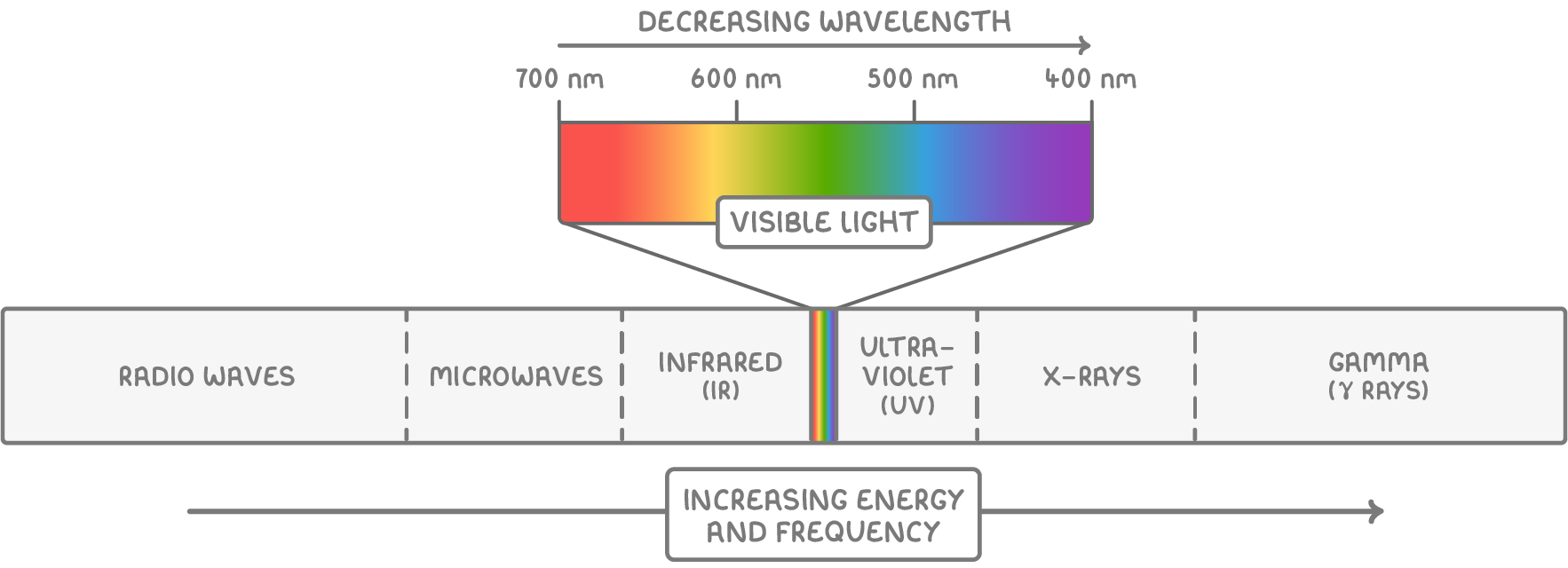
These waves exhibit a spectrum of frequencies with distinct characteristics:
- As frequency increases along the spectrum, wavelength decreases.
- The electromagnetic spectrum includes, in order of increasing frequency: radio waves, microwaves, infrared, visible light, ultraviolet, X-rays, and gamma rays.
Electrons release and absorb energy in discrete amounts
In atoms, electrons occupy fixed energy levels called quantum shells:
- In the ground state, electrons reside in the lowest possible energy levels.
- Electrons can be excited to higher energy levels further from the nucleus by absorbing energy from their surroundings.
- As electrons drop back down from higher to lower energy levels, they emit electromagnetic radiation at specific frequencies.
- The energy levels are discrete, meaning electrons cannot exist between them and can only transition in these fixed jumps. Since each element has a unique electron configuration, the set of frequencies emitted is distinct for each element. This gives rise to characteristic emission spectra.
Emission spectra contain sets of lines
An atomic emission spectrum displays the frequencies of light emitted as electrons transition from higher to lower energy levels. The spectrum consists of sets of coloured lines on a dark background, with each set corresponding to electrons falling to a specific energy level.
Key features of emission spectra include:
- Multiple series of lines with each series representing transitions to a different final energy level (n = 1, n = 2, etc.).
- The lines within each series get closer together as frequency increases.
- The spectrum is unique to each element due to distinct electron configurations.
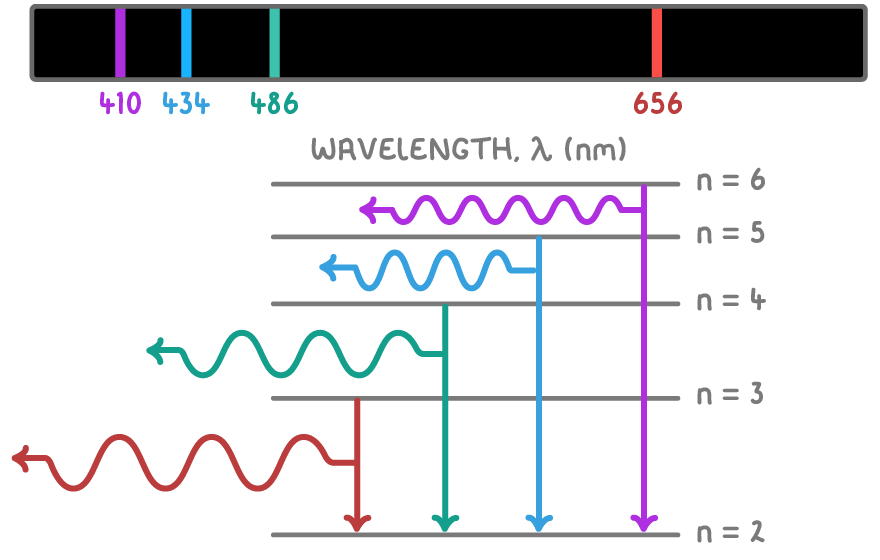
For example, the emission spectrum of hydrogen shows three key series:
- Electrons dropping to the n = 1 level produce a series of lines in the ultraviolet region.
- Transitions to the n = 2 level result in a series of lines in the visible spectrum.
- Electrons falling to the n = 3 level generate a series of lines in the infrared region.
Emission spectra provide evidence for quantum shells
The quantum shell model of the atom proposes that:
- Electrons are confined to fixed shells at specific distances from the nucleus.
- Each shell has a defined energy and electrons cannot exist between shells.
- Electrons must absorb or emit electromagnetic radiation to move between shells.
- The discrete nature of the shells means the emitted radiation has fixed frequencies.
Atomic emission spectra strongly support this quantum shell model:
- The presence of distinct lines rather than a continuous spectrum indicates that energy levels are quantized, not continuous.
- Electrons cannot transition smoothly between energy levels but must jump from one level to another.
- Each line represents a specific electronic transition between two energy levels, with the frequency determined by the energy difference.
Ionisation involves removing electrons
Ionisation refers to the process of removing one or more electrons from an atom or molecule. This process requires an input of energy, so ionisation is an endothermic process.
The first ionisation energy is the energy needed to remove 1 electron from each atom in 1 mole of gaseous atoms to form 1 mole of gaseous 1+ ions.
For example, the equation that represents the first ionisation energy (IE1) of magnesium is:
Mg(g) ➔ Mg+(g) + e− ΔHIE1 = +738 kJ mol−1
Since ionisation requires energy input, the values for ionisation energies are always positive.
Factors affecting ionisation energy
The ionisation energy of an atom depends on how strongly its outermost electrons are attracted to the nucleus. There are three key factors that affect this electrostatic attraction:
- Nuclear charge - Atoms with more protons in their nucleus have a stronger positive charge. This creates stronger electrostatic attraction between the nucleus and the outer electrons.
- Atomic radius - Electrostatic attraction drop off steeply with increasing distance. Electrons in smaller atoms are held closer to the nucleus so the attraction is greater.
- Electron shielding - Inner electron shells shield the outermost electrons from the full attractive force of the nucleus, reducing the effective nuclear charge experienced by the outer electrons. More electron shells provide more shielding.
In summary, low shielding and small atomic size lead to high ionisation energies, as the outermost electrons experience strong electrostatic attraction from the nucleus. Removing these tightly-held electrons requires substantial energy input.
Trends in ionisation energy
Ionisation energy is the energy needed to remove one mole of electrons from one mole of gaseous atoms to form one mole of gaseous ions.
An equation representing the first ionisation energy of sodium is:
Na(g) ➔ Na+(g) + e−
Ionisation energy decreases down a group
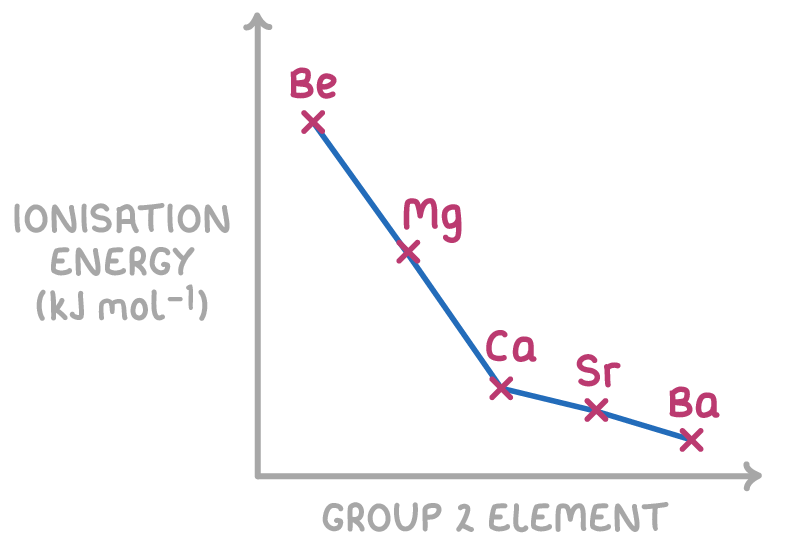
Ionisation energy decreases down a group, as shown by the group 2 elements in the graph above. This is because:
- Nuclear charge increases down the group as more protons are added. This increases attraction for electrons.
- Atomic radius increases down the group as more electron shells are added. This moves electrons away from nucleus.
- Electron shielding increases down group as more inner shells reduce nuclear attraction. The increasing atomic radius and shielding effects are greater than the increasing nuclear charge, leading to an overall decrease in ionisation energies down a group.
Ionisation energy increases across a period
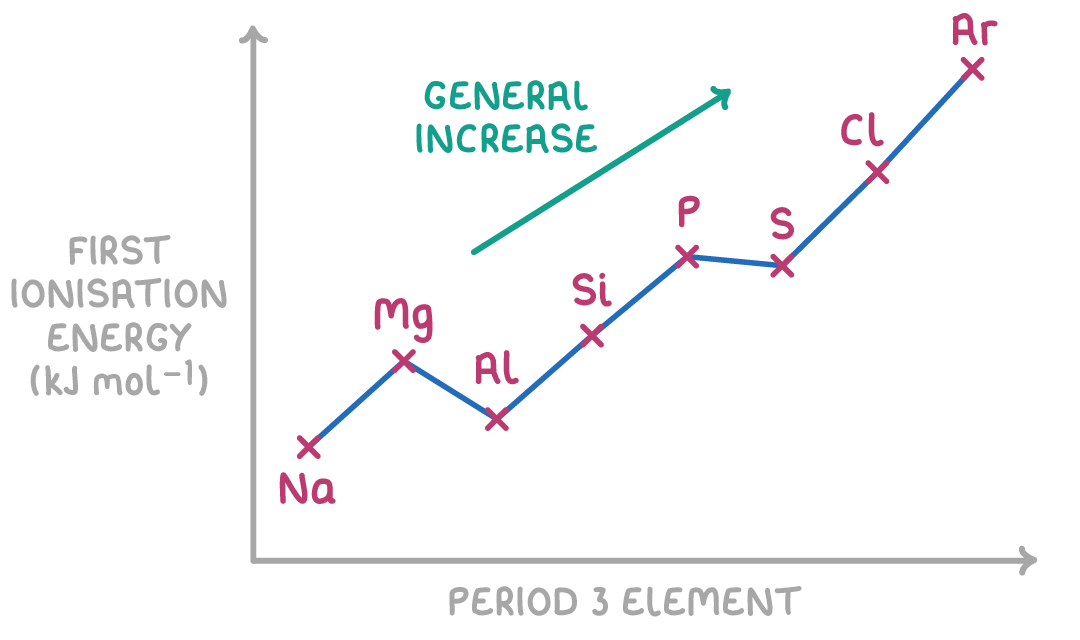
Ionisation energy generally increases across a period, as shown by the period 3 elements in the graph above. This is because:
- Nuclear charge increases as more protons are added across a period.
- Atomic radius decreases across a period as extra electrons are added to the same shell.
- Electron shielding stays similar across a period with no extra inner shells. The increasing nuclear charge effect outweighs the similar shielding across a period, so ionisation energies generally increase across a period.
Successive ionisation energies
Electrons can be sequentially removed until only the nucleus remains. The energy to remove each successive electron is called the successive ionisation energies.
For example, the second ionisation energy is the energy needed to remove 1 electron from each ion in 1 mole of gaseous 1+ ions to form 1 mole of gaseous 2+ ions.
For example, the equation that represents the second ionisation energy (IE2) of magnesium is:
Mg+(g) → Mg2+(g) + e− ΔHIE2 = +1,451 kJ mol−1
Successive ionisation energies provide evidence for electron shell structure:
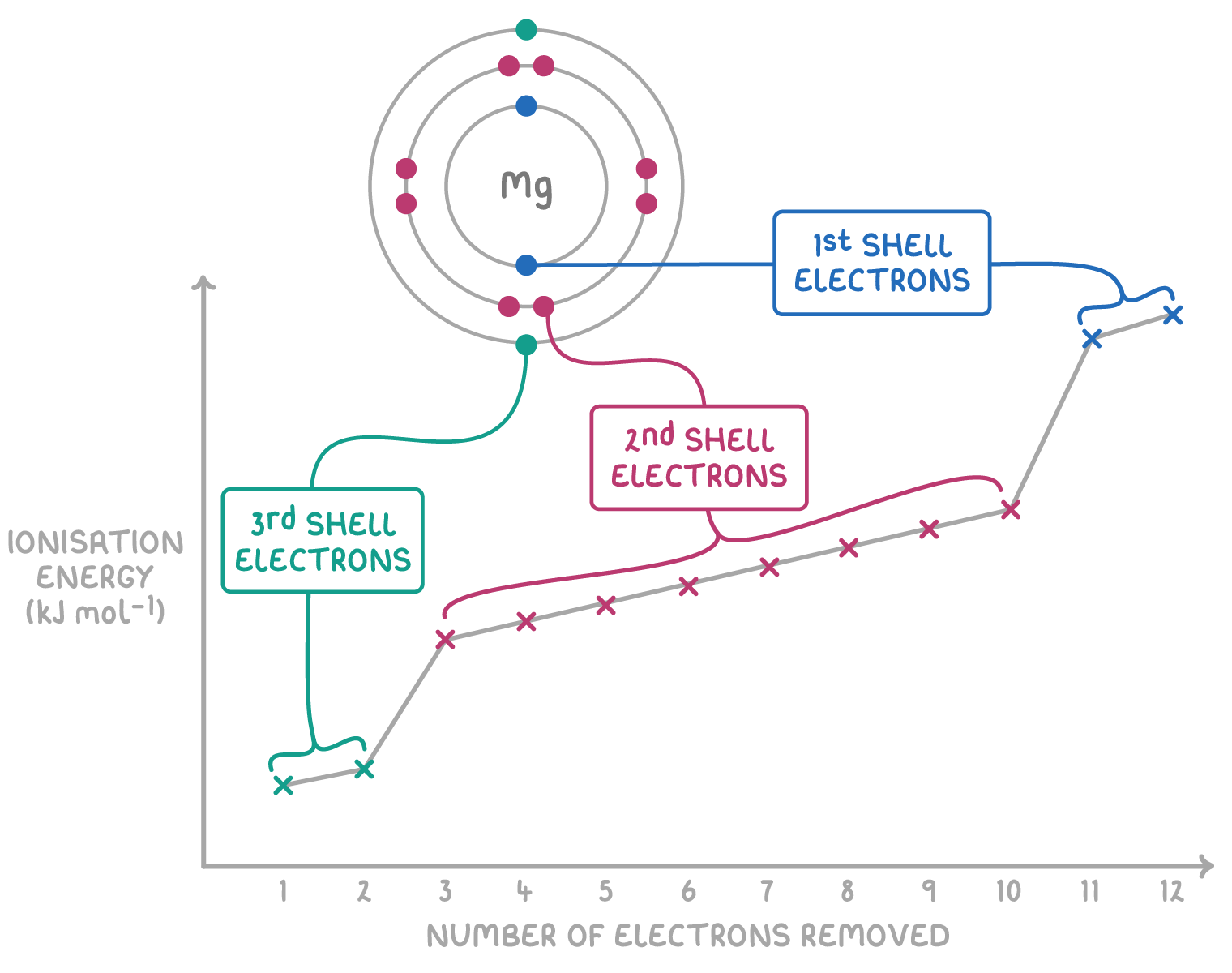
Successive ionisation energies increase within the same shell:
- As successive electrons are removed from the same shell, the remaining electrons experience greater electrostatic attraction to the increasingly positive nucleus. This increased nuclear attraction requires more energy to remove the next electron from that shell.
- For magnesium, the second ionisation energy (1,450 kJ mol^-1^) is slightly higher than the first (740 kJ mol^-1^) as these electrons are both being removed from the 3s subshell.
There are large jumps in successive ionisation energy between shells:
- When reaching a new inner electron shell, there is a big increase in the ionisation energy needed to remove the first electron in that new shell. This happens because the attraction to the nucleus is much greater for inner shell electrons closer to the nucleus.
- For magnesium, there is a large jump from the second ionisation energy (1,450 kJ mol^-1^) to the third (7,730 kJ mol^-1^) as the 3s subshell is now full, requiring the next electron to be removed from the inner 2p subshell.