4.1 - Group 2, Alkali Earth Metals
- 1
Trend in ionisation energy of the group 2 elements
- 2
Chemical properties relating to the reactivity of the group 2 elements
- 3
Reactions of group 2 elements with water, oxygen, and chlorine
Group 2 elements form 2+ ions
The alkaline earth metals readily form 2+ ions when they react, by losing their two outermost electrons.
This can be seen in their electron configurations:
| Element | Electron configuration of atom | Formula of ion | Electronic configuration of ion |
|---|---|---|---|
| Be | 1s^2^ 2s^2^ | Be^2+^ | 1s^2^ |
| Mg | 1s^2^ 2s^2^ 2p^6^ 3s^2^ | Mg^2+^ | 1s^2^ 2s^2^ 2p^6^ |
| Ca | 1s^2^ 2s^2^ 2p^6^ 3s^2^ 3p^6^ 4s^2^ | Ca^2+^ | 1s^2^ 2s^2^ 2p^6^ 3s^2^ 3p^6^ |
The electrons in the outer s sub-shell are relatively weakly bound and are lost during reactions.
This loss of two electrons results in a stable noble gas electron configuration.
First ionisation energy decreases down group 2
Related to atomic radius, the first ionisation energy shows an overall decrease going down the group. This energy is a measure of the strength of electrostatic attraction between the outer electron and the nucleus.
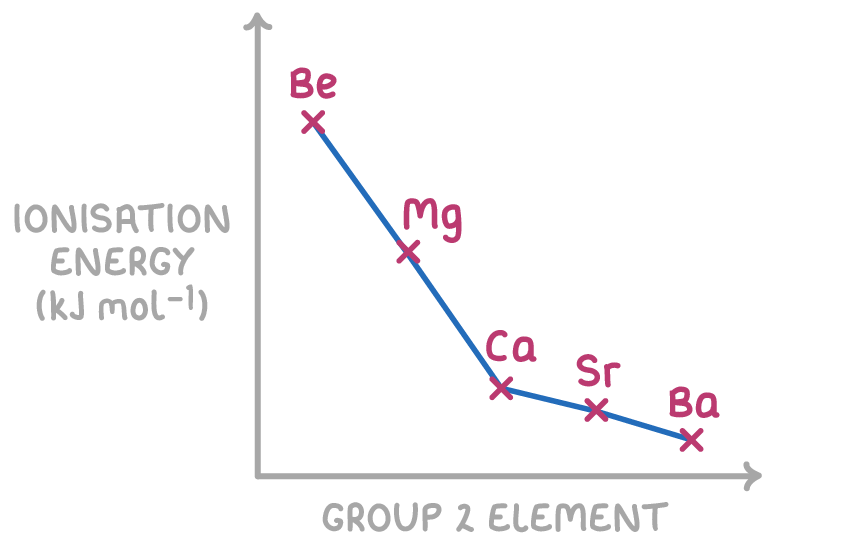
Ionisation energy decreases down group 2 because:
- Nuclear charge - Increases down the group as more protons are added, increasing attraction for electrons.
- Atomic radius - Increases down the group as more electron shells are added, moving electrons away from nucleus.
- Electron shielding - Increases down group as more inner electron shells reduce nuclear attraction. The atomic radius and shielding effects down groups are greater than the nuclear charge effect, leading to an overall decrease in ionisation energies as you move down group 2.
Reactivity increases down group 2
Since it becomes easier to remove electrons further down the group, the reactivity of group 2 metals increases as you progress from beryllium (Be) down to radium (Ra).
The reactions of group 2 elements with water, oxygen, and chlorine become more vigorous as you descend the group.
Reaction with water
Reaction of a group 2 metal (M) with cold water produces a metal hydroxide and hydrogen gas:
M(s) + H2O(l) ➔ M(OH)2(aq) + H_2(g)_
Using calcium as an example:
- Ca(s) + 2H2O(l) ➔ Ca(OH)2(aq) + H2(g)
- Calcium is oxidised from 0 to +2
The reactivity trend of the alkaline earth metals with water is shown below:
| Metal | Reactivity |
|---|---|
| Be | No reaction |
| Mg | Reacts very slowly |
| Ca | Steady reaction rate |
| Sr | Reacts fairly quickly |
| Ba | Rapid reaction |
Reaction with oxygen
When a group 2 metal (M) burns in oxygen gas, a solid white oxide is formed:
2M(s) + O2(g) ➔ 2MO(s)
Using calcium as an example:
- 2Ca(s) + O2(g) ➔ 2CaO(s)
- Calcium is oxidised from 0 to +2
- Oxygen is reduced from 0 to -2
Reaction with chlorine
Reaction of a group 2 metal with chlorine gas produces a solid white chloride:
M(s) + Cl2(g) ➔ MCl2(s)
Using calcium as an example:
- Ca(s) + Cl2(g) ➔ CaCl2(s)
- Calcium is oxidised from 0 to +2
- Chlorine is reduced from 0 to -1