17.6 - Acyl Chlorides
- 1
The structure and nomenclature of acyl chlorides
- 2
Reactions of acyl chlorides
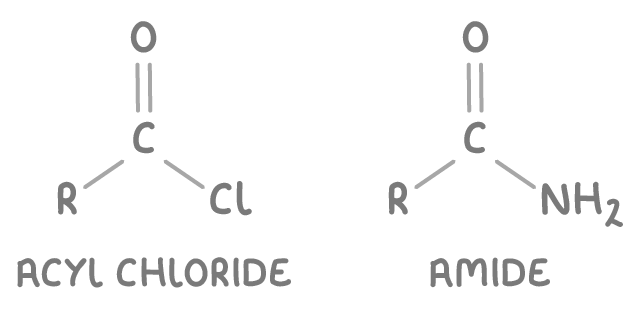
Acyl chlorides contain the functional group -COCl
Acyl chlorides, also known as acid chlorides, are a type of compound that features the functional group -COCl. These compounds are derived from carboxylic acids, where the hydroxyl (-OH) group is replaced by a chlorine atom (-Cl).
Similar to acyl chlorides, amides are also derivatives of carboxylic acids.
To name an acyl chloride, the suffix "-oic acid" of the parent carboxylic acid is replaced with "-oyl chloride". For example:
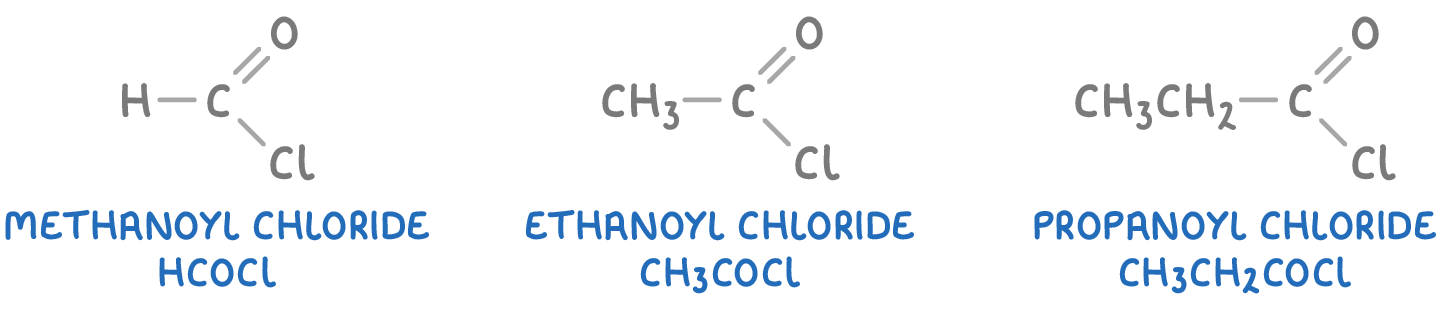
When numbering the carbon chain in an acyl chloride, the numbering starts from the end closest to the -COCl group, similar to carboxylic acids.
Reactions of acyl chlorides
Acyl chlorides are highly reactive due to their polar C=O bond and the chlorine atom, which is readily displaced.
They can react with:
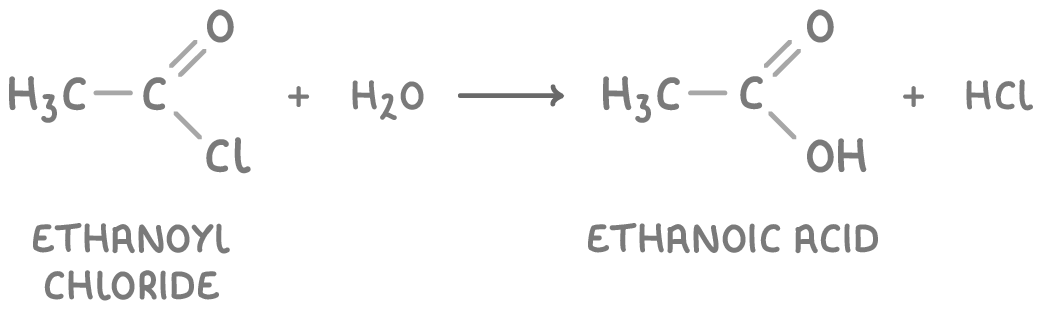
- Water - This reaction is vigorous, even at low temperatures, and reforms the carboxylic acid. The reaction also produces steamy fumes of hydrogen chloride gas. For example, ethanoyl chloride is hydrolysed to ethanoic acid according to the equation:
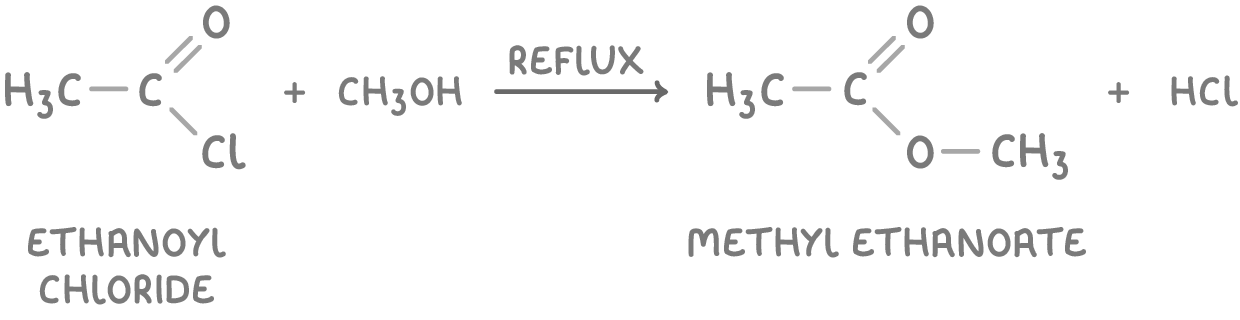
- Alcohols - At room temperature, this reaction is vigorous, producing an ester and HCl. For example, ethanoyl chloride reacts with methanol to form methyl ethanoate according to the equation:
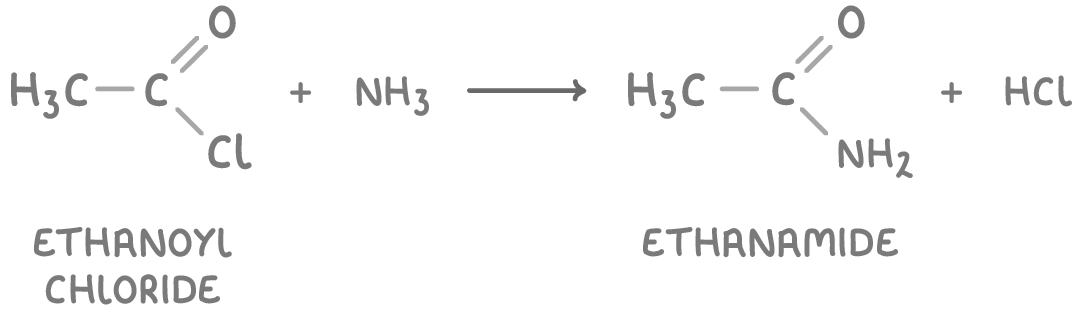
- Concentrated ammonia - This reaction occurs violently at room temperature, resulting in a primary amide and HCl. For example, ethanoyl chloride reacts with concentrated ammonia to form ethanamide according to the equation:
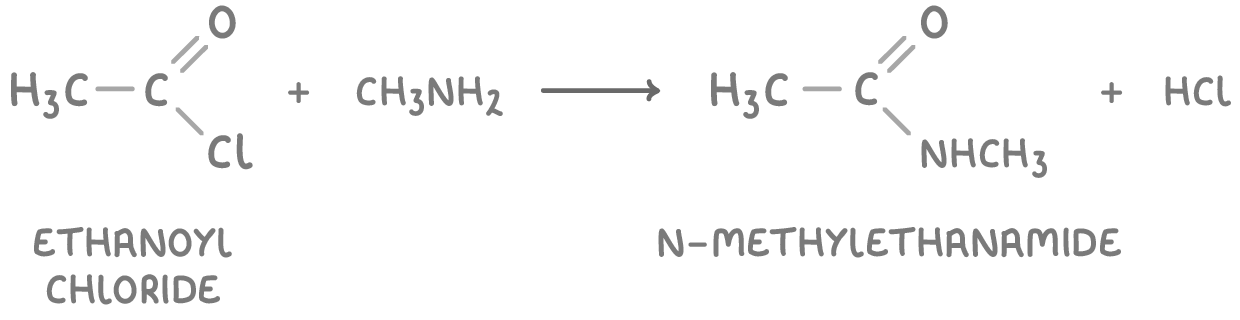
- Primary amines - This reaction occurs violently at room temperature, resulting in a secondary amide and HCl. For example, ethanoyl chloride reacts with methylamine to form N-methylethanamide according to the equation: