14.4 - Modern Storage Cells and Fuel Cells
- 1
How energy storage cells work
- 2
How to calculate the cell voltage of an energy storage cell
- 3
How hydrogen-oxygen fuel cells generate electricity
- 4
Alternative fuels for fuel cells
Energy storage cells function like electrochemical cells
Energy storage cells, also known as batteries, operate based on the principles of electrochemical cells. The key principle underpinning their function is that the two electrodes have different electrode potentials. This potential difference drives the cell reaction, allowing the battery to generate electricity.
The voltage that these cells produce can be calculated by looking at the electrode potentials of the substances inside the cell.
You won't need to memorise specific E⦵ values for the reactions, but you might need to calculate the cell potential or voltage for a particular cell. Let's go through an example to show you how.
Worked example 1 - Calculating the cell voltage of a lead-acid storage cell
Calculate the cell voltage produced by a lead-acid storage cell, which has a lead (Pb) anode, a lead dioxide (PbO2) cathode, and a sulfuric acid electrolyte.
| Half equation | E^⦵^ (V) |
|---|---|
| Pb2+(aq) + 2e- ⇌ Pb(s) | -0.13 |
| PbO2(s) + 4H+(aq) + SO42-(aq) + 2e- ⇌ PbSO4(s) + 2H2O(l) | +1.69 |
Step 1: Identify oxidation and reduction half-reactions
The Pb2+ half-reaction proceeds in the oxidation direction (Pb(s) ➔ Pb2+(aq) + 2e-), as indicated by its lower (i.e. negative) E⦵ value relative to the half-reaction of PbO2.
The PbO2 half-reaction proceeds in the reduction direction (PbO2(s) + 4H+(aq) + SO42-(aq) + 2e- ➔ PbSO4(s) + 2H2O(l)), as indicated by its higher (i.e. positive) E⦵ value.
Step 2: Equation
Step 4: Substitution and correct evaluation
Therefore, the cell voltage of the lead-acid battery is 1.82 V.
Fuel cells generate electricity by continuously reacting a fuel with oxygen
Fuel cells generate electricity by continuously reacting a fuel with oxygen. Unlike energy storage cells (batteries) that hold a finite amount of chemical energy, fuel cells can generate electricity continuously as long as fuel and oxygen are provided. Hydrogen fuel cells are seen as a promising power source for electric vehicles, providing an alternative to traditional internal combustion engines and batteries.
There are two main types of hydrogen-oxygen fuel cells: acidic and alkaline. Both types use hydrogen as the fuel and oxygen as the oxidant, with water being the only by-product.
How acidic hydrogen fuel cells work:
- Hydrogen oxidation at the anode - At the anode, H2 is split into protons (H+) and electrons (e-) with the help of a platinum catalyst.
- Proton migration through the electrolyte - The protons move through the electrolyte membrane, which only allows protons to pass. This forces the electrons to travel through an external circuit to get to the cathode.
- Electron flow through the external circuit - The electrons flowing through the external circuit generate an electric current that can power devices.
- Oxygen reduction at the cathode - Oxygen (O2) at the cathode combines with the protons from the anode and the electrons from the circuit to produce water (H2O).
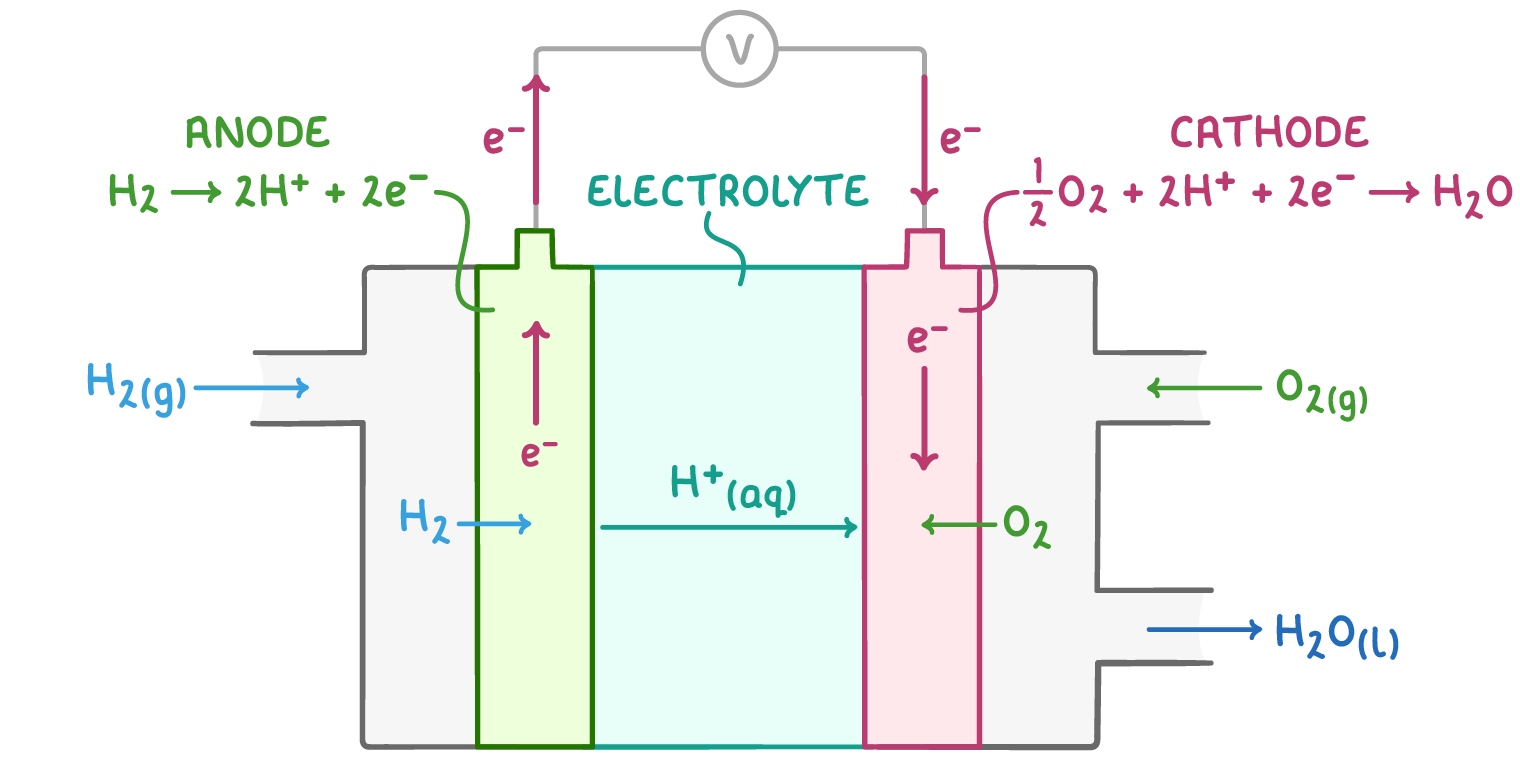
The overall reaction in the acidic fuel cell is:
2H2(g) + O2(g) ➔ 2H2O(l)
The specific reactions at each electrode are:
- Negative electrode: H2(g) ➔ 2H+(aq) + 2e-
- Positive electrode: 1⁄2O2(g) + 2H+(aq) + 2e- ➔ H2O(l)
How alkaline hydrogen fuel cells work:
- Hydrogen oxidation at the anode - At the anode, hydrogen (H2) reacts with hydroxide ions (OH-) to produce water (H2O) and electrons (e-).
- Hydroxide ion migration through the electrolyte - Hydroxide ions move through the electrolyte membrane, which only allows OH- ions to pass. This forces the electrons to travel through an external circuit to get to the cathode.
- Electron flow through the external circuit - The electrons flowing through the external circuit generate an electric current that can power devices.
- Oxygen reduction at the cathode - Oxygen (O2) at the cathode combines with water and the electrons from the circuit to produce OH- ions.
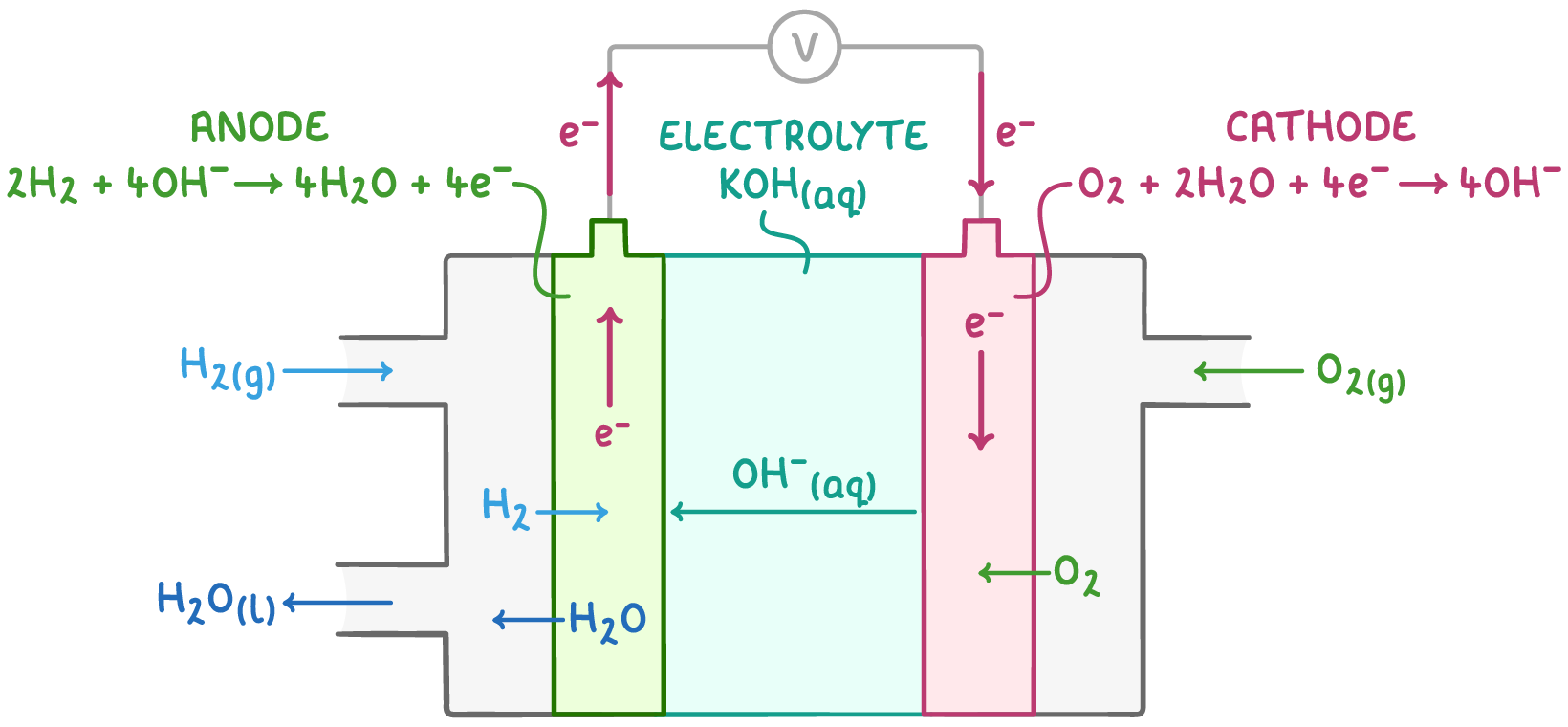
The overall reaction in the alkaline fuel cell is the same as in the acidic fuel cell.
However, the specific reactions at each electrode are different:
- Negative electrode: 2H2(g) + 4OH-(aq) ➔ 4H2O(l) + 4e-
- Positive electrode: O2(g) + 2H2O(l) + 4e- ➔ 4OH-(aq)
Alternative fuels for fuel cells
Fuel cells are not limited to pure hydrogen. Researchers are developing fuel cells that can use hydrogen-rich fuels, such as methanol and ethanol, which can be converted into H2 using a reformer.
Moreover, a new generation of fuel cells has been developed that can directly use alcohols without needing to reform them into hydrogen.
In these advanced fuel cells, the alcohol undergoes oxidation at the anode in the presence of water.
For example, in a methanol fuel cell:
-
Methanol is oxidised at the anode: CH_3_OH_(aq)_ + H_2_O_(l)_ ➔ CO_2(g)_ + 6H^+^(aq) + 6e^−^
-
The generated H+ ions pass through the electrolyte and are subsequently reduced to water at the cathode: 3⁄2O_2(g)_ + 6H^+^(aq) **+6e^−^ ➔ 3H_2_O_(l)_
The overall reaction is:
CH3OH(g) + 3⁄2O2(g) ➔ CO2(g) + 2H2O(l)