6.13 - Halogenoalkanes
- 1
How to name halogenoalkanes
- 2
How halogenoalkanes are classified as primary, secondary or tertiary
- 3
Polarity of the carbon-halogen bond
- 4
Trend in hydrolysis rates of halogenoalkanes
- 5
Comparing halogenoalkane reactivity experimentally
Naming halogenoalkanes
A halogenoalkane is a type of chemical compound where one or more hydrogen atoms in an alkane have been replaced by halogen atoms (like fluorine, chlorine, bromine, or iodine).
To name a halogenoalkane, we use prefixes (like fluoro-, chloro-, bromo-, iodo-) to indicate the type and number of halogen atoms.
Here are some examples of halogenoalkanes:
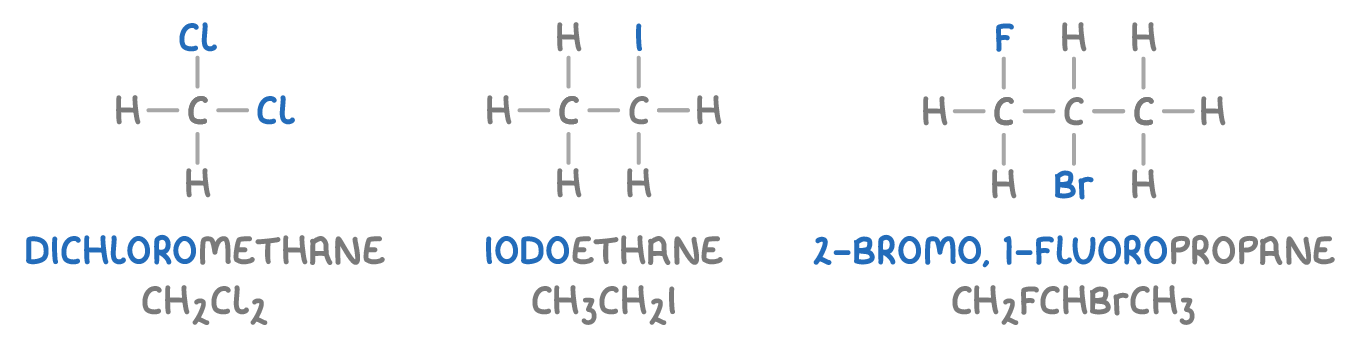
Types of halogenoalkanes
Halogenoalkanes with one substituted halogen atom can be categorised based on the groups attached to the carbon with the halogen:
- Primary - The halogen is attached to a carbon atom connected to only one alkyl group (or no alkyl groups).
- Secondary - The halogen is attached to a carbon atom connected to two alkyl groups.
- Tertiary - The halogen is attached to a carbon atom connected to three alkyl groups.
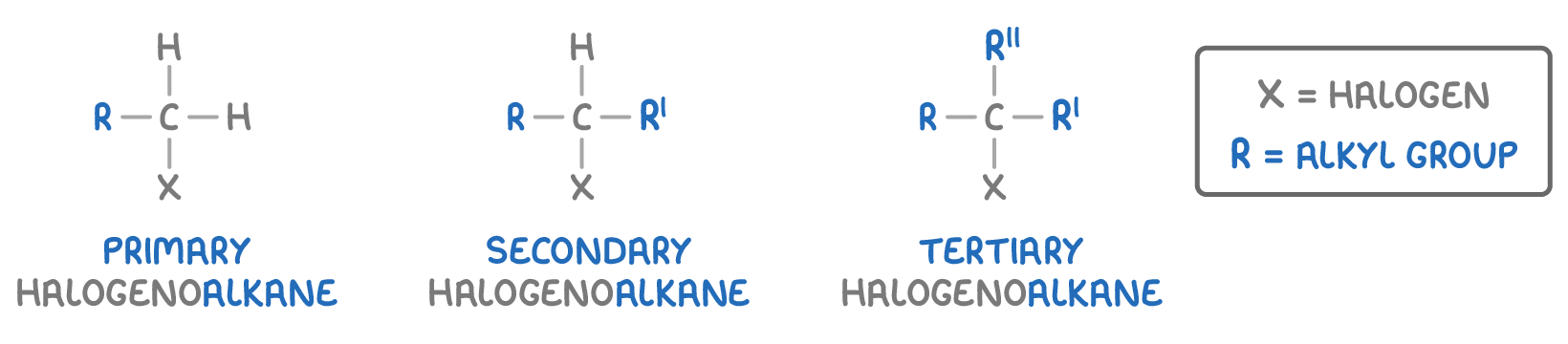
Polarity of the carbon-halogen bond
In halogenoalkanes, the carbon-halogen bond is polar because halogen atoms have a higher electronegativity than carbon. This causes an uneven distribution of electrons, making the carbon atom partially positively charged (δ+) and the halogen atom partially negatively charged (δ-).
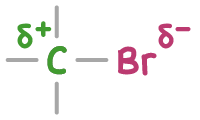
This polarity in the bond makes the carbon atom a target for nucleophiles (electron pair donors). Common nucleophiles include OH-, CN-, NH3, and H2O.
Trends in hydrolysis rates
Hydrolysis of a halogenoalkane is a reaction where the carbon-halogen bond breaks in the presence of water, forming an alcohol and a hydrogen halide.
For example:
RCl + H2O ➔ ROH + H+ + Cl-
The rate of hydrolysis depends on the bond enthalpy of the carbon-halogen bond. Bond enthalpy measures bond strength quantitatively - it is the energy required to break one mole of bonds between two atoms in the gaseous state.
Carbon-halogen bonds with lower bond enthalpies are weaker and require less energy to break, allowing them to react at a faster rate.
Carbon-halogen bond enthalpy decreases down group 7 because:
- The atomic radius of the halogen increases.
- The carbon-halogen bond length increases.
- The electrostatic attraction between bonding electrons and nuclei decreases.
- The amount of energy needed to break these longer, weaker bonds decreases.
Therefore, iodoalkanes (with the weakest carbon-halogen bonds) hydrolyse the fastest, while fluoroalkanes (with the strongest bonds) hydrolyse the slowest.
| Bond | Bond enthalpy (kJ mol-1) |
|---|---|
| C–F | 467 |
| C–Cl | 346 |
| C–Br | 290 |
| C–I | 228 |
Comparing halogenoalkane reactivity using experiments
To compare the relative reactivity of chloro-, bromo- and iodo-alkanes, a common experiment is performed:
-
Place a chloroalkane, a bromoalkane, and an iodoalkane in separate test tubes.
-
Add ethanol to each tube and warm them in a water bath at 50°C.
-
Add silver nitrate solution to each tube. The water in the solution hydrolyses the halogenoalkane (RX): RX(aq) + H2O(l) ➔ ROH(aq) + H+(aq) + X-(aq)
-
The halide ions (X-) produced then react with the silver ions to form a silver halide precipitate: X-(aq) + Ag+(aq) ➔ AgX(s)
-
Time how long it takes for a visible precipitate to form after adding silver nitrate.
A quicker formation of precipitate indicates a faster hydrolysis. Generally, iodoalkanes show the fastest precipitate formation, and chloroalkanes the slowest.
The colour of the precipitate also helps to identify the original halogenoalkane:
- Silver chloride (AgCl) forms a white precipitate.
- Silver bromide (AgBr) forms a cream precipitate.
- Silver iodide (AgI) forms a yellow precipitate.
Trend in reactivity of primary, secondary, and tertiary halogenoalkanes
The reactivity of halogenoalkanes also depends on whether they are primary, secondary, or tertiary. The general trend in reactivity is:
tertiary > secondary > primary
This trend is observed in nucleophilic substitution reactions, where the rate of reaction increases from primary to tertiary halogenoalkanes.
The reason for this trend is related to the stability of the carbocation intermediate formed during the reaction:
- Tertiary halogenoalkanes - Form the most stable carbocations due to increased electron-donating alkyl groups, which stabilise the positive charge.
- Secondary halogenoalkanes - Form less stable carbocations than tertiary, but more stable than primary.
- Primary halogenoalkanes - Form the least stable carbocations, as they have the least number of electron-donating alkyl groups.
It's important to note that this trend applies specifically to SN1 (unimolecular nucleophilic substitution) reactions, where the formation of a carbocation intermediate is a key step.
Experimental comparison of hydrolysis rates
To compare the relative hydrolysis rates of primary, secondary, and tertiary halogenoalkanes, a similar experiment to the one described earlier can be performed:
- Prepare solutions of equal concentration of a primary, secondary, and tertiary halogenoalkane in separate test tubes. Examples include 1-bromopropane (primary), 2-bromopropane (secondary), and 2-bromo-2-methylpropane (tertiary).
- Add an equal volume of ethanolic silver nitrate solution to each tube.
- Observe and measure the time taken for the formation of the silver halide precipitate.
Expected observations:
- The tertiary halogenoalkane will generally produce a precipitate the fastest.
- This is followed by the secondary halogenoalkane.
- The primary halogenoalkane will typically produce a precipitate the slowest.