1.7 - Periodic Properties
- 1
How bond strength affects melting and boiling points across a period
- 2
Trends in atomic radius and first ionisation energy across a period
Melting and boiling points reflect structure and bonding across periods
The type of bonds and strength of bonds between atoms affects the melting and boiling points of elements across periods 2 and 3.
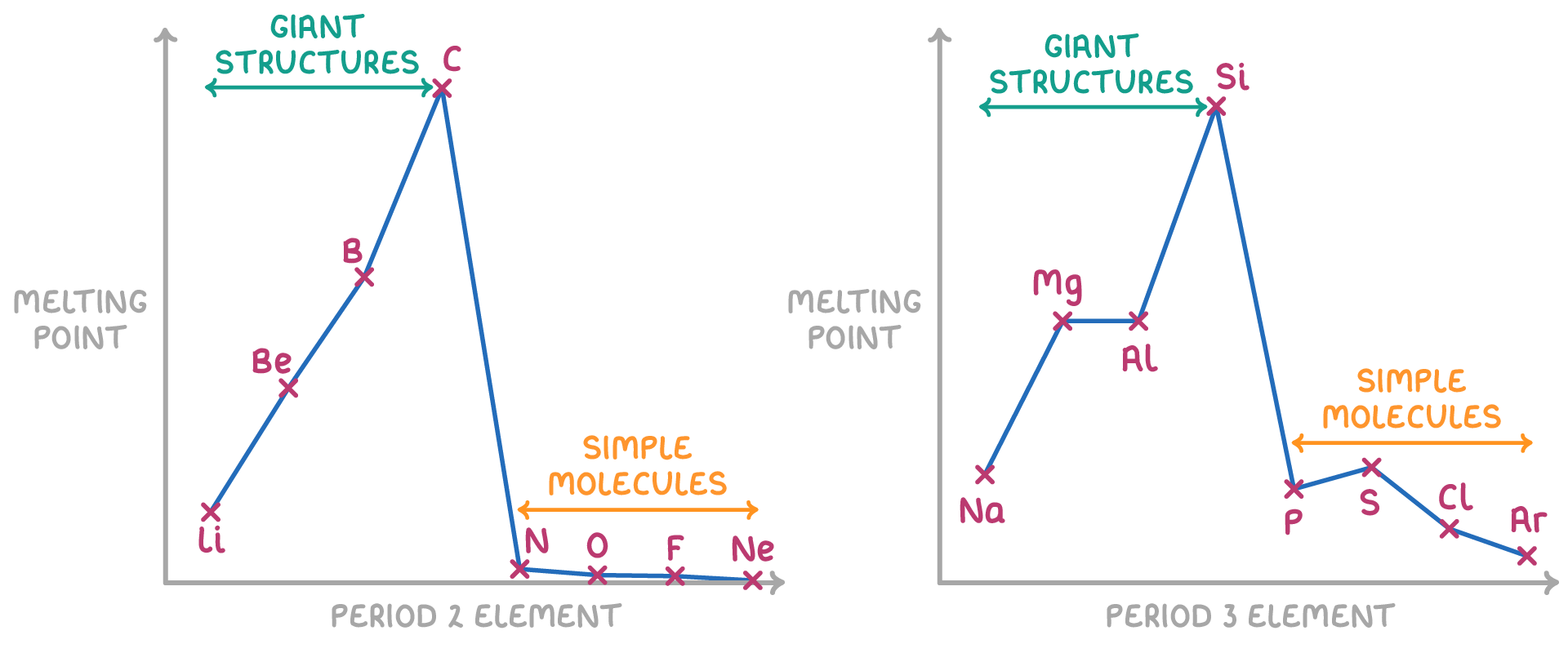
- For the metals lithium (Li), beryllium (Be), sodium (Na), magnesium (Mg) and aluminium (Al), the melting and boiling points increase across the period due the increasing strength of the metallic bonding. The strength of metallic bonding increases across the period because:
- The ions have a larger positive charge (1+, 2+, 3+).
- The ions have a smaller ionic radius.
- There will be more delocalised electrons (e.g. Na only has 1 delocalised electron per ion, but Al has 3 per ion).
- These three factors all result in a stronger electrostatic attraction between metal cations and delocalised electrons which requires increasing amounts of energy to overcome.
-
The elements carbon (C) and silicon (Si) have giant covalent lattice structures. Here, each atom is covalently bonded to 4 neighboring atoms in a tetrahedral arrangement. This forms very strong bonds linking all the atoms together in sheets (e.g. graphite) or 3D lattices (e.g. diamond). A huge amount of energy is required to break these covalent bonds, resulting in extremely high melting and boiling points.
-
Nitrogen (N_2_), oxygen (O_2_), fluorine (F_2_), phosphorus (P_4_), sulfur (S_8_), and chlorine (Cl_2_) have simple molecular structures, with only weak induced dipole-dipole forces existing between the molecules. These intermolecular forces are easily overcome, requiring little energy, and so they result in low melting and boiling points.
-
The noble gases neon (Ne) and argon (Ar) have the lowest melting and boiling points. Their atoms do not form any bonds and only very weak induced dipole-dipole forces attract them. Minimal energy is needed to overcome these negligible forces between atoms.
Atomic radius decreases across a period
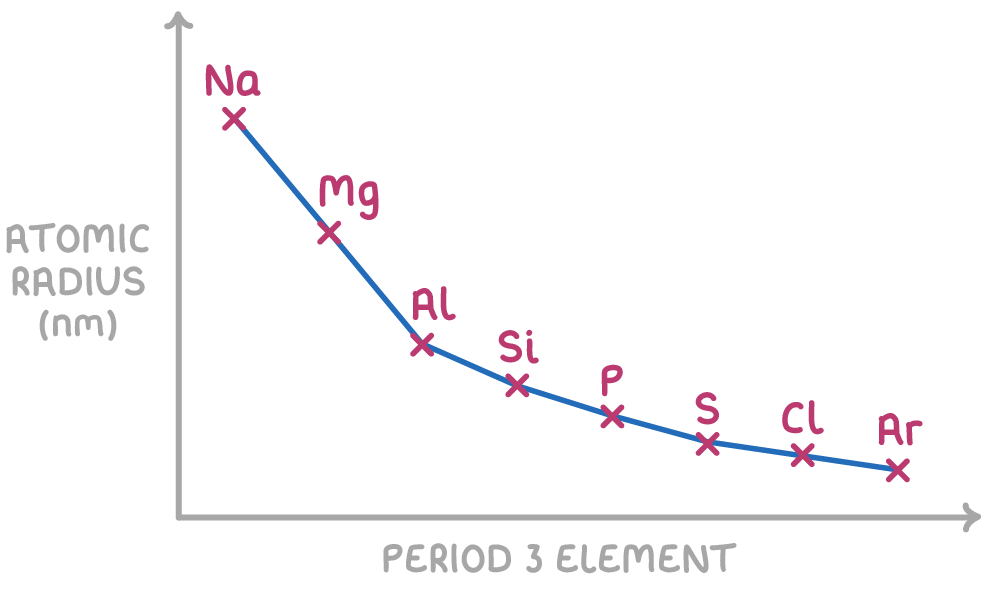
Atomic radius decreases across a period because:
- As protons are added across a period, the nuclear charge increases. This results in a stronger electrostatic attraction between the nucleus and the outer electrons, drawing the outer electrons closer to the nucleus.
- The electrons added across a period go into the outer energy level, so provide little additional shielding for inner electrons.
- With increasing nuclear charge and minimal change in shielding, the stronger electrostatic attraction causes the atomic radius to decrease across the period.
Trends in ionisation energy
Ionisation energy is the energy needed to remove one mole of electrons from one mole of gaseous atoms to form one mole of gaseous ions.
An equation representing the first ionisation energy of sodium is:
Na(g) ➔ Na+(g) + e−
Ionisation energy decreases down a group
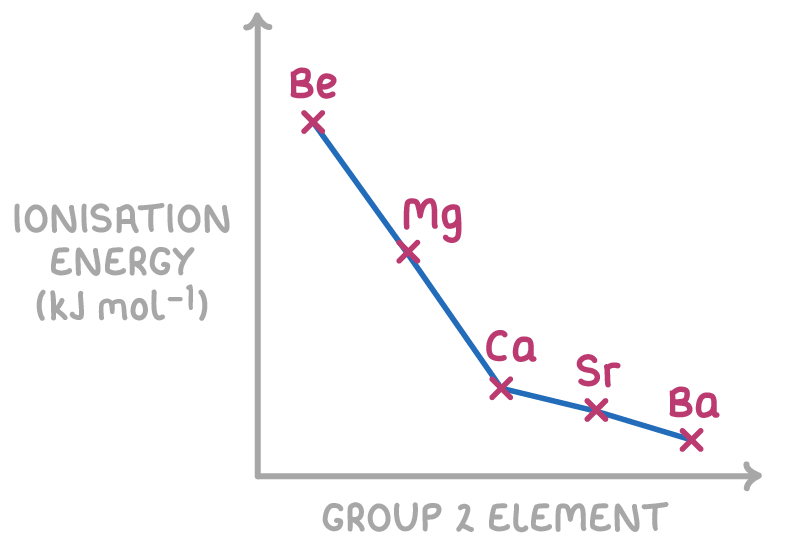
Ionisation energy decreases down a group, as shown by the group 2 elements in the graph above. This is because:
- Nuclear charge increases down the group as more protons are added. This increases attraction for electrons.
- Atomic radius increases down the group as more electron shells are added. This moves electrons away from nucleus.
- Electron shielding increases down group as more inner shells reduce nuclear attraction. The increasing atomic radius and shielding effects are greater than the increasing nuclear charge, leading to an overall decrease in ionisation energies down a group.
Ionisation energy increases across a period
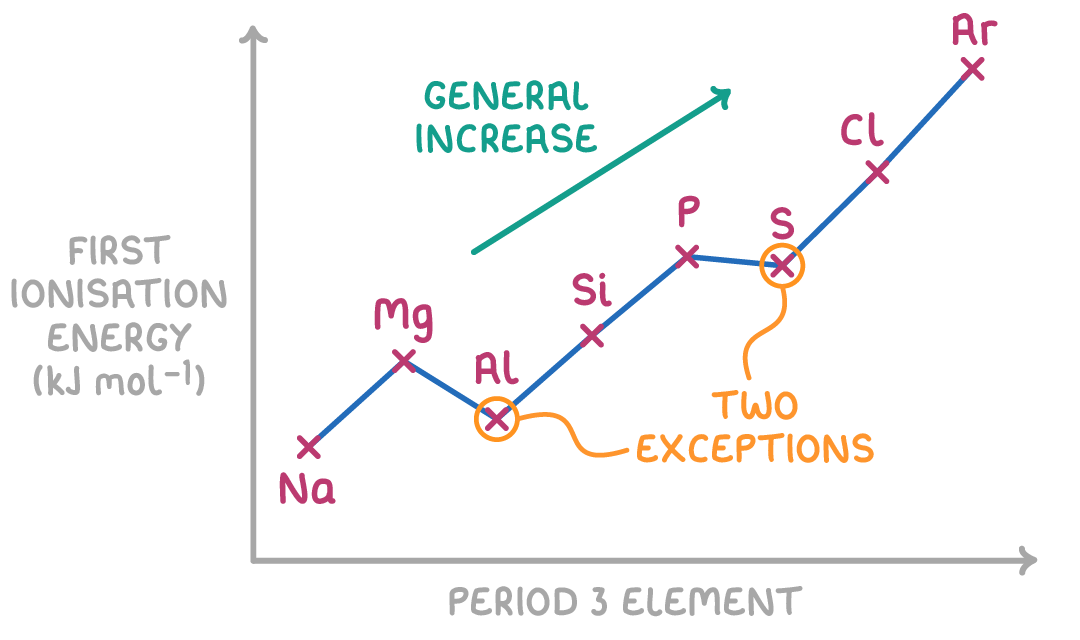
Ionisation energy generally increases across a period, as shown by the period 3 elements in the graph above. This is because:
- Nuclear charge increases as more protons are added across a period.
- Atomic radius decreases across a period as extra electrons are added to the same shell.
- Electron shielding stays similar across a period with no extra inner shells. The increasing nuclear charge effect outweighs the similar shielding across a period, so ionisation energies generally increase across a period.
There are two exceptions between groups 2-3 and groups 5-6. These drops occur due to electron configuration effects.
The drop between groups 2 and 3
This drop occurs because:
- In group 3, the electron is removed from a p orbital rather than an s orbital like in group 2.
- p orbitals have slightly higher energy than s orbitals, so the outermost electron is on average further from the nucleus.
- The p orbital also experiences additional shielding from the nucleus provided by the s electrons.
- As a result, less energy is required to remove the outermost p electron from the group 3 element compared to removing the outermost s electron from the group 2 element.
For example, aluminium has a lower first ionisation energy than magnesium.
| Element | Group | Electronic configuration | First ionisation energy (kJ mol^-1^) |
|---|---|---|---|
| Magnesium | 2 | [Ne] 3s^2^ | 738 |
| Aluminium | 3 | [Ne] 3s^2^ 3p^1^ | 578 |
The drop between groups 5 and 6
This drop occurs because:
- In group 5, the electron is removed from a singly occupied orbital.
- In group 6, the electron is removed from an orbital containing two electrons.
- The paired electrons in the group 6 element experience greater electron-electron repulsion.
- As a result, less energy is needed to remove one of these paired electrons in the group 6 element compared to the unpaired electron in the group 5 element.
For example, sulfur has a lower first ionisation energy than phosphorus.
| Element | Group | Electronic configuration | First ionisation energy (kJ mol^-1^) |
|---|---|---|---|
| Phosphorus | 5 | [Ne] 3s^2^ 3p^3^ | 1,011 |
| Sulfur | 6 | [Ne] 3s^2^ 3p^4^ | 999 |