9.3 - Catalysts
- 1
What catalysts are and how they function
- 2
The difference between heterogeneous and homogeneous catalysts
- 3
How reaction profiles and Maxwell-Boltzmann distributions illustrate the role of catalysts
- 4
The economic benefits of catalysts
Catalysts speed up reactions
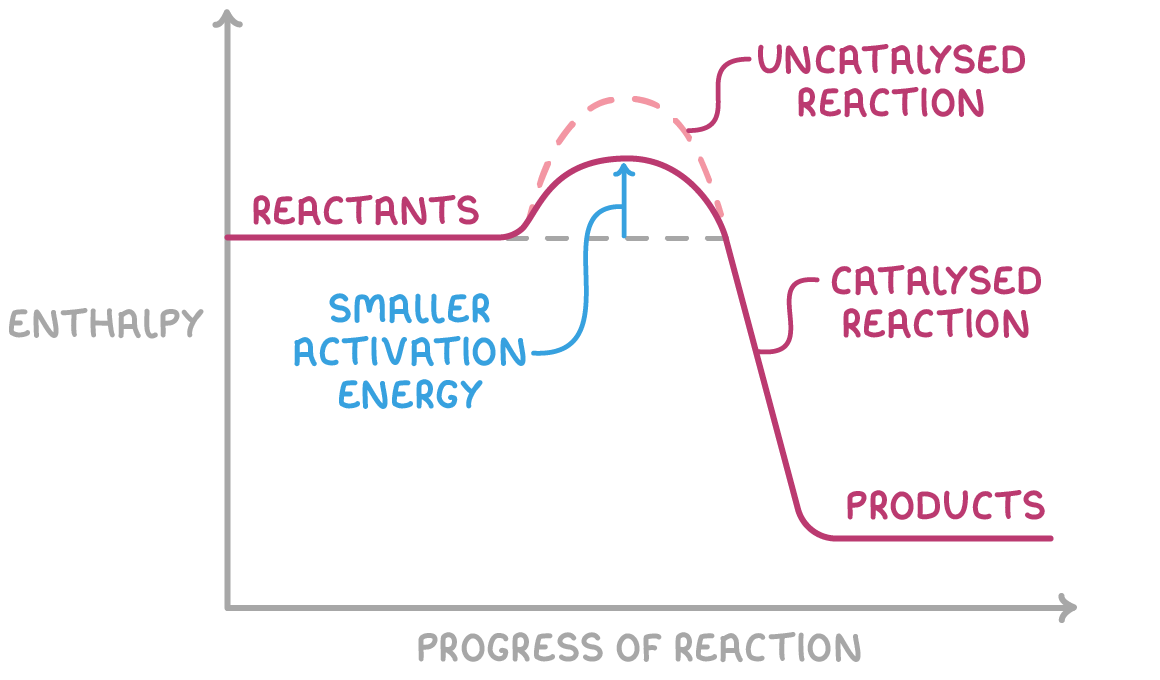
A catalyst is a substance that accelerates the rate of a chemical reaction without being permanently altered by the reaction itself. Catalysts achieve this by providing an alternative reaction pathway that has a lower activation energy. This allows a greater proportion of particle collisions to result in successful reactions.
Key features of catalysts:
- They are highly efficient - A small quantity of catalyst can facilitate the reaction of a large amount of reactants.
- They are usually very specific - Most catalysts only work for particular reactions.
- They participate in the reaction but are regenerated at the end.
Types of catalysis
There are two primary types of catalysis:
- Heterogeneous catalysis - The catalyst is in a different phase from the reactants.
- This often involves a solid catalyst with gaseous or liquid reactants.
- The reaction occurs on the catalyst's surface.
- For example, in the Haber process, solid iron is used as a catalyst for gaseous nitrogen and hydrogen.
- Homogeneous catalysis - The catalyst is in the same phase as the reactants.
- This typically involves an aqueous catalyst in a solution of aqueous reactants.
- The reaction occurs throughout the mixture.
- For example, sulfuric acid is used as a catalyst in the reaction between aqueous hydrogen peroxide and aqueous potassium iodide.
How catalysts work
Catalysts function by altering the reaction pathway, thereby lowering the activation energy required for the reaction to proceed. This can be visualised using reaction profile diagrams.
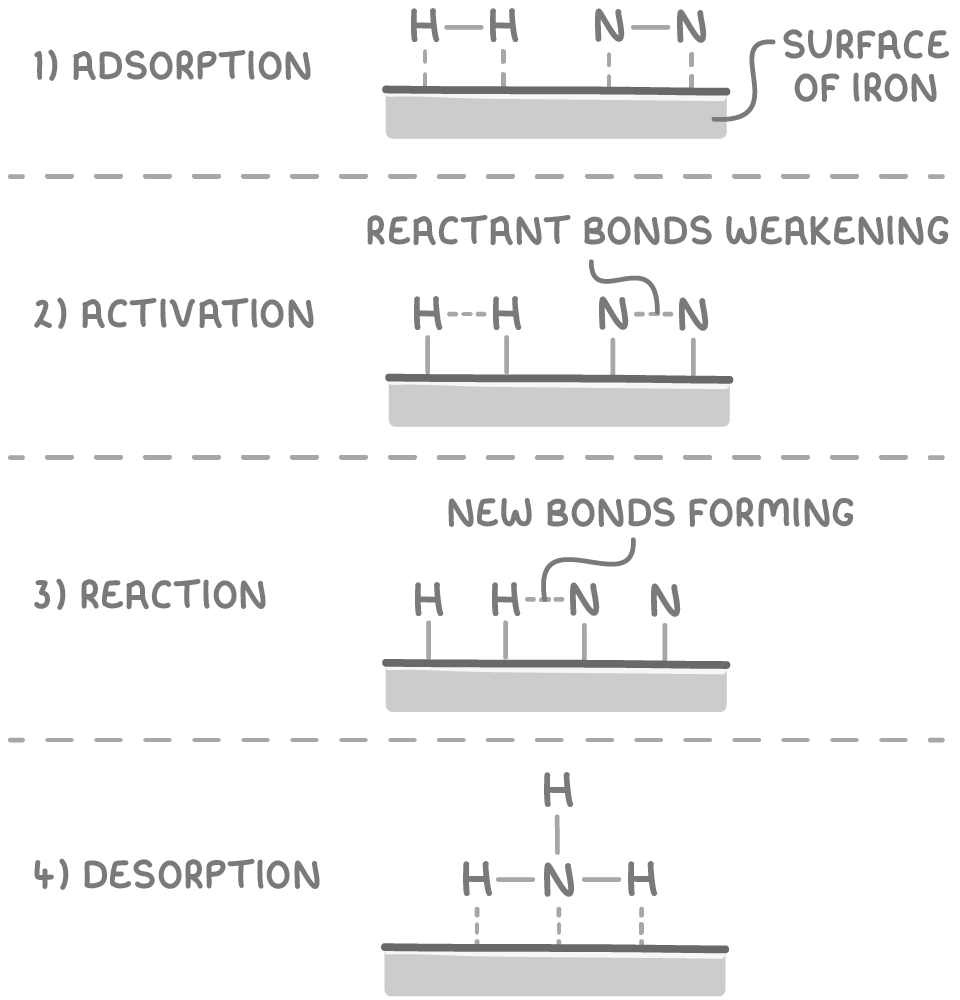
In heterogeneous catalysis, the process occurs in several steps:
- Adsorption - Reactant molecules attach to the catalyst surface.
- Activation - Bonds in the reactants weaken and break, forming reactive species.
- Reaction - New bonds form between the reactive species.
- Desorption - Product molecules detach from the catalyst surface.
The mechanism of heterogeneous catalysis for the synthesis of ammonia using an iron catalyst is shown below.
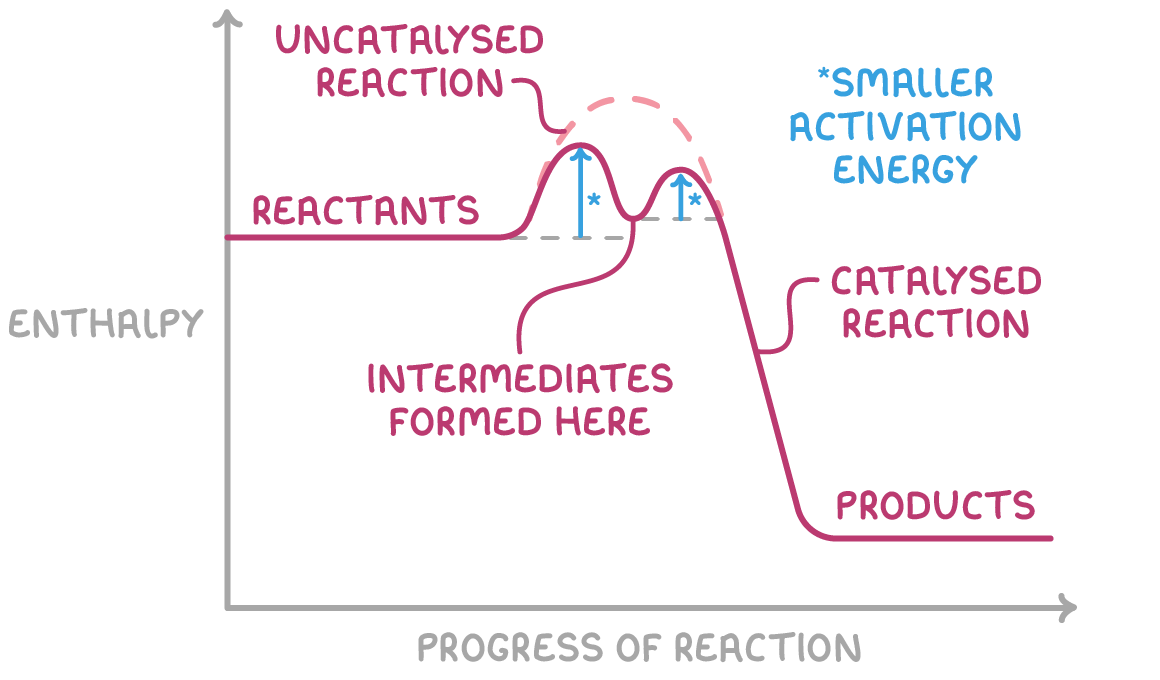
In homogeneous catalysis, the process involves:
- Reactants combining with the catalyst to form an intermediate species.
- The intermediate reacting to form products and regenerate the catalyst.
Catalysts and the Maxwell-Boltzmann distribution
The effect of catalysts can also be understood using Maxwell-Boltzmann distribution curves, which illustrate the distribution of molecular energies in a system.
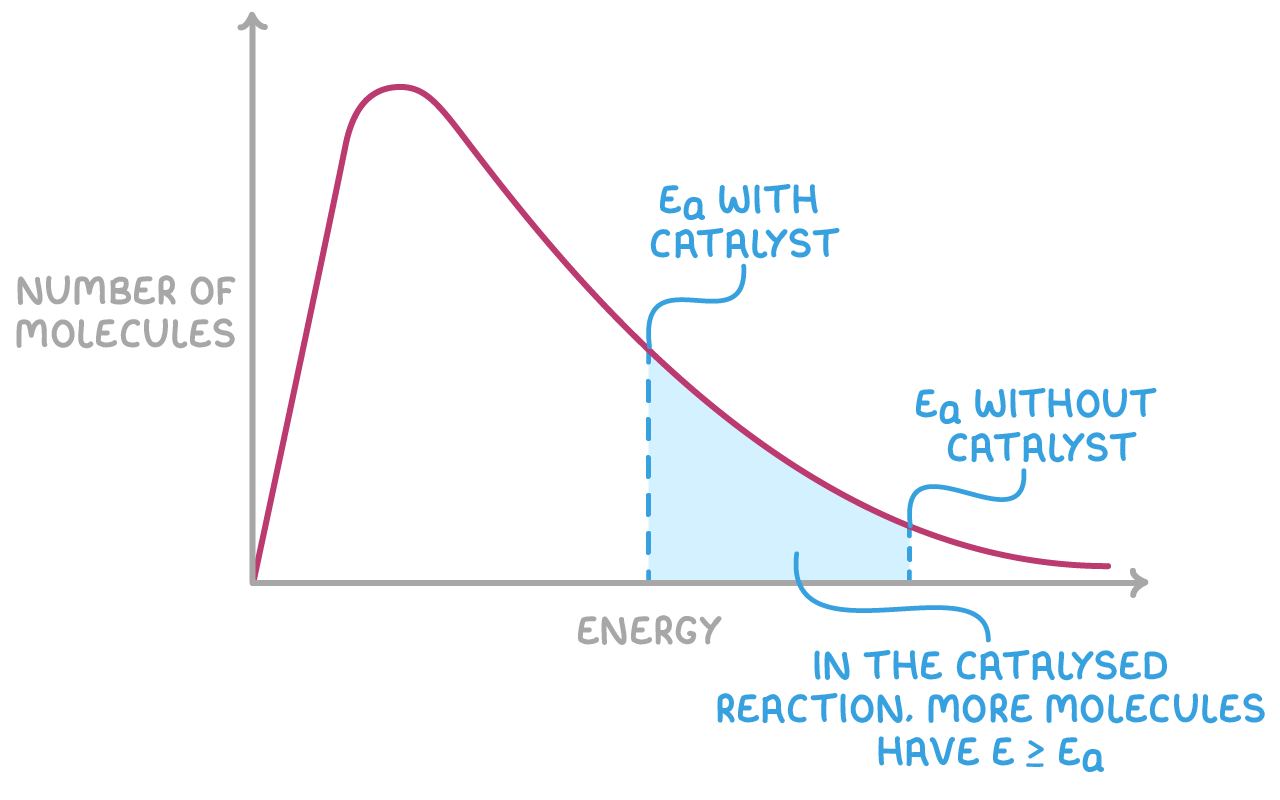
By lowering the activation energy, catalysts increase the proportion of molecules with sufficient energy to react upon collision. This leads to an increased reaction rate.
Economic benefits of catalysts
Catalysts play a vital role in many industrial processes, offering several economic advantages:
- Lower production costs - Catalysts often allow reactions to occur at lower temperatures, thereby reducing energy consumption.
- Increased efficiency - Faster reaction rates mean that more product can be produced in a shorter amount of time.
- Improved product quality - Some catalysts can influence the properties of the final product. For example, in the production of polyethene, the addition of a catalyst can alter the properties of the product:
| Property | Polyethene without catalyst | Polyethene with catalyst |
|---|---|---|
| Density | Lower | Higher |
| Rigidity | Less rigid | More rigid |
| Melting point | Lower | Higher |
These differences in properties allow manufacturers to produce polyethene suitable for a wide range of applications, from flexible plastic bags to rigid pipes.