5.6 - Acid-base Titrations
- 1
What titrations are
- 2
How to accurately carry out a titration
- 3
Creating standard solutions
- 4
Hazards and risks in chemistry experiments
- 5
Uncertainty and errors
Titrations determine neutralisation volumes
Titration is an analytical method used to determine the concentration of a solution of known volume by gradually adding a solution of known concentration to it until neutralisation occurs.
- A solution with an unknown volume and concentration is referred to as the analyte. It is measured using a pipette and placed into a conical flask.
- The standard solution, which has a known concentration, is filled into a burette and slowly added to the analyte.
- To visually determine when neutralisation has occurred, an indicator is added to the flask, causing a colour change at the end point - the point at which the reaction has just reached completion and neither reactant is in excess.
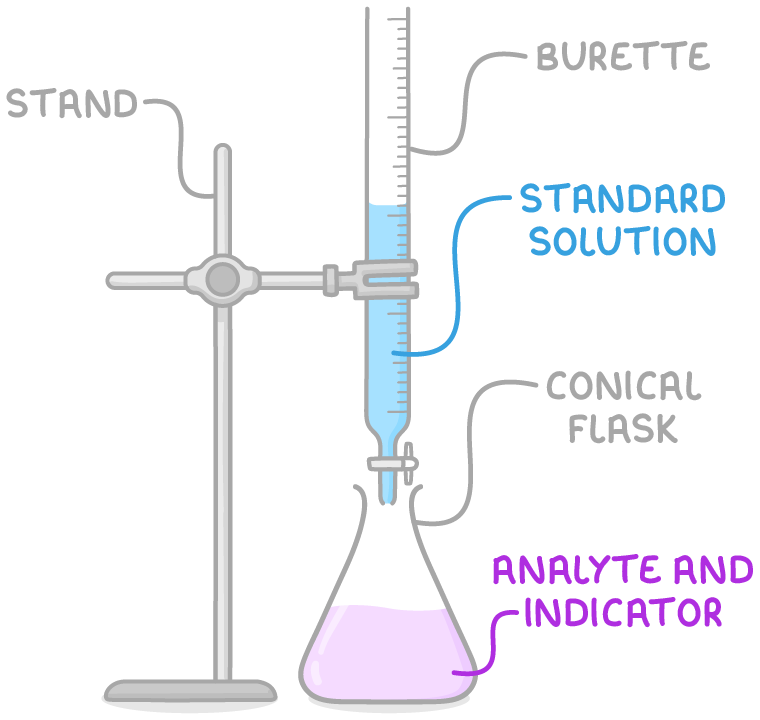
By calculating the volume of the standard solution required to reach the end point, you can determine the concentration of the analyte.
Steps in carrying out a titration
To perform a titration accurately, follow these steps:
- Measure the analyte into a conical flask using a pipette, and add an indicator.
- Fill the burette with the standard solution and note the initial reading.
- Gradually add the standard solution to the flask, swirling to mix, until you approximately reach the point of neutralisation.
- Refill the burette and repeat steps 2 and 3 to get an approximate idea of where neutralisation occurs.
- Conduct a precise titration by adding the standard solution slowly to identify the exact end point. Record the final burette reading, also known as the titre volume.
- Perform the titration multiple times to obtain concordant results, which are titre volumes that differ by no more than 0.10 cm3.
- Calculate the mean titre volume using the concordant results.
Measuring burette readings accurately
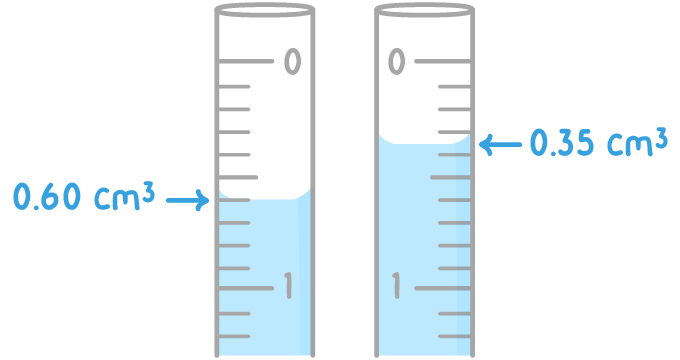
- When reading a 50 cm3 burette, the volume should be recorded to the nearest half division (±0.05 cm3), with the bottom of the meniscus either on a mark or between two marks.
- The meniscus is the curved surface of the liquid in the burette, which is caused by the adhesive forces between the liquid and the glass.
- To ensure accurate readings, always read the volume at the bottom of the meniscus, as shown in the image below.
Indicators mark reaction completion
Indicators are crucial for visually identifying the end point of a titration through a colour change, indicating neutralisation.
Common indicators include:
- Methyl orange, which changes from yellow to red when adding acid to alkali.
- Phenolphthalein, which changes from pink to colourless when adding acid to alkali. Conduct titrations against a white background to easily observe the colour change.
Standard solutions enable calculation of unknown concentrations
To determine an unknown concentration via titration, it's essential to use a standard solution with a precisely known concentration.
These solutions are prepared by:
- Weighing a precise mass of solute using a balance.
- Dissolving the weighed solute in distilled water in a beaker.
- Transferring the solution to a volumetric flask of a specific volume.
- Rinsing the beaker several times with distilled water and adding the rinsings to the volumetric flask.
- Diluting the solution to the mark on the volumetric flask with a pipette.
- Inverting the flask several times to ensure thorough mixing of the solution.
The formula for the concentration of the stock solution is:
Worked example 1 - Determining the mass of solid Na_2_CO_3_ needed
What mass in g of solid sodium carbonate (Na2CO3) is needed to make 250 cm3 of a 0.400 mol dm-3 solution?
Step 1: Conversion of cm3 into dm3
To convert from cm3 into dm3, divide by 1,000
250 cm3 = 0.250 dm3
Step 2: Calculate number of moles of Na_2_CO_3_ required
n = c x V = 0.400 x 0.250 = 0.100 mol
Step 3: Calculate mass of Na_2_CO_3_ required
m = n x Mr = 0.100 x 106.0 = 10.6 g
Experiments involve hazards and risks
In chemistry, a hazard is anything that could potentially cause harm or damage. The risk associated with a hazard is the probability of someone or something being harmed if exposed to that hazard.
Many chemistry experiments carry risks related to:
- The equipment used (e.g., risk of burns from a hot plate).
- The chemicals involved.
When planning an experiment, it's crucial to:
- Identify all hazards.
- Assess the risk from each hazard. How likely is it that something could go wrong? How serious would it be if it did?
- Develop strategies to reduce these risks. This process is known as a risk assessment.
For example, when titrating sodium hydroxide with hydrochloric acid:
- Both substances are irritants at low concentrations and corrosive at high concentrations.
- Irritants inflame tissue, while corrosives cause chemical burns on skin or eyes.
- To mitigate risks, use low concentrations if possible and wear protective equipment (gloves, lab coat, goggles).
Uncertainty in measurements
All measurements have some degree of uncertainty due to the sensitivity limits of the equipment used.
The uncertainty varies depending on the equipment. For instance:
- A 50 cm3 burette has scale markings every 0.1 cm3.
- Readings should be within 0.05 cm3 of the true value (assuming no gross errors).
- So the uncertainty is ±0.05 cm3. The ± sign indicates the range containing the true value (also called the margin of error).
In general, for any measuring device, the uncertainty is half the smallest increment the equipment can measure, in either direction.
Manufacturers typically provide uncertainty values for equipment based on its construction accuracy. These are often printed directly on the equipment.
When combining measurements with the same units, their uncertainties must also be combined.
Worked example 2 - Calculating the total uncertainty in mass measurement
A student uses electronic scales (measures to nearest 0.05 g) to weigh out 1.65 g of a solid after zeroing the scales.
Calculate the total uncertainty.
Step 1: Determine number of readings
There are two readings:
- Initial: 0.00 g
- Final: 1.65 g
Step 2: Calculate total uncertainty
Each has an uncertainty of = 0.025 g.
Total uncertainty = 0.025 + 0.025 = 0.05 g
Calculating percentage uncertainty
The percentage uncertainty of a measurement can be calculated using:
Percentage uncertainty =
Worked example 3 - Calculating percentage uncertainty
A 500 cm3 volumetric flask has a manufacturer's stated uncertainty of ±0.50 cm3.
Calculate the flask's percentage uncertainty to 2 decimal places.
Step 1: Equation
Percentage uncertainty =
Step 2: Substitution and correct evaluation
Percentage uncertainty = = 0.10%
Minimising percentage uncertainty
Percentage uncertainty can be reduced in two key ways:
- Use the most precise equipment available
- Plan experiments strategically
For example, when using a measuring cylinder with 0.1 cm3 increments:
- Measuring 5 cm3 of liquid: % uncertainty = = 1%
- Measuring 10 cm3 of liquid: % uncertainty = = 0.5% So using a larger volume reduces the percentage uncertainty.
Systematic vs. random errors
Systematic errors are consistent each time an experiment is repeated. They often stem from issues with the experimental setup or equipment.
For example, using a 10.00 cm3 pipette that actually only delivers 9.95 cm3 - the sample will be ~0.05 cm3 too small every time.
Random errors vary between repeated experiments. They cause results to differ slightly each time.
For eample, reading errors from a burette - readings may be slightly above or below the true value.
Calculating total uncertainty in titrations
To find the total uncertainty in a titration result:
- Calculate the percentage uncertainty for each piece of equipment.
- Add these individual percentage uncertainties to get the overall percentage uncertainty.
- Use this to determine the absolute uncertainty in the final result.
Worked example 4 - Calculating total uncertainty in titration
20.00 cm3 of KOH solution (uncertainty ±0.080 cm3) is neutralised by 35.40 cm3 of HCl (uncertainty ±0.15 cm3). The KOH concentration is calculated as 1.250 mol dm-3.
Calculate the absolute uncertainty in this concentration to 2 significant figures.
Step 1: Individual percentage uncertainties
KOH: = 0.40%
HCl: = 0.42%
Step 2: Calculate total percentage uncertainty
0.40 + 0.42 = 0.82%
Step 3: Calculate absolute uncertainty in final result
0.82% of 1.250 mol dm-3 = ±0.010 mol dm-3