16.3 - Rate Equations and Reaction Mechanisms
- 1
What the rate-determining step is
- 2
How the rate-determining step relates to the rate equation
- 3
Predicting the rate equation from the rate-determining step
- 4
Using the rate equation to deduce reaction mechanisms
- 5
Intermediates in the rate-determining step
- 6
SN1 and SN2 reaction mechanisms
The slowest step determines the overall reaction rate
The rate-determining step (also known as the rate-limiting step) is the slowest step in a multi-step reaction mechanism. It dictates the overall rate of the reaction.
Just like how the flow of people exiting a crowded room is limited by how quickly they can get through the doorway, the rate of a multi-step reaction is restricted by its slowest step.
Each step in a reaction mechanism can have a different rate, but the step with the slowest rate controls how fast the reaction proceeds overall.
The rate equation reveals the rate-determining step
The rate equation provides valuable insights into the mechanism of a chemical reaction, particularly in identifying which reactants are involved in the rate-determining step.
Here are the key points to remember:
- If a reactant appears in the rate equation, it must be involved in the rate-determining step, either directly or via a substance derived from it.
- Conversely, if a reactant is absent from the rate equation, neither it nor any substance derived from it participates in the rate-determining step.
It's important to note that:
- The rate-determining step is not always the first step in the mechanism.
- The reaction mechanism usually cannot be deduced solely from the balanced equation.
Predicting the rate equation from the mechanism
The order of reaction with respect to a particular reactant indicates how many molecules of that reactant are involved in the rate-determining step.
For instance, if a reaction is second-order with respect to reactant X, then two molecules of X must be present in the rate-determining step.
Consider the following example.
The mechanism for the reaction between chlorine radicals and ozone (O3) consists of two steps:
Step 1 (slow): Cl• + O3 ➔ ClO• + O2
Step 2 (fast): ClO• + O3 ➔ Cl• + 2O2
To predict the rate equation, note that:
- Both Cl• and O3 appear in the slow, rate-determining step, so both must be in the rate equation.
- There is one Cl• radical and one O3 molecule in this step, so the reaction is first-order with respect to each. Therefore, the rate equation takes the form: rate = k[Cl•][O3]
Using the rate equation to deduce the mechanism
Knowledge of which reactants feature in the rate-determining step can aid in deducing the reaction mechanism.
Let's examine an example.
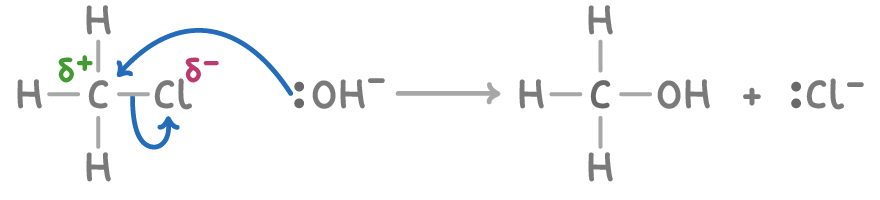
The reaction below shows the substitution of Cl in chloromethane by the OH- nucleophile.
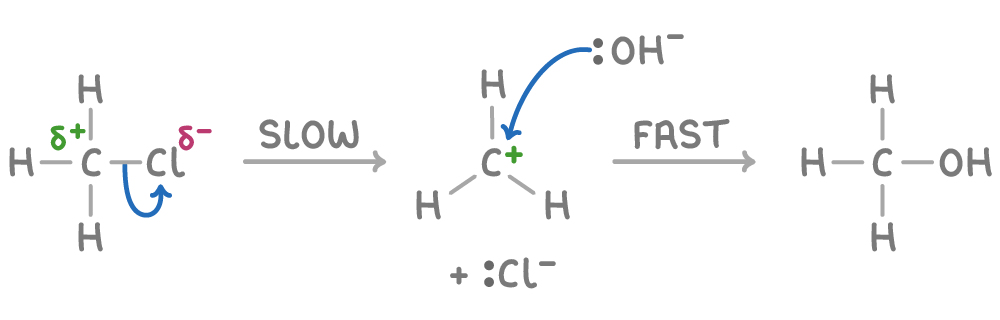
There are two potential mechanisms for this process.
Mechanism 1 (single-step)
A one-step process where the OH- nucleophile directly substitutes the Cl atom in a single transition state.
Mechanism 2 (two-step)
Step 1 (slow) - The C-Cl bond breaks, forming a carbocation intermediate and Cl-. This is likely the rate-determining step as breaking a strong C-Cl bond requires significant energy.
Step 2 (fast) - The positively charged carbocation rapidly reacts with the negatively charged OH- nucleophile to form the final product. If the OH- concentration is high, this step should occur quickly once the carbocation forms.
The experimentally determined rate equation is:
rate = k[CH3Cl]
The absence of [OH-] in this equation indicates that OH- is not involved in the rate-determining step. This supports mechanism 2 being correct, where OH- only appears in the fast second step.
Intermediates in the rate-determining step
In some cases, the rate-determining step may involve an intermediate species that is formed and consumed during a reaction, but does not appear in the overall balanced equation.
Consider this example.
The reaction 2NO(g) + O2(g) ➔ 2NO2(g) proceeds via a two-step mechanism:
Step 1: 2NO ➔ N2O2
Step 2: N2O2 + O2 ➔ 2NO2
If the rate equation is experimentally determined to be: rate = k[NO]2[O2], which step is rate-determining?
The rate equation tells us that the rate-determining step must involve:
- 2 molecules of NO
- 1 molecule of O2
Step 1 cannot be the rate-determining step as it does not involve O2. Although step 2 doesn't contain the reactants in the stoichiometry expected from the rate equation, it does involve the intermediate N2O2. This intermediate is derived from 2NO molecules, matching the rate equation.
Therefore, step 2 is the rate-determining step, even though it involves the intermediate N2O2 rather than the reactants shown in the overall equation.
SN1 and SN2 mechanisms
Nucleophilic substitution reactions of halogenoalkanes can proceed via two distinct mechanisms:
- S_N_2 - Two molecules, or one molecule and one ion, or two ions are involved in the rate-determining step.
- S_N_1 - Only one molecule or ion is involved in the rate-determining step.
The type of halogenoalkane determines which mechanism occurs:
- Primary halogenoalkanes only react via S_N_2.
- Secondary halogenoalkanes can react via both S_N_1 and S_N_2.
- Tertiary halogenoalkanes only react via S_N_1.
SN2 mechanism in primary halogenoalkanes
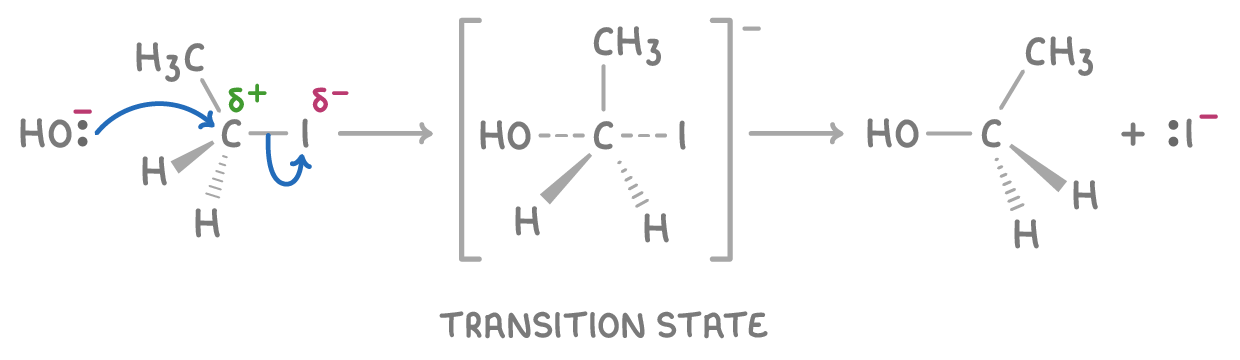
Primary halogenoalkanes react via the SN2 mechanism. Consider the reaction of iodoethane (a primary halogenoalkane) with hydroxide ions:
CH3CH2I + OH- ➔ CH3CH2OH + I-
This reaction occurs in a single step, which is also the rate-determining step.
The rate equation for this reaction is:
rate = k[CH3CH2I][OH-]
The rate equation shows that the reaction rate depends on the concentration of both reactants, with an order of 1 for each. This indicates that one molecule of each reactant is involved in the rate-determining step, which aligns with the SN2 mechanism.
Primary halogenoalkanes favour this mechanism because there is enough space around the carbon atom for the nucleophile to approach.
SN1 mechanism in tertiary halogenoalkanes
Tertiary halogenoalkanes react via the SN1 mechanism. Consider the reaction of 2-iodo-2-methylpropane (a tertiary halogenoalkane) with hydroxide ions:
(CH3)3CI + OH- ➔ (CH3)3COH + I-
Although the equation looks similar, the rate equation for this reaction is different:
rate = k[(CH3)3CI]
This rate equation shows that the reaction rate depends only on the concentration of the halogenoalkane, indicating that the hydroxide ion is not involved in the rate-determining step.

The SN1 reaction occurs in two steps:
- Rate-determining step - The C-I bond breaks to form a carbocation intermediate and an iodide ion.
- Fast step - The nucleophile (OH-) then attacks the carbocation to form the product.
Tertiary halogenoalkanes favour this mechanism because the carbon atom is surrounded by alkyl groups, making direct nucleophilic attack more difficult. The carbocation intermediate is also stabilised by the surrounding alkyl groups.