18.4 - The Properties and Reactions of Amines
- 1
The structure and classification of amines
- 2
How the structure of amines affects their basicity
- 3
The solubility of amines in water
- 4
The reaction of amines with copper(II) ions
Amines are derivatives of ammonia
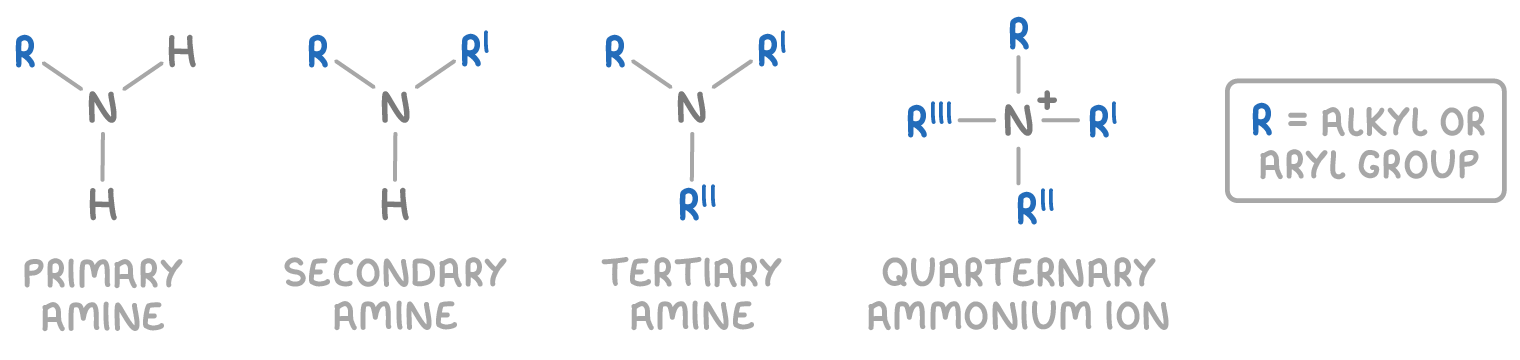
Amines are organic compounds that come from ammonia (NH3). This transformation happens when one or more hydrogen atoms in the ammonia molecule are replaced with alkyl or aryl groups.
Amines can be classified into two main categories: aliphatic and aromatic. Aliphatic amines have alkyl groups attached to the nitrogen atom, while aromatic amines contain a nitrogen atom directly bonded to a benzene ring.
Amines are further categorised based on the number of hydrogen atoms that have been replaced:
- Primary amines - One hydrogen is replaced. The general formula is RNH2.
- Secondary amines - Two hydrogens are replaced. The general formula is R2NH.
- Tertiary amines - Three hydrogens are replaced. The general formula is R3N.
- Quaternary ammonium ions - Four organic groups are attached to positively charged nitrogen, general formula R4N+.
Amines contain a lone pair of electrons
Amines contain a nitrogen atom with a lone pair of electrons, enabling them to act as weak Brønsted-Lowry bases. They accept protons (H+ ions) from acids, forming substituted ammonium salts through the transfer of a proton from the acid to the amine.
This neutralisation reaction occurs due to the lone pair's ability to accept protons.
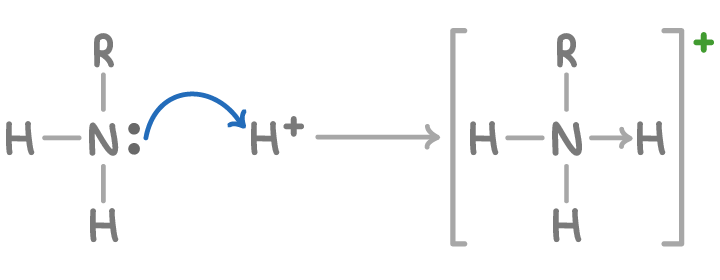
For example, butylamine neutralises hydrochloric acid to form butylammonium chloride:
CH3(CH2)3NH2 + HCl ➔ CH3(CH2)3NH3+ Cl-
Aliphatic amines are stronger bases than aromatic amines
The strength of an amine as a base is influenced by how available nitrogen's lone pair of electrons is:
- Aromatic amines have the electron density of the nitrogen reduced by the partial delocalisation of the lone pair into the π-system, which decreases its availability for bonding.
- Aliphatic amines, however, have electron-donating alkyl groups that increase the electron density on the nitrogen, making the lone pair more readily available for bonding.
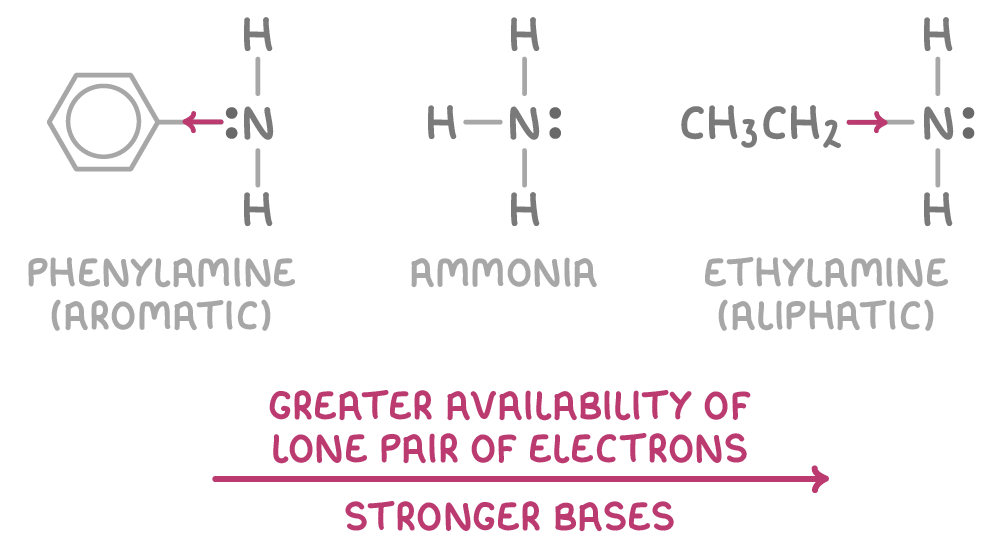
The more available the lone pair of electrons, the stronger the base. So the order of increasing basicity is:
primary aromatic amines < ammonia < primary aliphatic amines
Solubility of amines in water
The solubility of amines in water depends on their size:
Small amines such as butylamine are highly soluble due to hydrogen bonding between the amine group and water molecules.
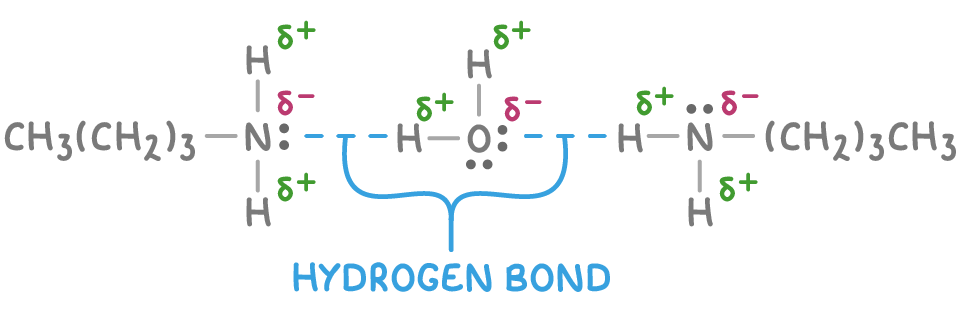
Larger amines are less soluble because:
- Increased London forces between amine molecules require more energy to overcome.
- Large carbon chains disrupt the hydrogen bonding network of water.
When amines dissolve in water, they create alkaline solutions. This happens because some amine molecules accept a proton from water, forming alkyl ammonium ions and hydroxide ions.
For example, butylamine dissolves in water as follows:
CH3(CH2)3NH2 + H2O ⇌ CH3(CH2)3NH3+ + OH-
Amines form complex ions with copper(II) ions
Amines can act as ligands by using their lone pair to form dative covalent bonds with metal ions like Cu2+. This results in the formation of complex ions with distinct colours.
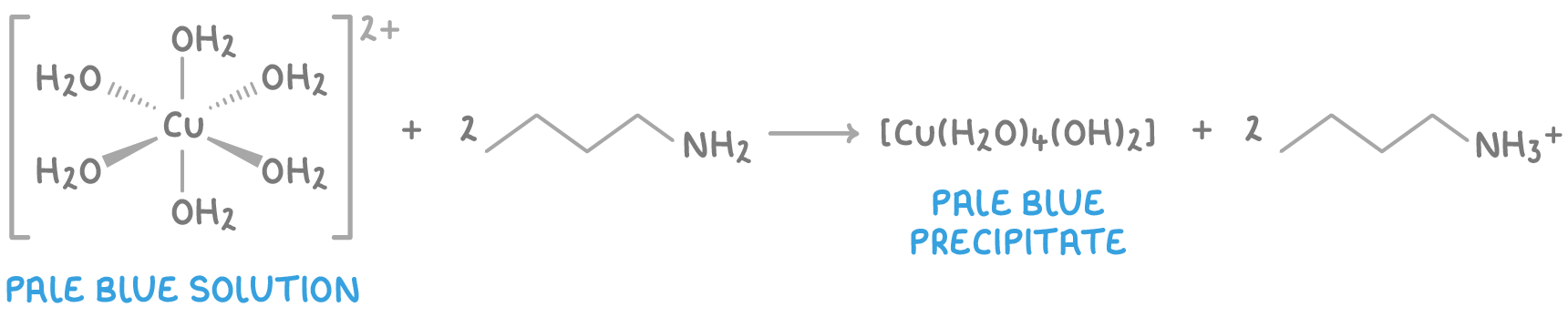
The reaction of butylamine with copper(II) sulfate solution occurs in two stages:
- At low concentrations of butylamine, a pale blue precipitate of copper(II) hydroxide forms as the amine deprotonates the [Cu(H2O)6]2+ complex:
- In excess butylamine, the precipitate dissolves, forming a deep blue solution containing [Cu(CH3(CH2)3NH2)4(H2O)2]2+ as the amine ligands replace the water:
