Lattice Energy - exam practice
Lattice Energy
Question 1 of 7
State the meaning of the term enthalpy of solution, ΔHsol.
The following table lists some enthalpy changes for compounds of magnesium and barium.
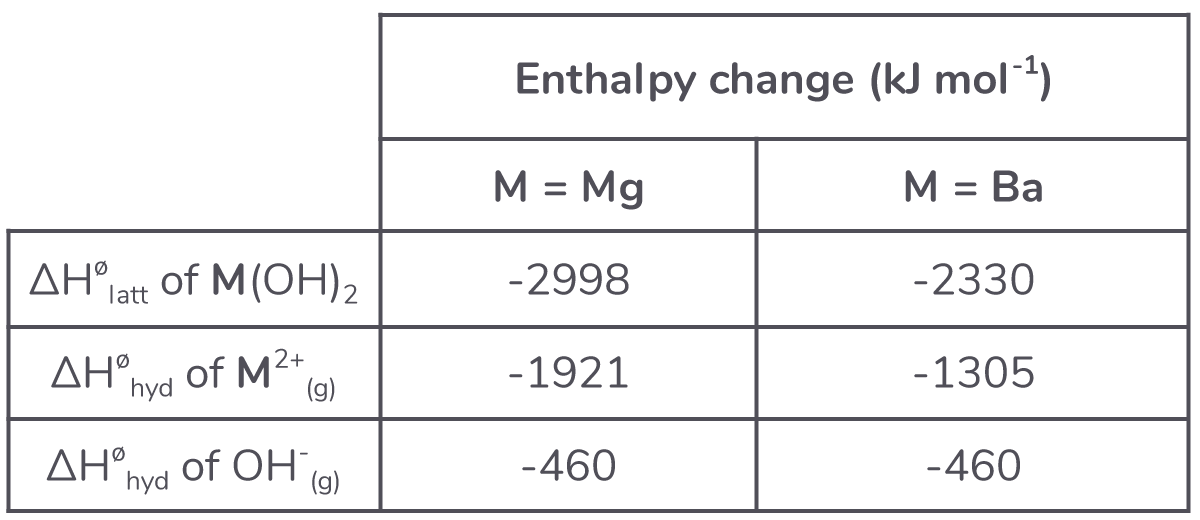
Use data in the table above to calculate the values, in kJ mol-1, of ΔHsol for Mg(OH)2 and Ba(OH)2.
Use your results to part b) to suggest whether Mg(OH)2 is more or less soluble than Ba(OH)2.
Explain your answer.
Define the term enthalpy of lattice formation.
The lattice enthalpies of potassium fluoride, potassium chloride and calcium fluoride are shown in the table below.
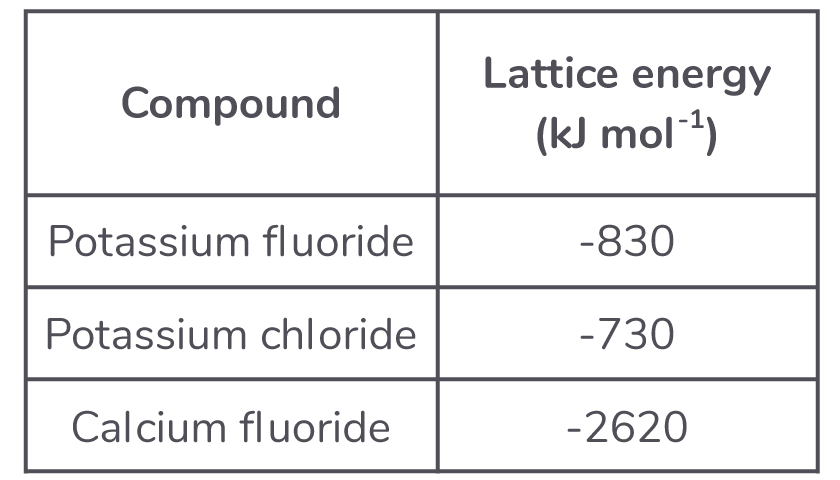
Explain the differences between these lattice enthalpies.
Write an equation to represent the enthalpy change of atomisation, ΔHat, of chlorine.
Explain why ΔHat for chlorine is positive (endothermic).
Lattice enthalpies can be determined indirectly using Born-Haber cycles.
The table below shows the enthalpy changes that are needed to determine the lattice enthalpy of sodium chloride, NaCl.
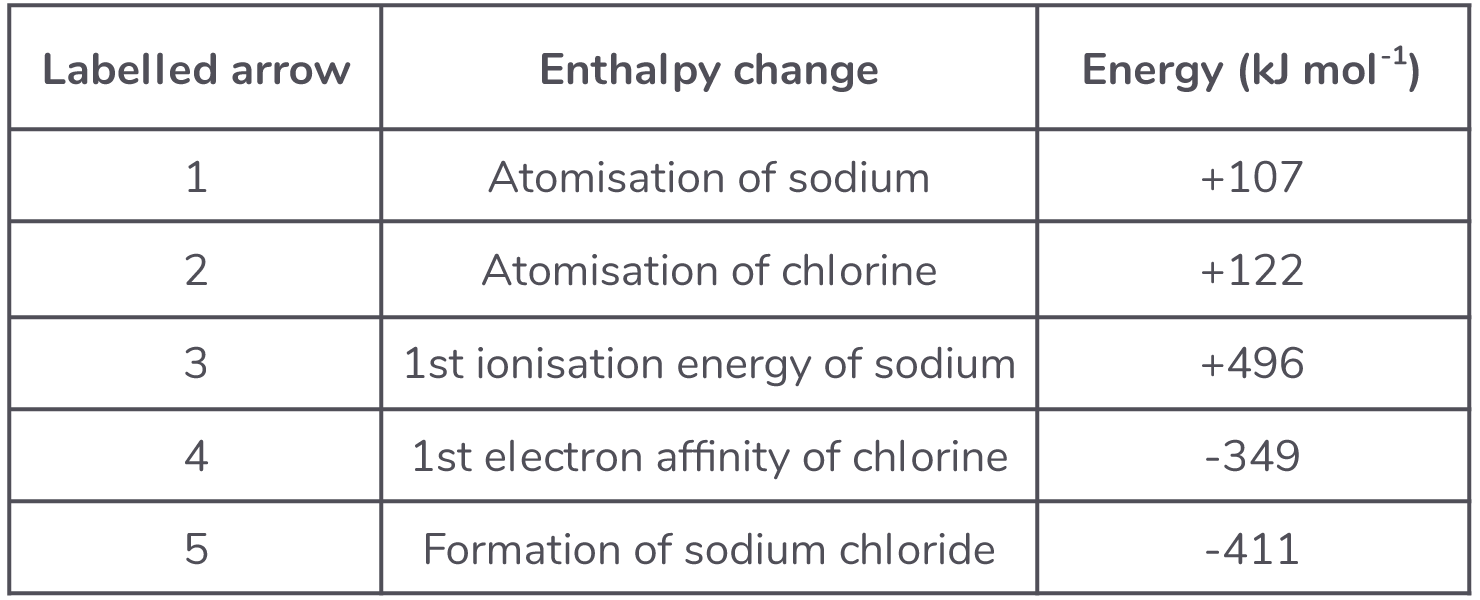
The diagram below shows an incomplete Born-Haber cycle to determine the lattice enthalpy of sodium chloride.
The arrows labelled 1-5 correspond to the five rows of the table above.
On the five dotted lines, add the species present, including state symbols.
Using the model answer from part a), calculate the enthalpy of lattice formation, ΔHlatt, of sodium chloride.
The change that produces lattice enthalpy is spontaneous but has a negative entropy change.
Why is this change able to take place spontaneously?
Define the term first electron affinity.
Write an equation to represent the first electron affinity, ΔHea1, of fluorine.
The diagram below shows an incomplete Born-Haber cycle to determine the enthalpy of lattice formation of magnesium fluoride.
Complete the Born-Haber cycle diagram for magnesium fluoride.
Include the formulae and state symbols of appropriate species.
The table below contains some enthalpy data.
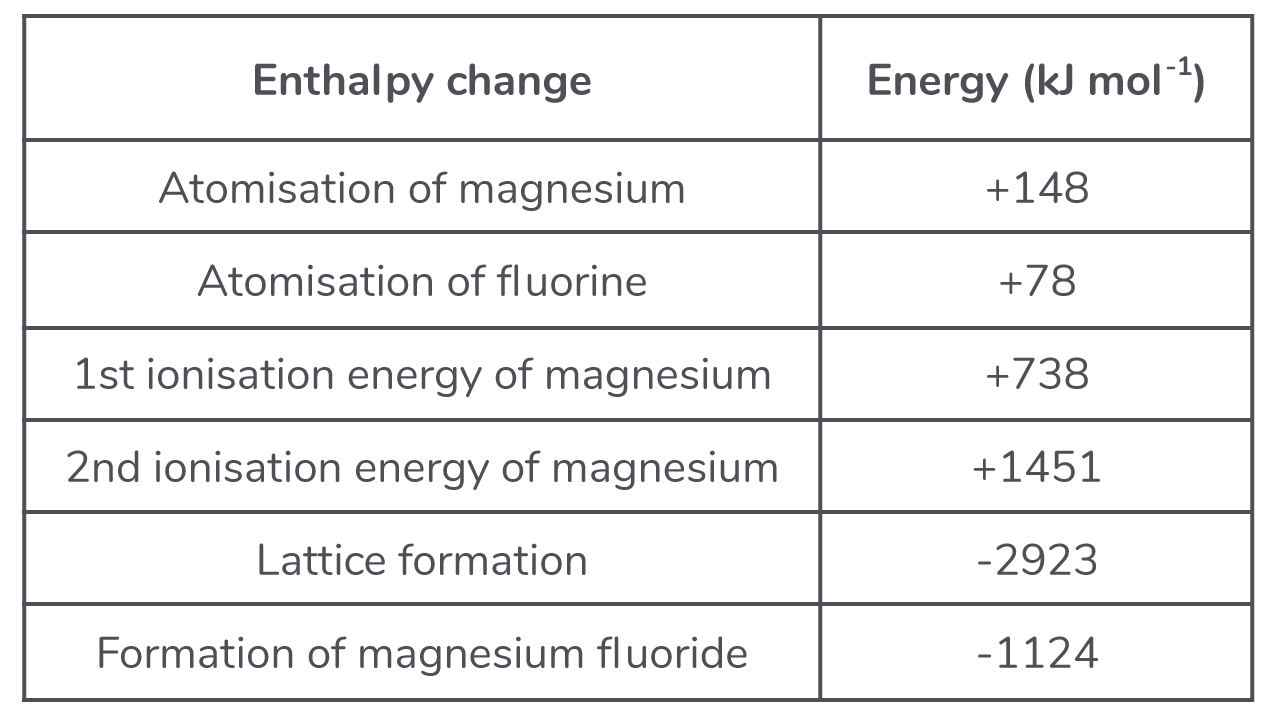
Use the Born-Haber cycle from part a) and data from the table above to calculate a value for the first electron affinity, ΔHea1, of fluorine.
The theoretical and experimental lattice enthalpies of MgF2 are 2,923 and 2,978 kJ mol-1 respectively.
Explain why the experimental lattice enthalpy of MgF2 is more exothermic than the theoretical value.
Define the term enthalpy of hydration.
The table below shows enthalpy of hydration values for some group 2 ions.
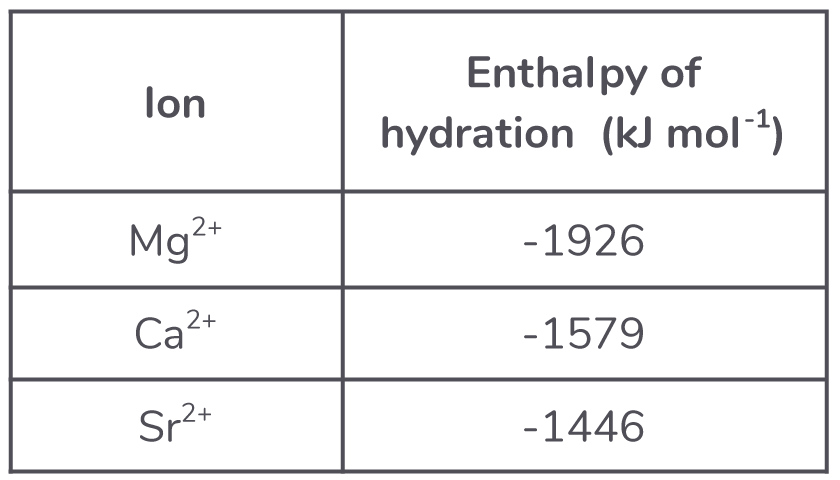
Explain why the enthalpy of hydration becomes less exothermic from Mg2+ to Sr2+.
Draw a line from each ion to the enthalpy of hydration of that ion.
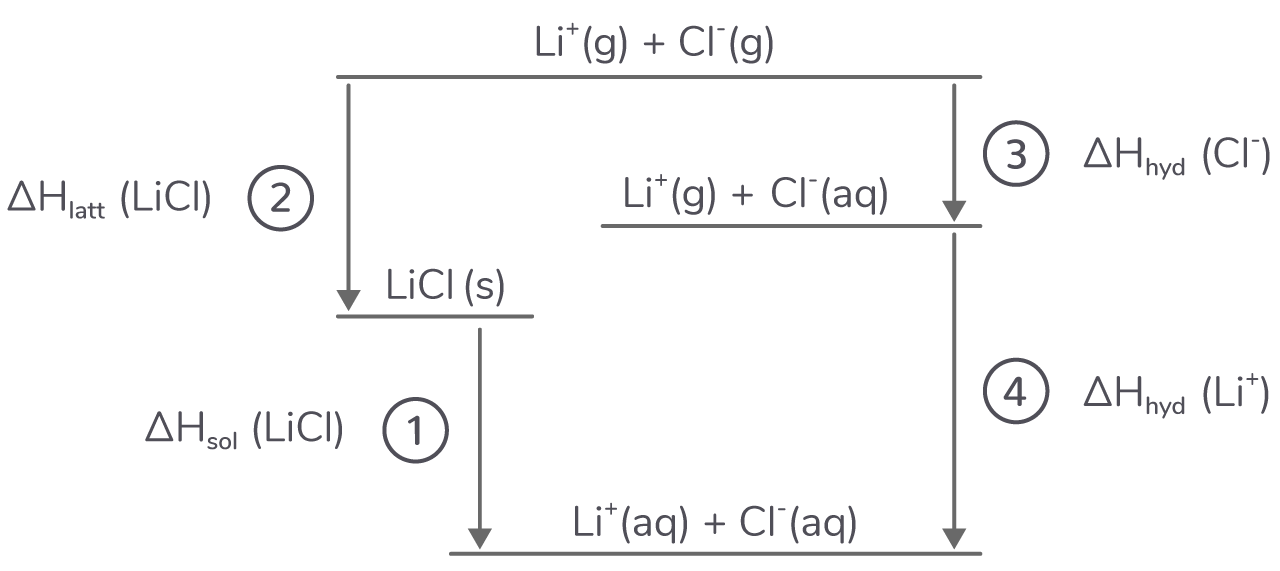
The diagram below is an incomplete Born-Haber cycle showing the enthalpy changes involved when lithium chloride, LiCl, dissolves in water.
On the two dotted lines, add the species present, including state symbols.
State the enthalpy changes represented by the four arrows labelled 1-4.
The table below shows some enthalpy data.
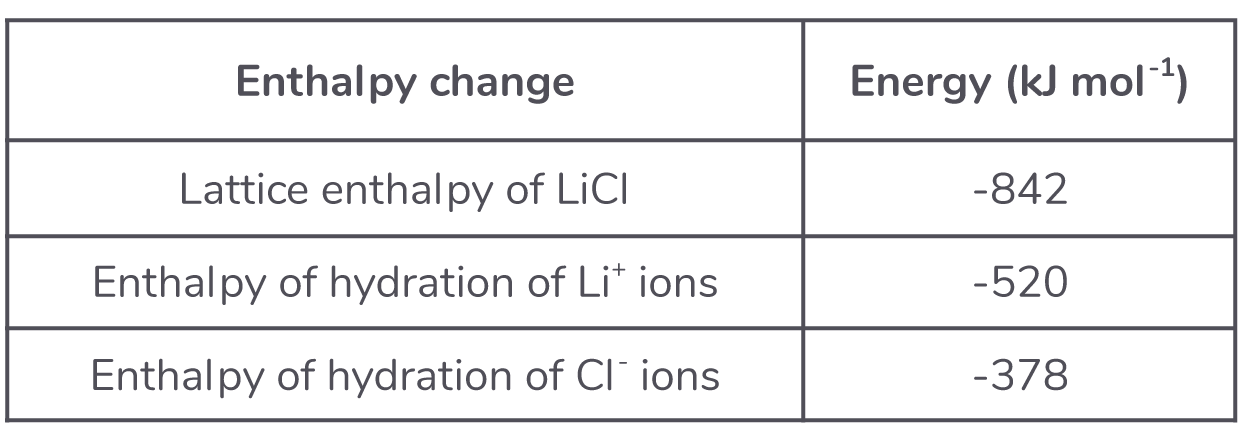
Use the tabulated data and the Born-Haber cycle from part b) to calculate the standard enthalpy of solution, ΔHsol, of lithium chloride.
Use your answer from part c) to predict whether lithium chloride is soluble in water.
Potassium forms an ionic compound with a group 7 halide, X-.
The enthalpy of lattice formation for this compound is -674 kJ mol-1 and its enthalpy of solution is +6 kJ mol-1.
The hydration enthalpies for potassium and other halide ions are shown in the table below.
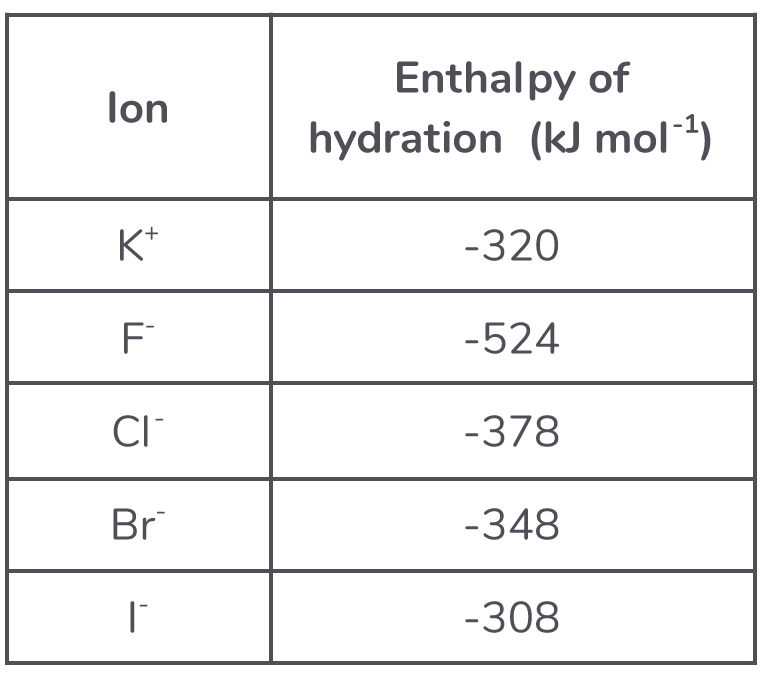
Identify the halide ion, X-.
Bromine forms an ionic lattice with another group 1 ion. The new ionic compound has an enthalpy of lattice formation of -733 kJ mol-1.
Suggest a formula for the new ionic lattice. Explain your answer.