Reactions of Transition Metal Elements - exam practice
Reactions of Transition Metal Elements
Question 1 of 12
A blue solid was given to a student who suggested, from its colour only, that it was copper(II) sulfate. Another student suggested that it was copper(II) hydroxide, which is also blue. The students proposed some tests to distinguish between these two blue solids.
Give the expected observations for copper(II) sulfate and copper(II) hydroxide.
A flame test was carried out on the blue solid, but the flame colour observed was not that expected for a blue solid containing copper(II) ions.
Therefore another student suggested that the blue solid could be anhydrous cobalt(II) chloride, which can easily be distinguished from copper(II) compounds by the addition of deionised water.
State the expected observation for the addition of deionised water to anhydrous cobalt(II) chloride.
Give the formula of the complex ion formed.
Cobalt(II) chloride can be distinguished from copper(II) sulfate and copper(II) hydroxide by testing for the anion. Describe a suitable test for the chloride ion, including the positive result.
A compound of a d-block element is dissolved in water to form a solution X.
A series of tests is carried out on separate 1 cm3 portions of solution X.
Complete the table.
Sulfur dioxide is passed through a sample of solution X. A redox reaction occurs in which the sulfur dioxide forms sulfate ions.
The solution Y which forms is no longer yellow-brown.
Excess dilute aqueous ammonia was added to a 1 cm3 solution of Y in a test tube. A precipitate is observed.
State the colour and formula of the precipitate.
State the formula of the cation in solution Y.
The mixture from part b) was left to stand for a few minutes. The surface of the precipitate turned brown.
State the formuala of the brown compound.
Complete the ionic equation for the reaction between the cation in solution X and sulfur dioxide to form solution Y.
State symbols are not required.
.......... + SO2 + 2H2O ➔ .......... + SO42- + ..........
This question is about catalytic converters in car exhaust systems.
When petrol is burnt in a car engine, pollutant gases including carbon monoxide and nitrogen monoxide are formed.
Write the equation for the reaction between these two polluting gases that takes place on the surface of a catalytic converter. State symbols are not required.
Describe the stages by which the reaction in part a) occurs in a catalytic converter.
State why a heterogeneous catalyst is suitable for a reaction in the gas phase.
Vanadium(V) oxide, V2O5, acts as a catalyst in the oxidation of sulfur dioxide in the Contact process.
Give two equations to describe how V2O5 acts as a catalyst in this process.
Explain why V2O5 can be described as a catalyst in this reaction.
Fe2+(aq) ions catalyse the reaction between iodide and peroxodisulfate ions:
S2O82-(aq) + 2I-(aq) ➔ 2SO42-(aq) + I2(aq)
Explain what type of catalysis is occuring this reaction.
Give two equations to describe how Fe2+(aq) ions act as a catalyst in this reaction.
Iron catalyses the reaction of hydrogen and nitrogen to form ammonia in the Haber process:
N2(g) + 3H2(g) ➔ 2NH3(g)
Explain what type of catalysis is occuring in the Haber process.
Describe the stages in the catalytic production of ammonia by iron in the Haber process.
Some transition metals and their compounds act as catalysts. The catalysis can be classified as heterogeneous or homogeneous.
Complete the table below to indicate the type of catalysis in each reaction.
The oxidation of C2O42- ions by MnO4- ions in acidic solution is an example of a reaction that is autocatalysed.
State the meaning of the term autocatalysed.
Write 2 equations to show how the autocatalyst, Mn2+, is involved in this oxidation of C2O42- ions.
When NH3(aq) is added to Cu2+(aq), dropwise at first and then in excess, two chemical reactions occur as shown.

For each reaction:
- describe what you would see
- write an equation.
When complex ion B, [Cu(NH3)4(H2O)2]2+, reacts with 1,2-diaminoethane (en), the ammonia molecules but not the water molecules are replaced.
Write an equation for this reaction.
en = 1,2-diaminoethane.
Suggest why the enthalpy change for the reaction in part b) is approximately zero.
Explain why the reaction in part b) is spontaneous despite having an enthalpy change that is approximately zero.
The equation below represents the dissociation of [Fe(H2O)6]3+ ions in aqueous solution.
[Fe(H2O)6]3+(aq) ⇌ [Fe(H2O)5OH]2+(aq) + H+(aq)
The Ka for this dissociation is 6.00 × 10⁻³ mol dm-3
Calculate the pH of a 1.50 x 10⁻² mol dm-3 solution of [Fe(H2O)6]3+.
Give your answer to 2 decimal places.
The diagram below shows some reactions of iron ions in aqueous solution.
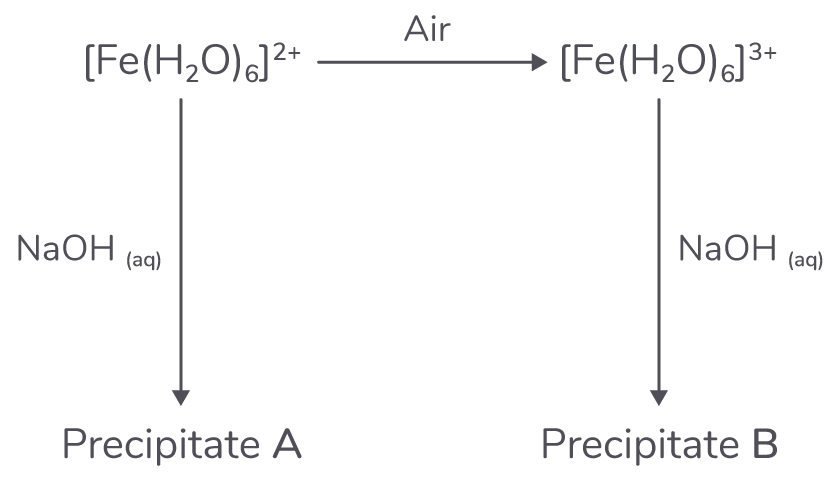
Give the formulae of A and B and state their colours.
The green precipitate A, Fe(OH)2, turned brown on standing in air.
Explain why.
When concentatd hydrochloric acid is added to aqueous Cu2+ ions, the following equilibirum is established.
[Cu(H2O)6]2+ + 4Cl- ⇌ [CuCl4]2- + 6H2O
State the colours of the [Cu(H2O)6]2+ and [CuCl4]2- complex ions.
Draw the shapes of the [Cu(H2O)6]2+ and [CuCl4]2- complex ions.
Give the name of the shape for each ion.
State the coordination numbers of the copper ion in [Cu(H2O)6]2+ and [CuCl4]2-.
Explain the change in coordination number in this equilibrium.
In aqueous solution, the [Cu(H2O)6]2+ ion reacts with an excess of ethane-1,2-diamine (en) to form the complex ion Z.
Write an equation for this reaction.
en = 1,2-diaminoethane
Explain, in terms of the chelate effect, why the complex ion Z is formed in preference to the [Cu(H2O)6]2+ complex ion.
Describe the reactions of [Cr(H2O)6]3+ complex ions with:
- aqueous sodium hydroxide
- excess aqueous ammonia
- hydrochloric acid In your answer you should link observations with ionic equations.
Describe the reactions of [Cu(H2O)6]2+ complex ions with:
- aqueous sodium hydroxide
- excess concentrated aqueous ammonia
- excess concentrated hydrochloric acid In your answer you should link observations with ionic equations.
Compound X is a green solid containing one cation and one anion. It dissolves in water to form a green solution.
Give the formula of two cations which could be responsible for the green colour in the solid.
A student adds dilute sodium hydroxide solution, drop by drop, to an aqueous solution of X.
A green precipitate forms, which dissolves in excess sodium hydroxide solution to form a dark green solution.
Give the formula of the cation in X.
Give a formula for the green precipitate.
Give a formula for the species present in the dark green solution.
The student adds a few drops of acidified potassium mangantate(VII) solution to another sample of a solution of X in a test tube.
State the colour change that occurs.
This question is about transition metal chemistry.
The amphoteric character of solid chromium(III) hydroxide is shown by the fact that it reacts separately with both dilute hydrochloric acid and dilute sodium hydroxide solution.
Write an ionic equation for the reaction of solid chromium(III) hydroxide with dilute hydrochloric acid, showing the formula of the complex ion formed.
Include state symbols in your answer.
Describe the changes you would see when the reaction in part a) is carried out.
Write an ionic equation for the reaction of solid chromium(III) hydroxide with dilute sodium hydroxide solution, showing the formula of the complex ion formed.
Include state symbols in your answer.
State the final appearance of the reaction mixture in part c).