Structure - exam practice
Structure
Question 1 of 5
This question is about elements in period 3 of the periodic table.
The table below shows some properties of magnesium, chlorine and magnesium chloride.
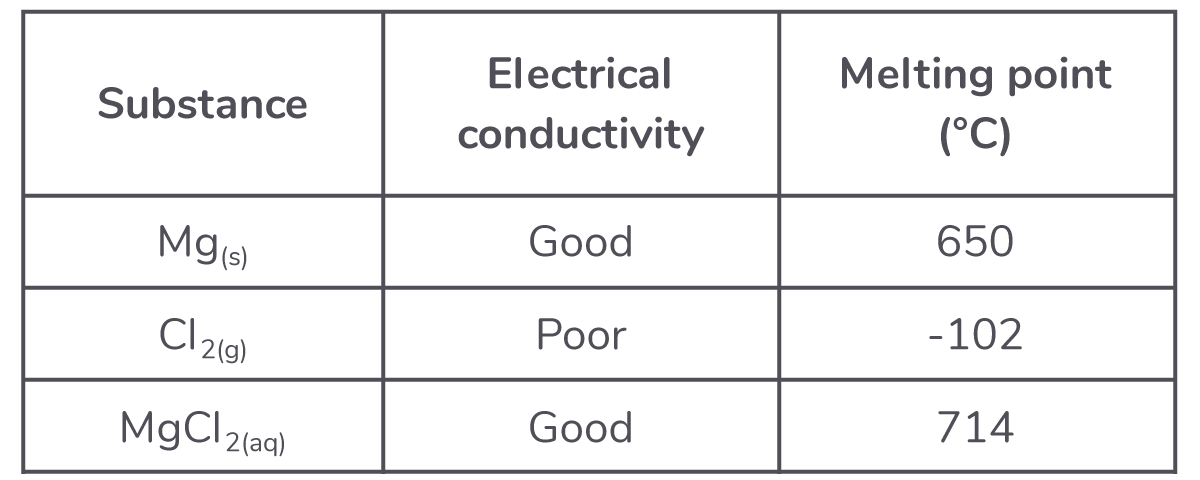
Use your knowledge of structure and bonding to explain the electrical conductivity and melting point of the three substances in the table above.
Graphene is an extremely strong and thin material used in electronics. It is an excellent conductor of electricity and it has a very high melting point.
Graphene is made from carbon atoms.
The diagram below shows part of the structure of graphene.
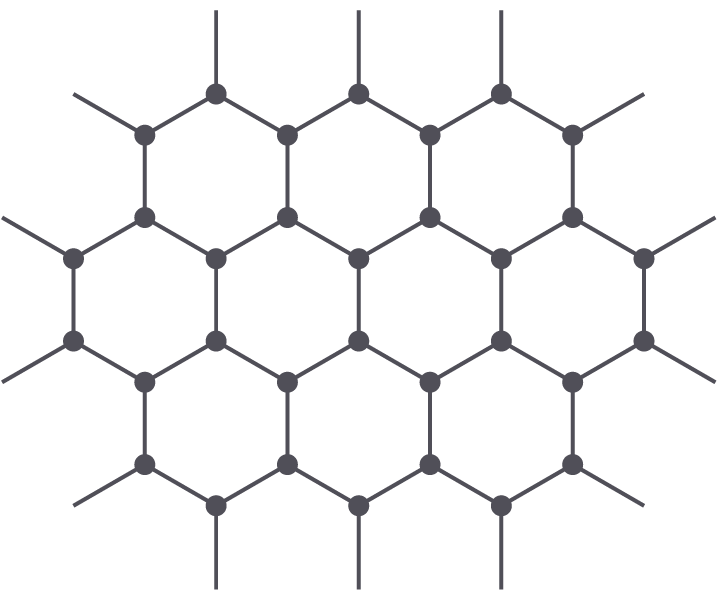
Deduce the type of crystal structure shown by graphene.
Explain why graphene is an excellent conductor of electricity.
Explain why graphene has a high melting point.
Carbon atoms can also bond to each other to produce a range of other structures, including graphite, diamond and nanotubes.
Describe two features of the structure and bonding in graphite that are similar to diamond.
Describe two features of the structure and bonding in graphite that are different to diamond.
Potassium and calcium are consecutive s-block metals.
Describe the bonding in metals.
Outline why metals can conduct electricity.
Suggest why calcium has a higher melting point than potassium.
Suggest two reasons why solid calcium has a greater density than solid potassium.
Element X is a metal.
Explain why element X is malleable whereas a crystal of sodium chloride is not.
Predict two other distinct physical properties that element X exhibits.
Explain your choices in terms of structure and bonding.
Element X is a first row transition element. An atom of element X contains six electrons in the 3d sub-shell.
Deduce the identity of element X.
The solubility of two compounds in different solvents was investigated.
A summary of the findings is shown.
| Compound | Soluble in water | Soluble in hexane |
|---|---|---|
| 2-methylpentane | x | ✓ |
| potassium bromide | ✓ | x |
Explain the findings of the investigation by considering the interactions between the compounds and each of the solvents.
Many properties of substances can be explained using structure and bonding.
Iodine, magneisum oxide, copper, diamond and ice are all crystalline solids.
Complete the table below with:
- the name of the type of bonding found in each crystalline solid,
- the type of lattice structure for each crystalline solid.