The Elements of Group 1 and 2 - exam practice
The Elements of Group 1 and 2
Question 1 of 15
Explain why magnesium nitrate, Mg(NO3)2 decomposes more readily on heating than potassium nitrate, KNO3.
Some metal carbonates also undergo thermal decomposition.
Draw a diagram of the apparatus that could be used to compare the ease of thermal decomposition of lithium carbonate, Li2CO3, and magnesium carbonate, MgCO3.
State one way in which you would ensure a fair test.
State how data obtained in this experiment could be used to make a comparison.
The elements in group 2 from Mg to Ba can be used to show the trends in properties down a group in the periodic table.
State and explain the trend in first ionisation energy for atoms of the elements down group 2 from Mg to Ba.
The group 2 elements react with water.
State the trend in reactivity with water of the elements down group 2 from Mg to Ba.
Write an equation for the reaction of calcium with water. State symbols are not required.
Give the formula of the hydroxide of the element in group 2 from Mg to Ba that is least soluble in water.
Describe the trend in the thermal stability of the group 2 nitrates down the group.
A sample of barium nitrate was heated strongly until no further change occurred. A white solid was formed.
Write an equation for the action of heat on barium nitrate.
When water was added to the white solid produced in part b), an alkaline solution was produced.
Identify the species responsible for making the solution alkaline.
Write an equation to explain this observation.
When sulfuric acid was added to the alkaline solution produced in part c), a white precipitate formed.
Identify the white precipitate.
Write an equation to explain this observation.
The trend in the first and second ionisation energies of group 2 elements can be linked to the increase in chemical reactivity down the group.
The table below shows the first and second ionisation energies of magneisum and calcium.
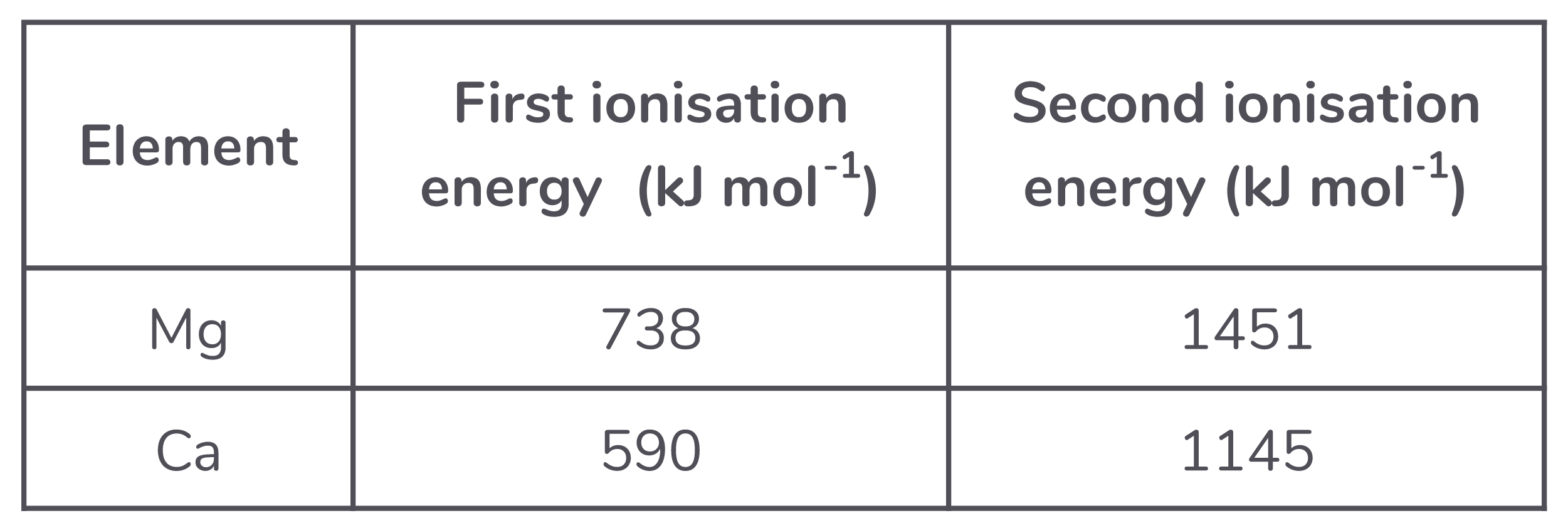
Write an equation, including state symbols, to represent the second ionsation energy of calcium.
Explain why the first ionisation energy of calcium is lower than the first ionisation energy of magnesium.
A chemist reacts a group 2 metal, M, with water and measures the volume of gas produced.
The digram below shows the apparatus used by the chemist.
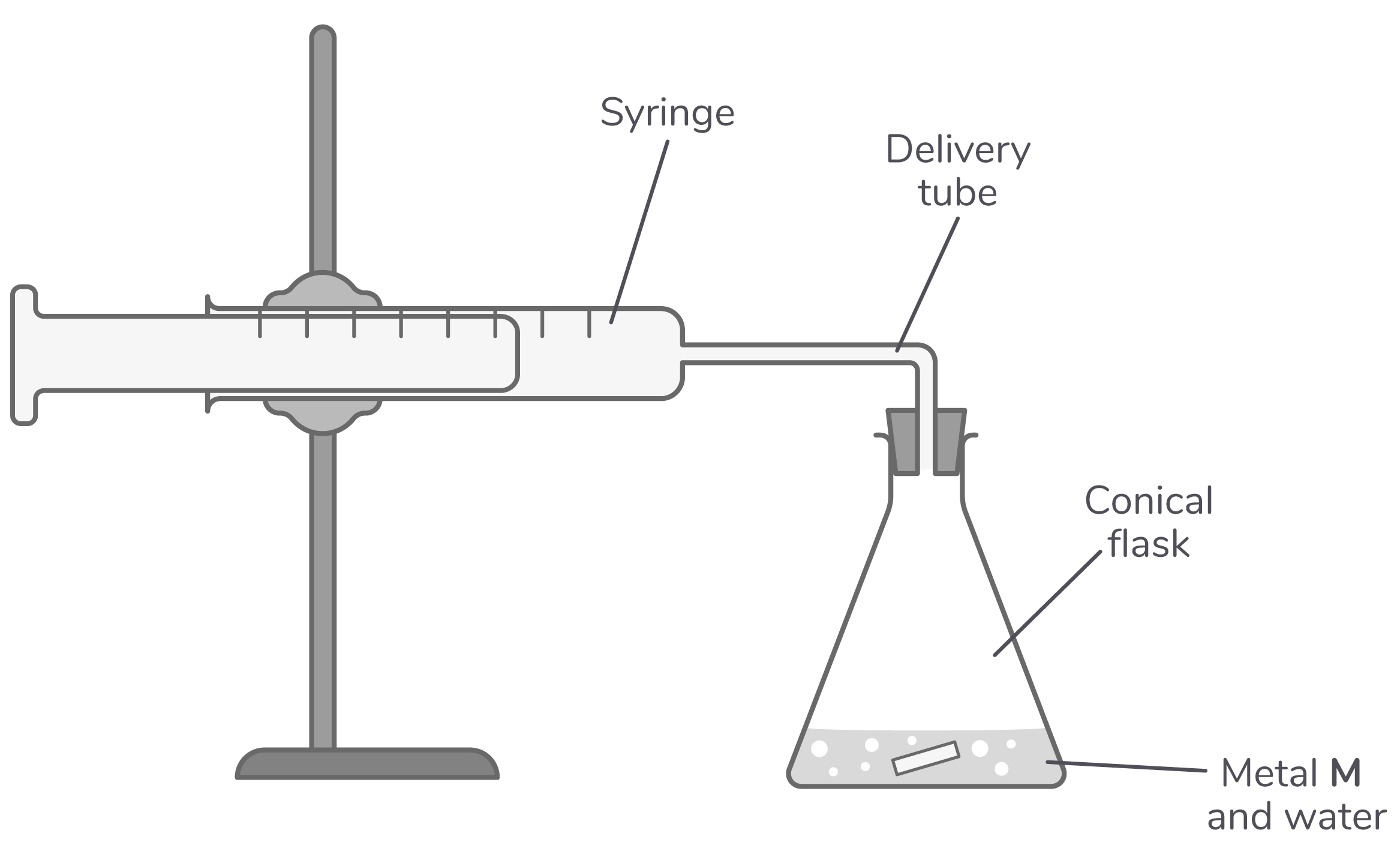
Write an equation for the reaction of M with water.
0.150 g of the metal produces 89.8 cm3 of hydrogen measured at room temperature and pressure.
Identify the group 2 metal, M.
The chemist plans to repeat the experiment using the same mass (0.150 g) of magnesium metal.
Predict whether the volume of hydrogen produced would be greater than, less than, or the same as, the volume in the first experiment.
Explain your answer.
This question is about group 2 elements and their oxides.
Magnesium burns in oxygen to form an ionic compound.
Write the electronic configuration of an atom of magnesium.
Explain why the following reaction is a redox process:
2Mg(s) + O2(g) ➔ 2MgO(s)
Identify the changes in oxidation number.
State and explain the trend in pH of the solution formed when the group 2 oxides are added to water.
Group 2 elements and their compounds have a range of uses.
From Mg(OH)2 to Ba(OH)2, the solubility in water:
From Mg to Ba, the outer shell electronic configuration:
From MgSO4 to BaSO4, the solubility in water:
Explain why beryllium has a higher melting point than magnesium.
P is a salt of a group 2 element M.
When P is heated a brown gas is released and a white solid remains.
The white solid dissolves in water to form a colourless solution of the metal hydroxide M(OH)2.
Addition of dilute sulfuric acid produces a white precipitate.
Identify the negative ion in salt P
Identify element M and write an ionic equation for the formation of the white precipitate with sulfuric acid.
Give the formula of salt P and use it to write an equation for the thermal decomposition of salt P.
Salt P can be formed in a neutralisation reaction between nitric acid and salt Q. This reaction produces a colourless gas that turns limewater cloudy.
Identify the negative ion in salt Q.
Give the formula of salt Q and use it to write an equation for the reaction of salt Q with nitric acid.
Strontium chloride is a component of toothpaste for sensitive teeth.
Write a balanced symbol equation, including state symbols, for the reaction between strontium and hydrochloric acid to form strontium chloride.
Explain, with the use of half equations, why this reaction is a redox process.
Describe and explain the trend in reactivity of group 2 elements with hydrochloric acid.
All of the group 2 carbonates can be decomposed upon heating.
Write an equation for the thermal decomposition of calcium carbonate.
The thermal stability of the group 2 carbonates changes down the group.
Describe and explain the trend in thermal stability of group 2 carbonates.
Calcium carbonate was heated in an open boiling tube.
Suggest two reasons why it was difficult to observe whether a thermal decomposition took place.
Which of the following ions has the strongest polarising power. Explain your answer.
- Na+
- Mg2+
- K+
- Ca2+
Which of the following ions is the most polarisable. Explain your answer.
- F-
- Cl-
- Br-
- I-
Which of the following ions has the smallest (least exothermic) enthalpy change of hydration. Explain your answer.
- Na+
- Mg2+
- K+
- Ca2+
Which of the following compounds has the largest (most exothermic) lattice energy. Explain your answer.
- MgO
- CaO
- KCl
- RbCl
This question is about the thermal stability of group 2 nitrates.
Write an equation, including state symbols, for the thermal decomposition of calcium nitrate.
The ionic radii of three ions are shown in the table below.
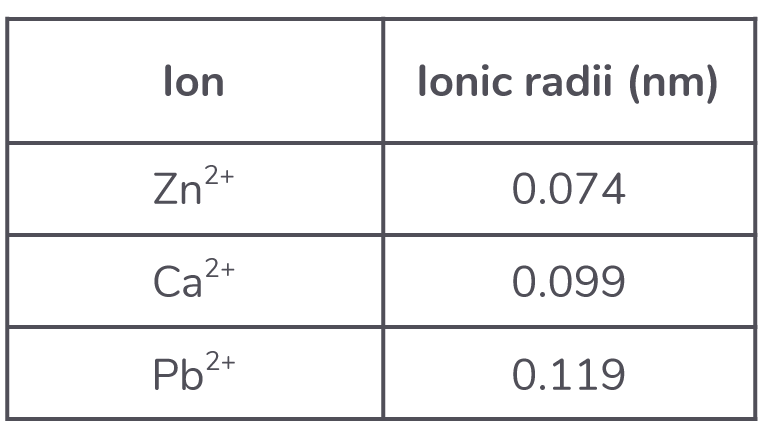
Suggest how the thermal stability of zinc nitrate might compare to that of calcium nitrate.
Explain your answer.
Suggest how the thermal stability of lead nitrate might compare to that of calcium nitrate.
Explain your answer.
Write an equation for the thermal decomposition of sodium nitrate, NaNO3. State symbols are not required.
Write an equation for the thermal decomposition of lithium carbonate, Li2CO3. State symbols are not required.
A chemist compares the rate of thermal decomposition of some group 1 and group 2 carbonates using the apparatus shown.
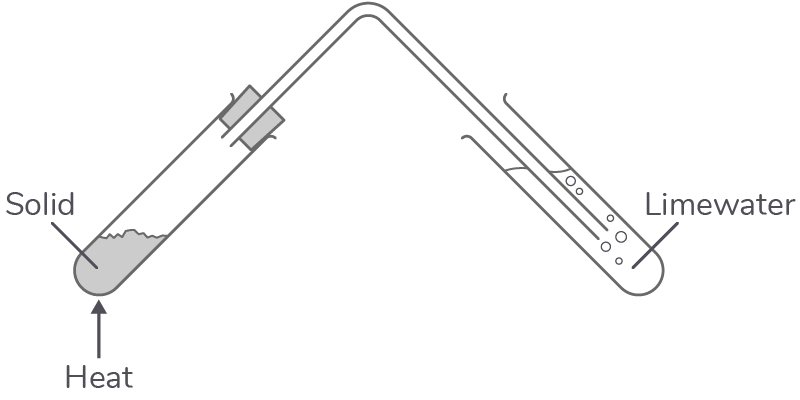
The chemist kept the temperature of heating approximately constant by using a Bunsen burner with the same setting.
The time taken for the limewater to go cloudy is shown in the table.
| Sample | Formula of carbonate | Time taken for limewater to turn cloudy (s) |
|---|---|---|
| A | CaCO_3_ | 40 |
| B | MgCO_3_ | 20 |
| C | K_2_CO_3_ | does not decompose |
| D | Li_2_CO_3_ | 35 |
Discuss how the chemist can use observations from the experiment, and knowledge of the cations present in the carbonates, to justify the relative rate of decomposition.
A solid, white, water-soluble compound was thought to be magnesium chloride.
A chemist carried out tests to confirm the identity of both ions present.
A flame test was carried out to test for the cation.
Describe how to carry out a flame test on an unknown solid.
Explain, with reference to electron transitions, the formation of the colour in a flame test.
Give a reason why the magnesium ion does not produce a flame colour.
Give a reason why the lack of a flame colour is not a positive test for the magnesium ion.
Give the formula of a reagent that would produce a white-coloured precipitate when added to an aqueous solution of magnesium chloride.
This question is about flame tests for group 1 and 2 metal ions.
State the colour of the flame produced by separate samples of potassium and strontium ions.
Give a reason why carrying out a flame test on a mixture of potassium chloride and strontium chloride does not clearly show that two different metal ions are present.
In the first state of the flame test, the nichrome wire is dipped into concentrated hydrochloric acid and then heated in a Bunsen flame.
In the second stage, this nichrome wire is dipped into fresh hydrochloric acid and then into the metal salt to be tested before being reheated in the Bunsen flame.
Give two reasons why the wire is made of nichrome and not iron.
Give a reason why the wire is dipped into acid and then heated in the first stage.
State why fresh concentrated hydrochloric acid is used in the second stage of the flame test.