Entropy - exam practice
Entropy
Question 1 of 7
At 298 K, carbon dioxide and hydrogen gases react to produce two liquids, as shown by the equation:
CO2(g) + 3H2(g) ➔ CH3OH(l) + H2O(l) ΔHø = -131 kJ mol-1
Standard entropies are shown in the tabe below.
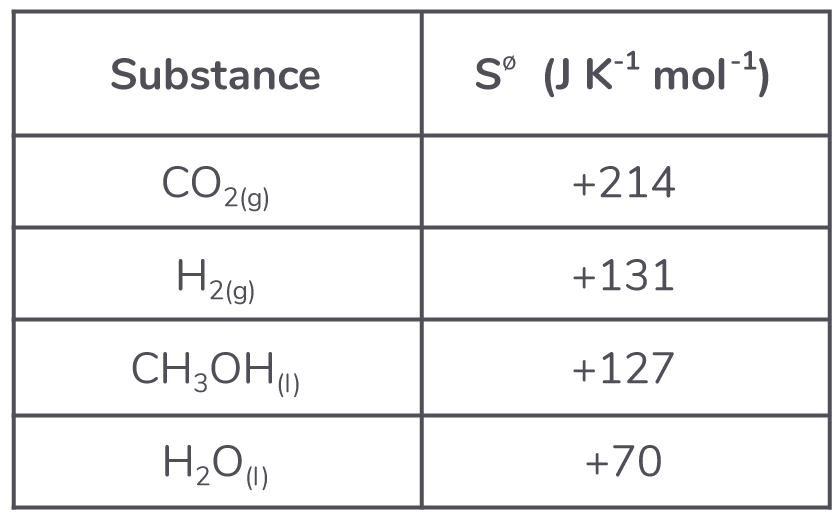
Calculate the standard entropy change, Sø, for this reaction.
Calculate the standard Gibbs free energy change, ΔGø, for this reaction at 298 K.
Give your answer in units of kJ mol-1 to 3 significant figures.
Predict the effect of decreasing the temperature on the feasibility of this reaction.
The feasibility of a chemical reaction depends on the standard Gibbs free energy change, ΔGø. This is related to the standard enthalpy and entropy changes by the equation:
ΔGø = ΔHø - TΔSø
Predict, with reasoning, whether the following processes will lead to an increase or decrease in entropy:
- solid potassium sulfate dissolving in water
- steam condensing to water
- the reaction of calcium carbonate with hydrochloric acid
Energy changes for the melting and boiling of H2O are shown below.
H2O(s) ➔ H2O(l) ΔHø = +6.01 kJ mol-1
H2O(l) ➔ H2O(g) ΔHø = +40.7 kJ mol-1
Explain why ΔHø is positive when water melts or boils.
Standard entropies of H2O in its three physical states are shown in the table below.
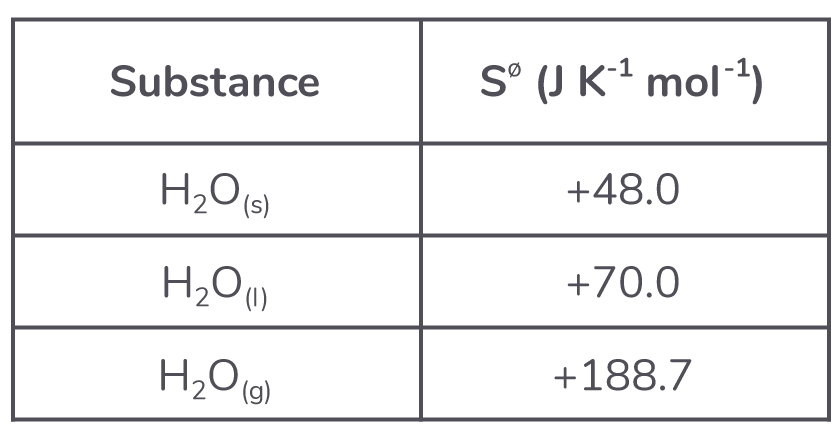
Explain why the increase in Sø is much greater when water boils than when water melts.
Use data in the table above to calculate the change in entropy, in kJ K-1 mol-1, when ice melts.
Use your answer to part d) to show that ice melts at 0°C (at standard pressure).
Hydrogen can be manufactured from the reaction of steam with methane.
CH4(g) + H2O(g) ⇌ 3H2(g) + CO(g) ΔHø = +206 kJ mol-1
The entropy change for the forward reaction, ΔSø, is +214.5 J K-1 mol-1.
Explain why the forward reaction has a positive ΔSø value.
The entropy values of some gases are shown in the table below.
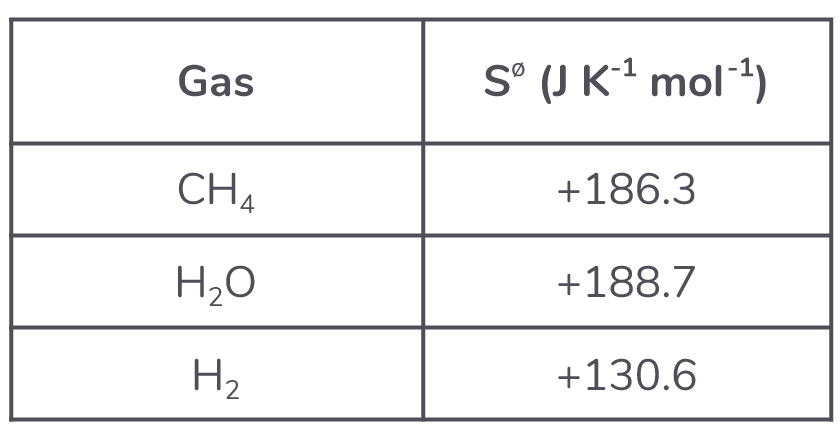
Using the value of ΔSø and the entropy values in the table, calculate the entropy of CO(g).
Give your answer to 1 decimal place.
Calculate whether the forward reaction is feasible at 700°C.
The temperature used for this manufacture of hydrogen is typically about 1,000°C.
Suggest one reason why a temperature of 1,000°C is used rather than 700°C.
The equation for the reaction between ammonia and oxygen is shown.
4NH3(g) + 5O2(g) ⇌ 4NO(g) + 6H2O(g)
The table below contains some enthalpy of formation and entropy data.
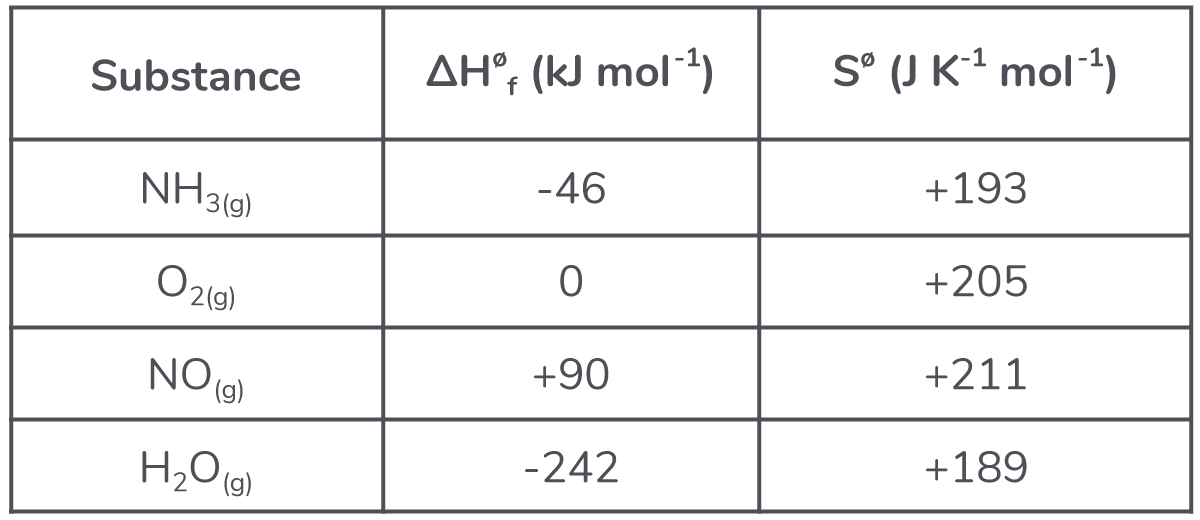
Use data in the table above to calculate the enthalpy change, ΔHr, for the reaction of ammonia with oxygen.
Use data in the table above to calculate the entropy change, ΔS, for the reaction of ammonia with oxygen.
Using your answers to parts a) and b), calculate a value for the Gibbs free energy change, ΔG, in kJ mol-1, for the reaction between ammonia and oxygen at 800 K.
Give your answer to the nearest integer.
Explain how the feasibility of the reaction between ammonia and oxygen changes as the temperature increases.
Methanol, CH3OH(l), is formed from the reaction of carbon monoxide, CO(g) and hydrogen, H2(g):
CO(g) + 2H2(g) ⇌ CH3OH(l) ΔH⦵ = 129 kJ
The equilibrium constant, K, has a value of 1.01 at 298 K.
Calculate ΔG⦵, in kJ mol-1, for this reaction. Give your answer to 3 significant figures.
R = 8.31 J K-1 mol-1.
Calculate a value for the entropy change, ΔS⦵, in J K-1 mol-1 at 298 K. Use your answer to part a).
Justify the sign of ΔS with reference to the equation.
Predict, giving a reason, how a change in temperature from 298 K to 263 K would affect the spontaneity of the reaction.
Under certain conditions, ethyne, C2H2(g) can be converted to benzene, C6H6(g).
3C2H2(g) ➔ C6H6(g)
Determine the standard enthalpy change, Hc⦵, for the reaction above, using the tabulated bond enthalpy data below.
| Bond | Bond enthalpy (kJ mol^-1^) |
|---|---|
| C≡C | 839 |
| C-C_benzene_ | 507 |
Predict, giving a reason, whether the standard entropy change, ΔS⦵, for this reaction is negative or positive.
Calculate the standard entropy change, in J K-1 mol-1, for this reaction using the tabulated entropy data below.
| Substance | Formula | S^⦵^ (J K^-1^ mol^-1^) |
|---|---|---|
| ethyne | C_2_H_2_ | +201 |
| benzene | C_6_H_6_ | +173 |
Calculate the standard Gibbs free energy change, ΔG⦵, in kJ, for the reaction at 25°C, using your answers to parts a) and c). Give your answer to 3 significant figures.
Determine, giving a reason for, the spontaneity of the reaction at 25°C.
Determine the maximum temperature, in K, at which the coversion of ethyne to benzene is spontaneous, using your answers to parts a) and c).
This reaction is used in the manufacture of sulfuric acid.
2SO2(g) + O2(g) ⇌ 2SO3(g)
Deduce the equilibrium constant expression, K, for this reaction.
At 700°C, the value of the equilibrium constant is 280.
Calculate the standard Gibbs free energy change, ΔG⦵, in kJ, for the reaction at 700°C. Give your answer to 3 significant figures.
R = 8.31 J K-1 mol-1
Predict, giving your reason, the sign of the standard entropy change of the forward reaction.
Predict, giving your reasons, whether the forward reaction is endothermic or exothermic. Use your answers to b) and c).
Calculate the standard entropy change, ΔS⦵, in kJ K-1, for the forward reaction at 700°C, using your answer to part b) and the tabulated enthalpy of formation data below. Give your answer to 3 significant figures.
| Substance | ΔH_f_^⦵^ (kJ mol^-1^) |
|---|---|
| SO_2(g)_ | -296.8 |
| SO_3(g)_ | -395.7 |