Amines, Amides, Amino Acids and Proteins - exam practice
Amines, Amides, Amino Acids and Proteins
Question 1 of 19
Amines can be prepared by the reaction of haloalkanes with ammonia.
Write an equation for the formation of butylamine, CH3CH2CH2CH2NH2, from ammonia and 1-bromobutane.
Name the mechanism for the reaction in part a).
Explain why butylamine is a stronger base than ammonia.
Draw the skeletal formula of a tertiary amine which is an isomer of butylamine.
This question is about propylamine.
Draw the structure of a nitrile compound which can be reduced to form propylamine.
Suggest a suitable reagent for the reduction of a nitrile compound to form an amine.
Isomers of propylamine include a primary, a secondary, and a tertiary amine.
Draw the structures of each of these three isomers.
Propylamine reacts with ethanoyl chloride to form an amide.
Outline a mechanism for this reaction.
Name the amide formed in the reaction in part d).
The diagram below shows the amino acids leucine, proline and glutamic acid.
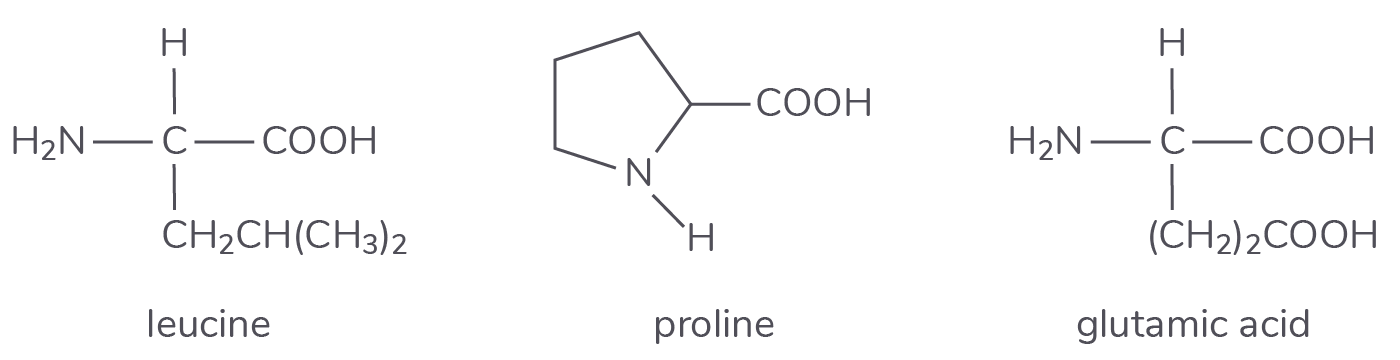
Give the IUPAC name of leucine.
Draw the zwitterion of proline.
Draw the structure of the product formed when glutamic acid is dissolved in an acidic solution.
Draw the structure of the tripeptide leucine-proline-leucine, formed from one molecule of proline and two molecules of leucine.
The diagram below shows the structure of the amino acid aspartic acid.
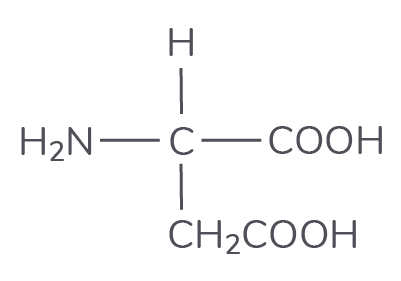
Draw the structure of the product formed when aspartic acid is reacted with HCl.
Draw the structure of the product formed when aspartic acid is reacted with excess CH3OH and H2SO4.
Aspartic acid has an isoelectric point of 2.77.
What is meant by the term isoelectric point?
Draw the structure of aspartic acid when it is dissolved in a solution with a pH greater than its isoelectric point.
Draw the structure of aspartic acid when it is dissolved in a solution with a high pH.
Name the compound with the structural formula (CH3)2NH.
(CH3)2NH can be formed by reacting CH3Br with an excess of CH3NH2.
Outline a mechanism for this reaction.
Draw the structure of the product formed if a large excess of CH3Br is reacted with CH3NH2.
Phenylamine can be prepared by the reduction of nitrobenzene.
Write an equation for the reduction of nitrobenzene to form phenylamine. Use [H] to represent the reducing agent.
Give a suitable reducing agent for the reduction of nitrobenzene.
The diagram below shows the structures of phenylamine and phenylethylamine.
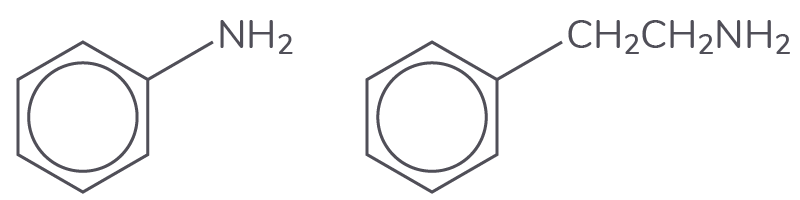
State and explain which of the two amines will be the stronger base.
Amines can be prepared from halogenoalkanes.
Outline a mechanism for the reaction of NH3 with 1-bromohexane to form an amine.
Name the mechanism for the reaction in part a).
Draw the structures of a secondary amine and a tertiary amine that could form in the reaction in part a) if 1-bromohexane is in excess.
Primary amines can also be formed from the reduction of nitriles.
Use your answer to part c) to suggest why reduction might be the preferred method for the formation of primary amines.
This question is about amines and amides.
Explain why ethylamine is basic.
Explain why phenylamine is less basic than ethylamine.
Ethylamine can react with CH3CH2COCl to form an amide.
Write an equation for the reaction.
Name the amide formed in part d).
The diagram below shows the structure of the amino acid alanine.
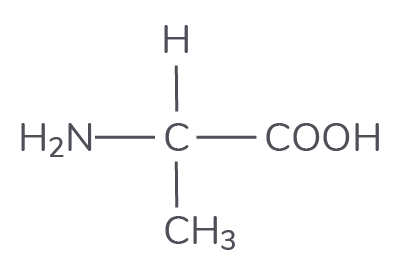
Outline the mechanism for the formation of alanine from CH3CHClCOOH and ammonia.
Draw the structure of the zwitterion formed by alanine.
Draw the structure of the product formed when alanine reacts with CH3OH in the presence of concentrated H2SO4.
This question is about amine X with the empirical formula C3H9N.
Isomers of amine X include a primary, a secondary, and a tertiary amine.
Draw the structures of each of these three isomers.
Propan-1-amine is formed from the reaction between ammonia and a bromoalkane.
Write an equation for this reaction.
Name the type of reaction occuring in part b).
Draw the structure of the product formed in the reaction below.
State the reagent(s) needed for the reaction shown below.
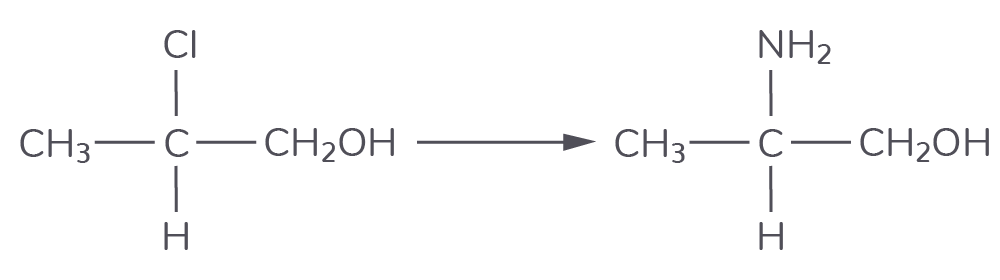
Phenylamine, C6H5NH2, is an aromatic amine and butylamine, C4H9NH2, is an aliphatic amine.
Phenylamine can be prepared from nitrobenzene.
Butylamine can be prepared from butanenitrile.
Compare and contrast these two preparations of amines.
Polyamides are produced by the reaction of dicarboxylic acids with diamines.
Draw the repeat unit that would form between the two compounds HOOC-(CH2)2-COOH and H2N-(CH2)2-NH2.
Draw the structure of the compound 2-aminobutanoic acid.
Draw the product formed by the condensation polymerisation of two molecules of 2-aminobutanoic acid.
Name the small molecule that is also formed during the condensation polymerisation in part c).
The diagram below shows the repeat unit of a polyester.
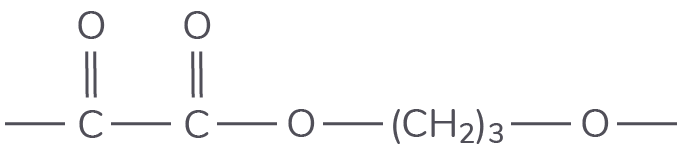
Draw the structure of the acid which could be used to prepare this polyester.
Draw the structure of the alcohol which could be used to prepare this polyester.
Which of the following compounds can form a polymer without requiring a second reagent?
The diagram below shows the repeat unit of the condensation polymer Terylene.
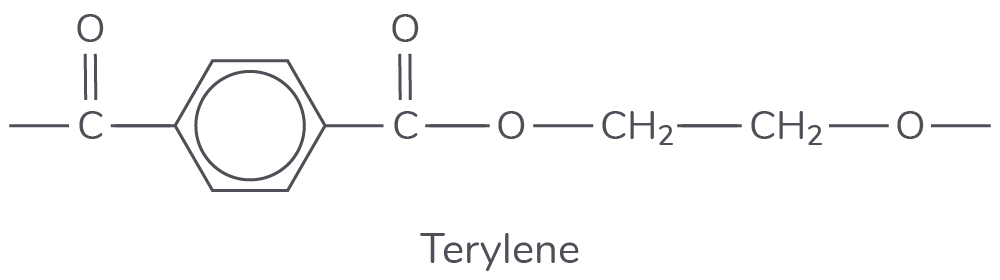
Explain what is meant by the term condensation polymer.
Draw the skeletal formulae of the two monomers that can react together to form Terylene.
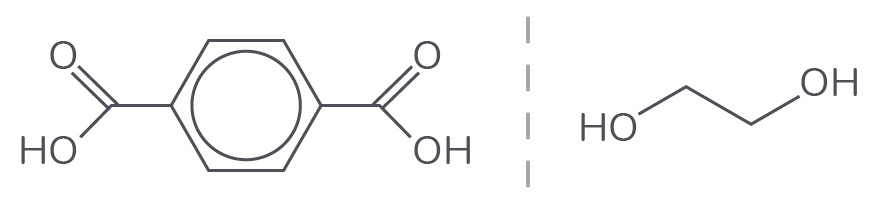
Give one advantage and one disadvantage of recycling objects made from Terylene.
Nylon-6,6 is a polymer made from the monomers hexane-1,6-diamine and hexanedioic acid.
Draw the structures of hexane-1,6-diamine and hexanedioic acid.
Draw the structure of the repeat unit of nylon-6,6.
Give two ways in which chemists contribute to a more sustainable use of such polymers as nylon-6,6.
Wool is a natural polymer. Part of the structure of a wool polymer is shown in the diagram below.
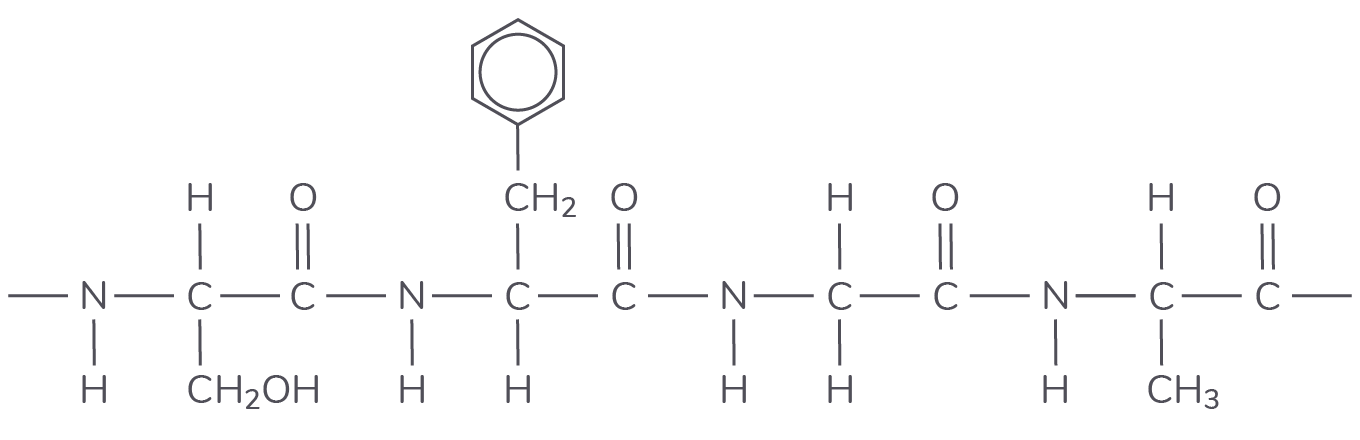
How many monomers make up this section of the wool polymer?
Amino acids can bond together to form polymers. The diagram below shows the repeat unit of poly(glutamic acid).
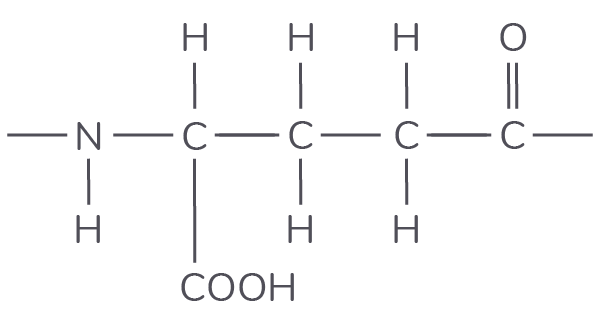
Draw the structure of glutamic acid.
The diagram below shows the amino acid proline.
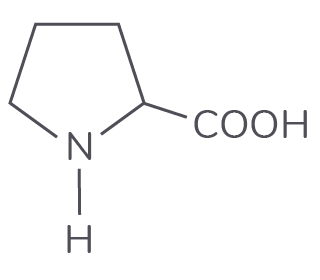
Draw the repeat unit of poly(proline).
Name the additional product formed in the polymerisation of proline.
Name the type of linkage formed between two amino acids in condensation polymerisation.
The polymer Kevlar is formed from two monomers, a diamine and benzene-1,4-dicarboxylic acid. The structure of the diamine is shown below.
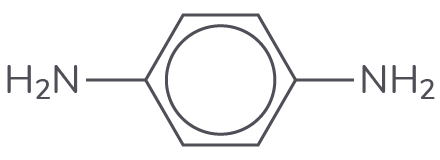
Draw the repeat unit of Kevlar.
Name the strongest type of intermolecular force that exists between chains of Kevlar.
The diagram below shows the structures of glycolic acid and lactic acid.
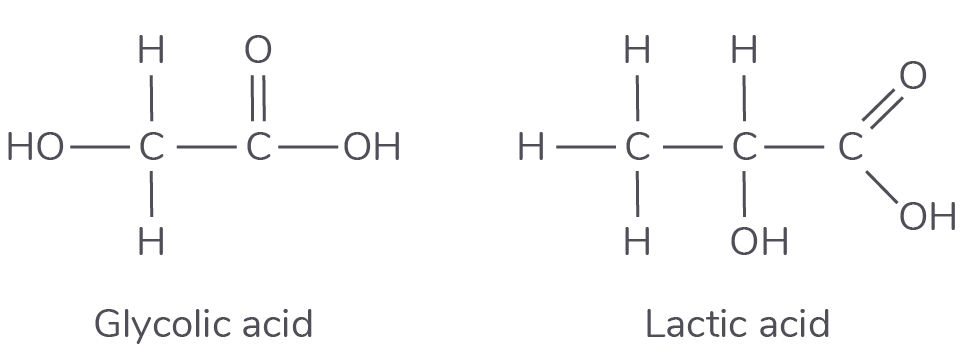
Draw one repeat unit of the polymer that can form between lactic acid and glycolic acid.
Name the type of polymerisation occurring in part a).
Which of the following structures shows the repeat unit of a polyamide?
The diagram below shows the repeat unit of a polyester.

Draw the skeletal formula of the product formed when the polyester is hydrolysed with aqueous acid.
Nylon-4,6 is a polyamide that can be prepared from 1,4-diaminobutane, NH2(CH2)4NH2, and hexanedioic acid, HOOC(CH2)4COOH.
Draw the skeletal formulae of these two monomers.
Draw the skeletal formula of the repeat unit of nylon-4,6.
The diagram below shows the repeat unit of a condensation polymer.
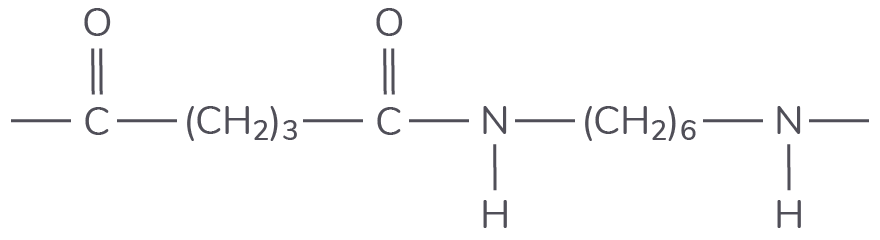
Which monomer, or pair of monomers, could be used to prepare this polymer?