Analysis of Inorganic Compounds - exam practice
Analysis of Inorganic Compounds
Question 1 of 8
Solution Z contains three different negative ions.
To a sample of solution Z a pupil adds
- excess dilute nitric acid
- barium nitrate solution The observations after each addition are recorded in the table below.
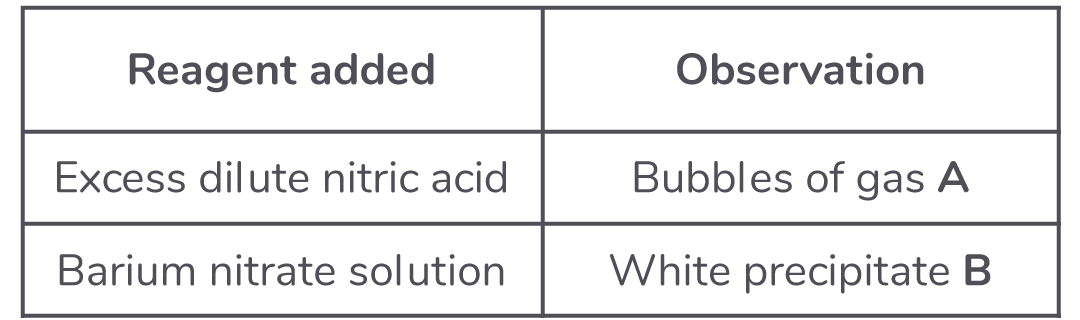
Give the formulas of A and B.
Suggest the identity of two of the negative ions.
The white precipitate B is removed from the solution by filtration.
To the filtrate the pupil adds
- silver nitrate solution
- excess concentrated ammonia solution Some of the observations are recorded in the table below.
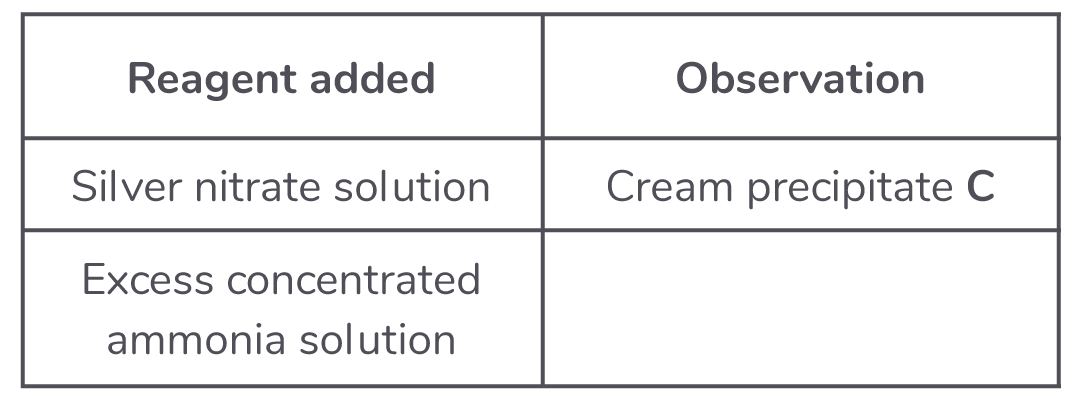
Give the formula of C.
Write an ionic equation, including state symbols, to show the formation of C.
Complete the table to show the expected observation upon addition of excess concentrated ammonia solution.
This question is about the identification of ions in unknown solutions.
A student completes a number of test-tube reactions on solutions A, B and C.
The table below shows the student's observations.
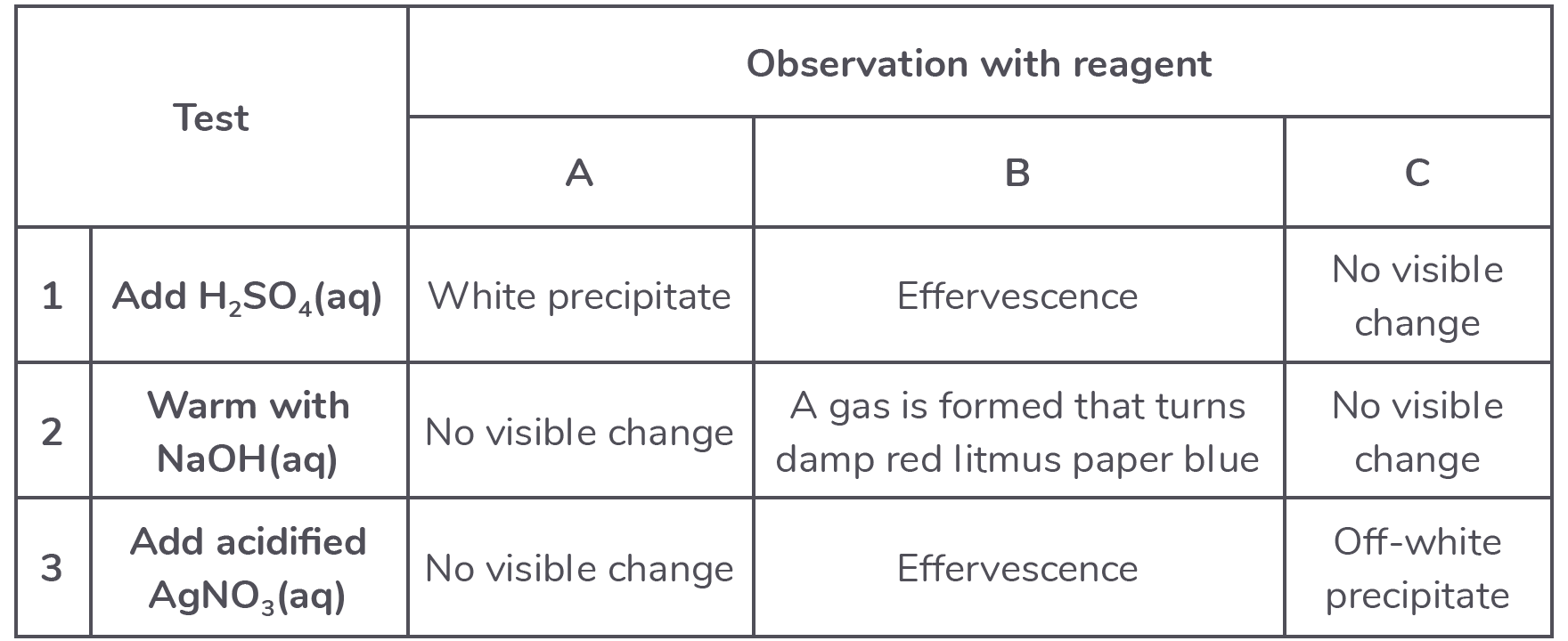
Suggest the identity of the positive ion in solution A.
Give the simplest ionic equation for the formation of the white precipitate in Test 1 for solution A.
Different gases are formed when solution B reacts in Test 1 and in Test 2.
Suggest the identity of each gas.
Give the simplest ionic equation for the formation of the gas in Test 2.
The student thinks that solution C contains either chloride ions or bromide ions.
Describe a further test to show whether solution C contains chloride or bromide ions.
Separate unlabelled solid samples of three anhydrous sodium compounds are provided for a student to identify.
These compounds are known to be sodium carbonate, sodium chloride and sodium fluoride but it is not known which sample is which.
Outline a logical sequence of test-tube reactions that the student could carry out to identify each of these compounds.
Include the observations the student would expect to make.
Give equations for any reactions that would take place.
The presence of the carbonate ion is usually confirmed using a simple test carried out in two stages at room temperature. Describe this test and its results.
Using barium carbonate as your example, write the equation for each of the stages of the carbonate test. Include state symbols in both equations.
Give a reagent that, when added separately to aqueous magnesium chloride and aqueous barium chloride, could be used to distinguish between them.
State what is observed in each case.
This question is about ion testing.
Give the reagent and the observation to show the presence of carbonate ions.
Give the reagent and the observation to show the presence of sulfate ions.
Give the reagent and the observation to show the presence of iodide ions.
Barium chloride solution and hydrochloric acid were added to separate aqueous solutions of ammonium sulfate and ammonium nitrate.
State what would be seen for each compound which would allow you to distinguish between them.
Give a test, with the expected result, to confirm the presence of the ammonium ion (NH4+) in the ammonium compounds.
Give a suitable reagent that could be added separately to AgBr(s) and AgI(s) to distiguish between them.
Describe what you would observe in each case.
A student investigated the chemistry of the halogens and the halide ions.
In the first two tests, the student made the following observations.
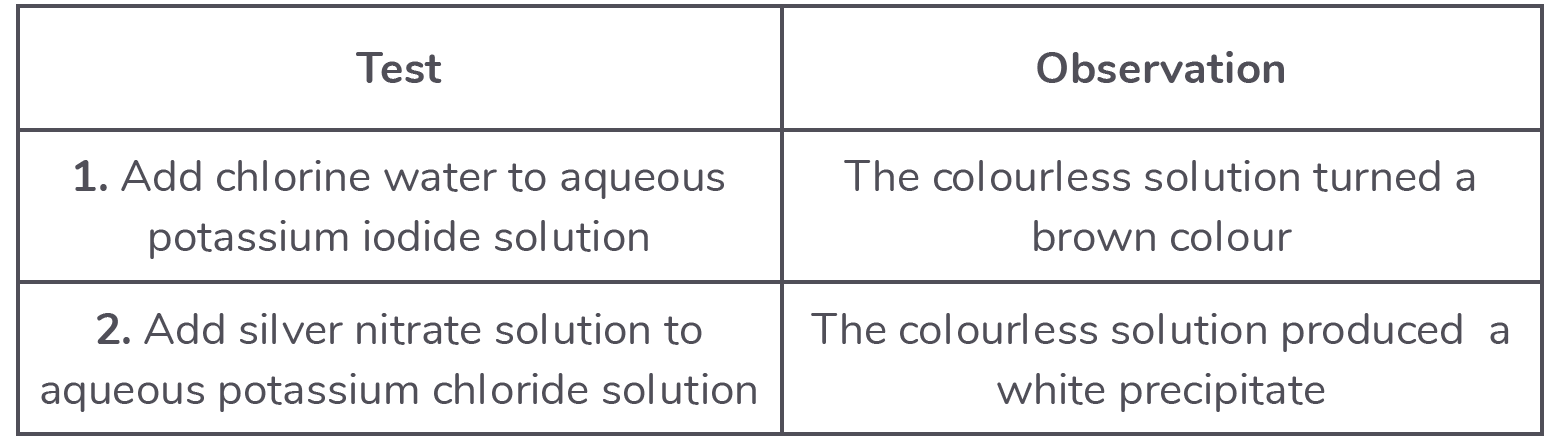
Identify the species responsible for the brown colour in Test 1.
Write an ionic equation for the reaction that has taken place in Test 1.
State the type of reaction that has taken place in Test 1.
Name the species responsible for the white precipitate in Test 2.
Write an ionic equation for the reaction that has taken place in Test 2.
State what would be observed when an excess of dilute ammonia solution is added to the white precipitate obtained in Test 2.
In two further tests, the student made the following observations.
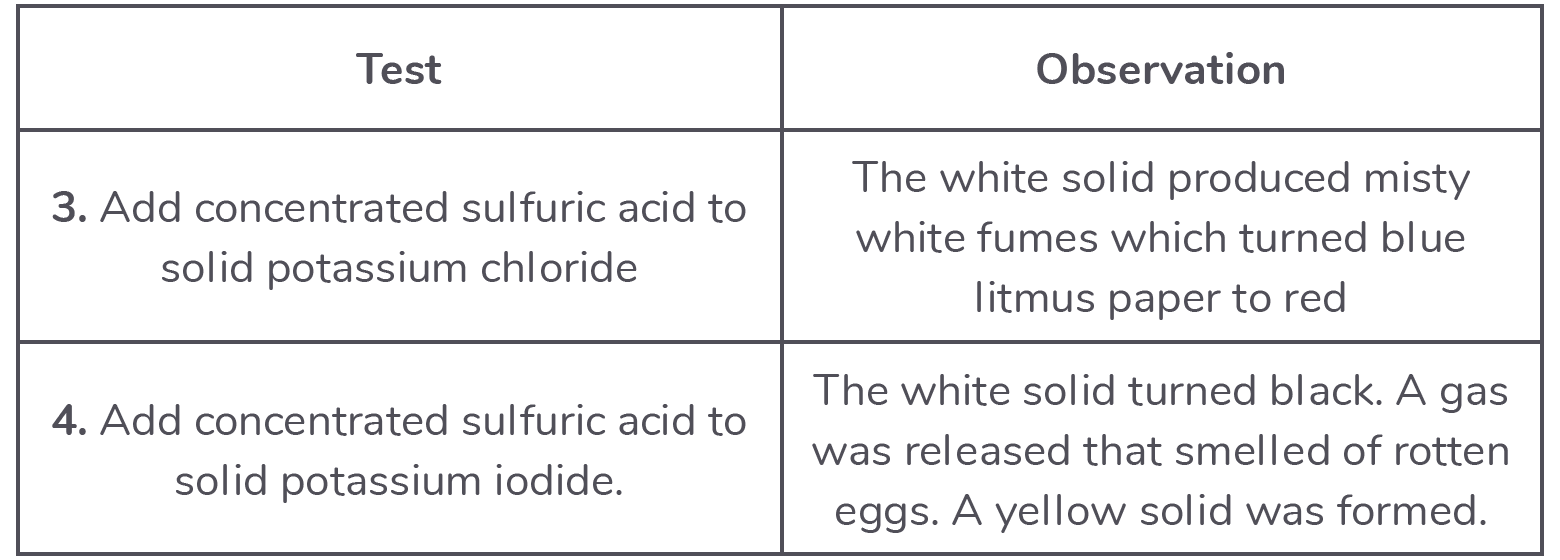
Write the simplest ionic equation for the reaction that has taken place in Test 3.
Identify the species responsible for the misty white fumes produced in Test 3.
The student had read in a textbook that the equation for one of the reactions in Test 4 is as follows.
8H+ + 8I- + H2SO4 ➔ 4I2 + H2S + 4H2O
Write the two half-equations for this reaction.
State the role of the sulfuric acid and identify the yellow solid that is also observed in Test 4.
A student carries out test-tube experiments to prove the trend in reactivity of halogens.
The student is provided with the following solutions:
- bromine water
- aqueous iodine
- aqueous barium chloride
- aqueous magnesium bromide
- aqueous calcium iodide. Chlorine gas and chlorine water are not available.
The student carries out the minimum number of test-tube experiments using these aqueous solutions.
- State the solutions that need to be added together in order to prove the trend in reactivity of the halogens, using the minimum number of test-tube experiments.
- Describe the colour seen at the end of each test-tube experiment.
- Write an ionic equation for one reaction that takes place.
You are supplied with a sample of ammonium bromide.
Describe simple tests that would identify the cation and anion present in ammonium bromide.
Include reagents, expected observations and relevant equations.
A student was provided with aqueous solutions of four compounds:
- hydrochloric acid
- potassium carbonate
- silver nitrate
- sodium chloride Four bottles, labelled A, B, C and D, each contained one of the solutions.
The student mixed pairs of the solutions to determine which was in each bottle.
The results are shown.
| Solutions mixed | Observations |
|---|---|
| A and B | A white precipitate formed which did not dissolve on the addition of dilute nitric acid |
| A and C | A precipitate formed dissolved with effervescence on the addition of dilute nitric acid |
| A and D | A white precipitate formed which did not dissolve on the addition of dilute nitric acid |
| B and C | Effervescence with bubbles of a colourless gas given off |
| B and D | No change |
| C and D | No change |
Using the observations in the table, deduce the identity of the compound in each bottle.
To identify the cations in sodium chloride and potassium carbonate, a student carried out flame tests using the following method.
Step 1: A sample of solid sodium chloride was placed on a watch glass and a few drops of concentrated nitric acid were added. The solid and acid were mixed to form a paste.
Step 2: A length of copper wire was dipped into the paste.
Step 3: A Bunsen burner was set up with the air-hole closed. The copper wire containing the paste was placed into the Bunsen burner flame and the colour observed.
Step 4: The procedure was repeated using solid potassium carbonate.
For each of the Steps 1, 2 and 3 give an improvement in the procedure explaining why the change is necessary.