Mass Spectrometry - exam practice
Mass Spectrometry
Question 1 of 3
The accurate relative atomic masses of four elements are shown in the table.
| Element | A_r_ |
|---|---|
| H | 1.0078 |
| C | 12.0000 |
| N | 14.0031 |
| O | 15.9949 |
The high resolution mass spectrum of a compound has a molecular ion peak with m/z = 88.0998.
Which of the following could be the molecular formula of the compound?
Explain why low resolution mass spectrometry would not allow you to distinguish between the options given in part a).
A sample of an unknown saturated hydrocarbon is injected into a high resolution mass spectrometer. It produces a molecular ion peak at m/z = 72.0936.
Draw a possible structure for and name the unknown hydrocarbon.
The diagram below shows the mass spectrum of 1-iodopentane.
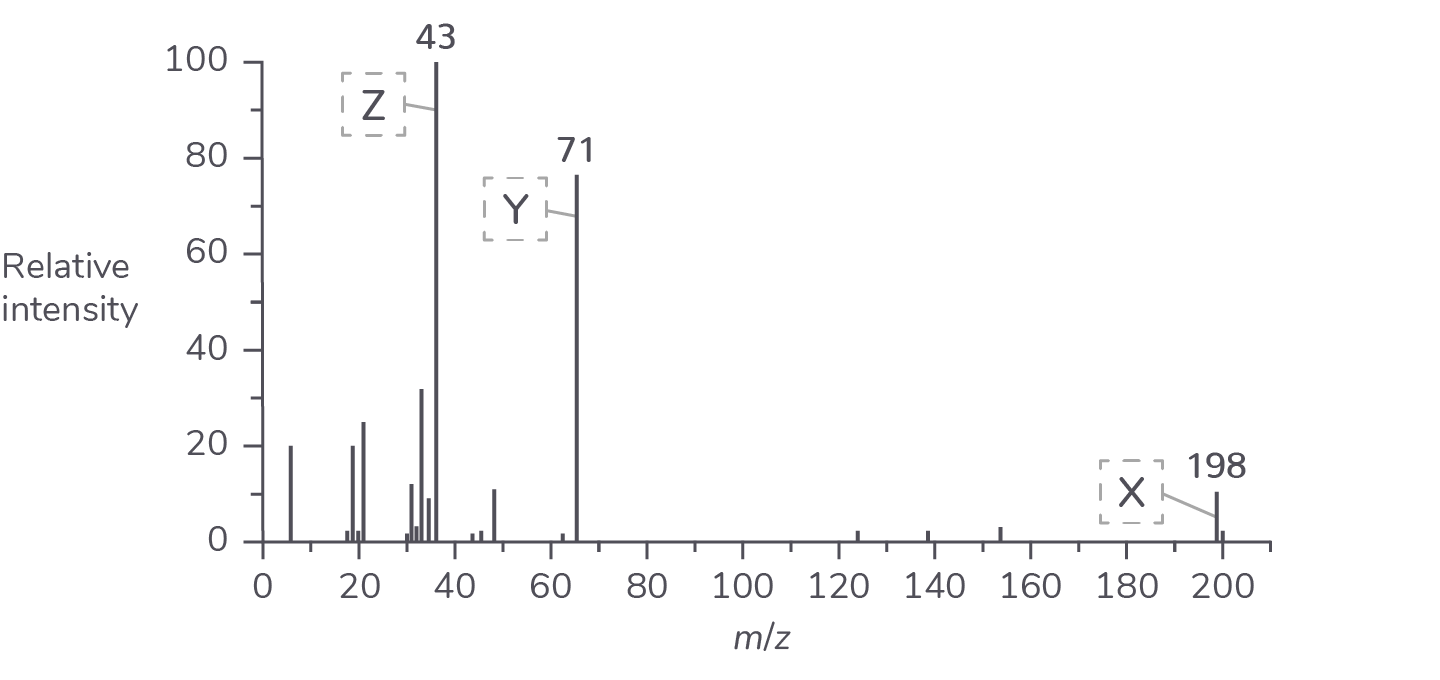
What information can be determined by the peak labelled X at m/z = 198?
Write the structural formulae of the ions responsible for the peaks labelled Y and Z.
The compound shown in the diagram below is an isomer of 1-iodopentane.
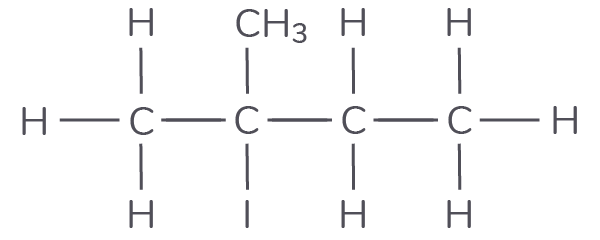
Name this compound.
Give one similarity and one difference between the mass spectra of 1-iodopentane and its isomer shown in part c).
Compound V is an E stereoisomer and has the following percentage composition by mass: C 68.6%; H 8.6%; O 22.8%. The infrared and mass spectra of compound V are shown in the diagrams below.
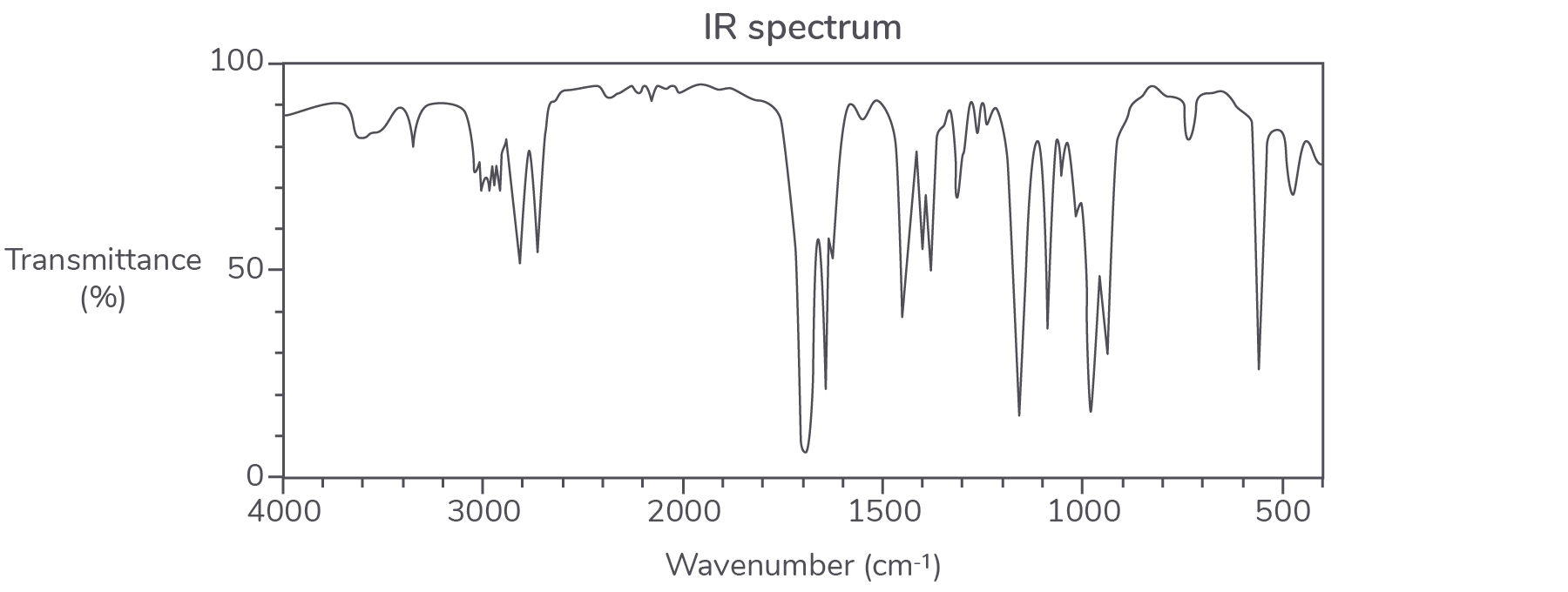
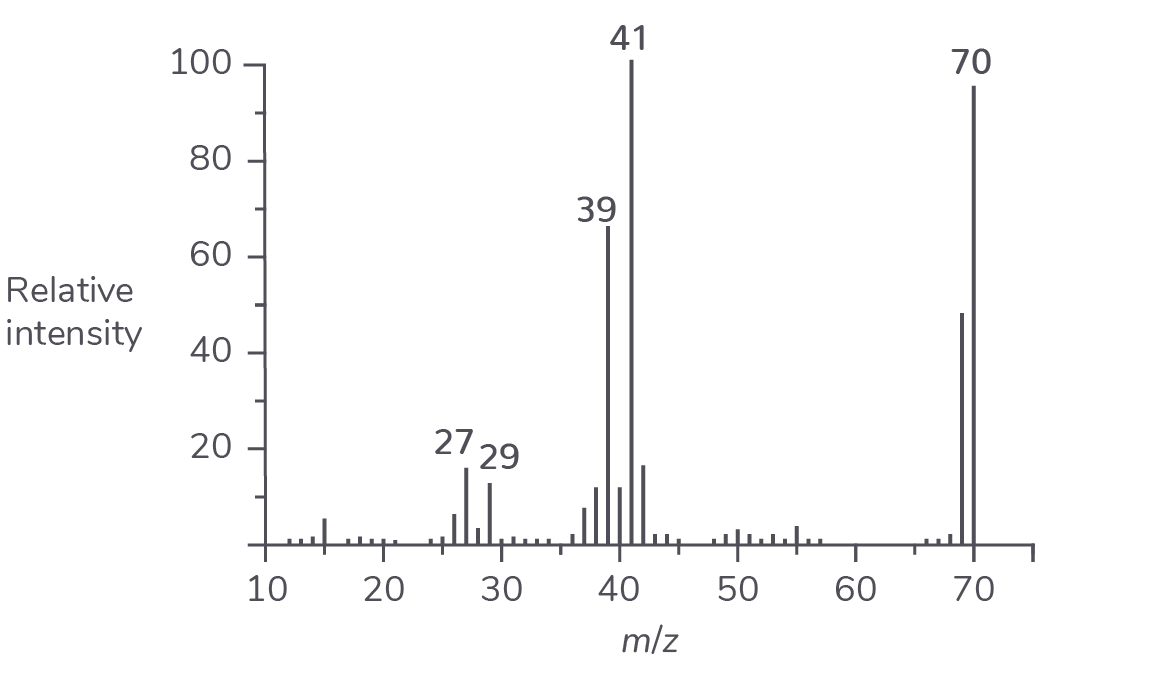
The peak with the greatest relative intensity (m/z = 41) in the mass spectrum is caused by the loss of a functional group from the molecular ion.
Determine the structure of compound V.
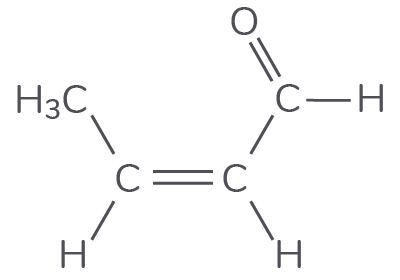
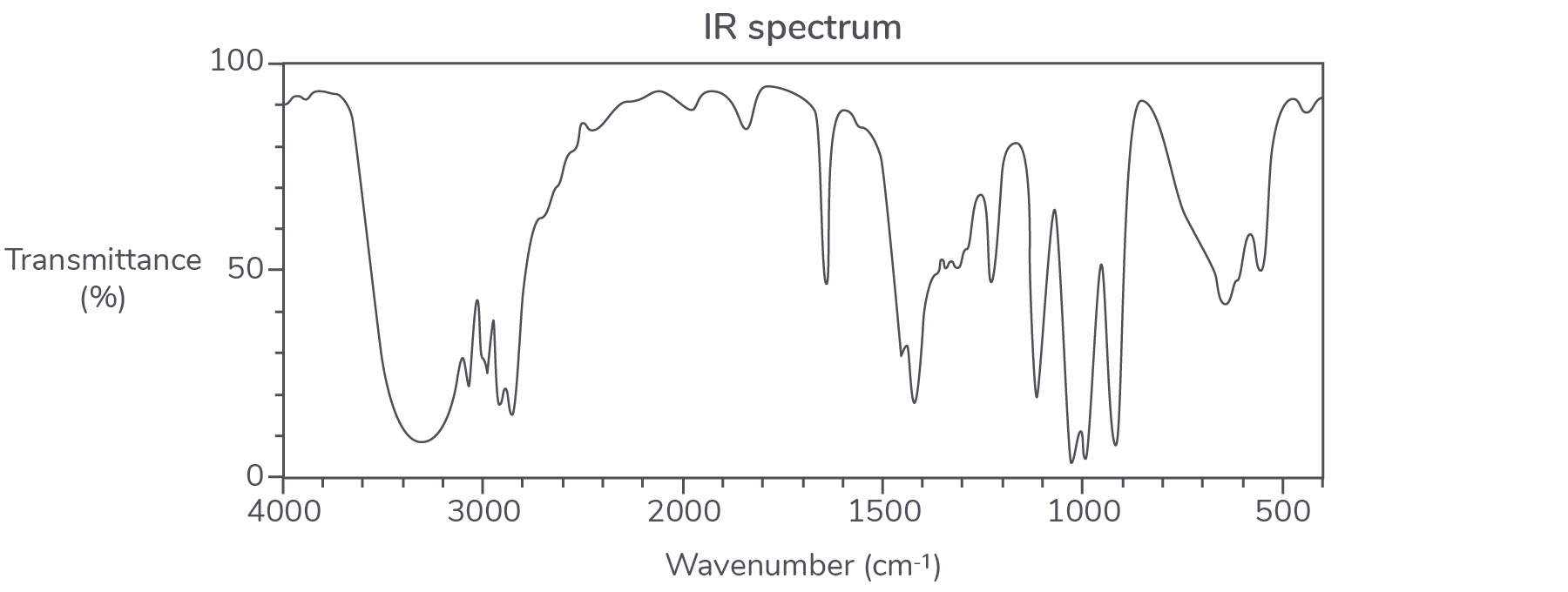
Which compound would produce the infrared spectrum shown in the diagram below?
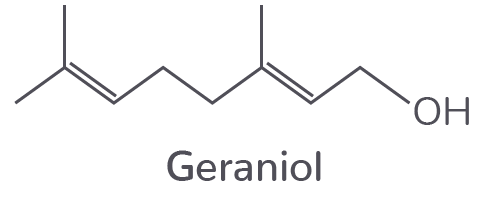
The structure of the compound geraniol is shown in the diagram below.
The mass spectrum of geraniol is shown in the diagram below.
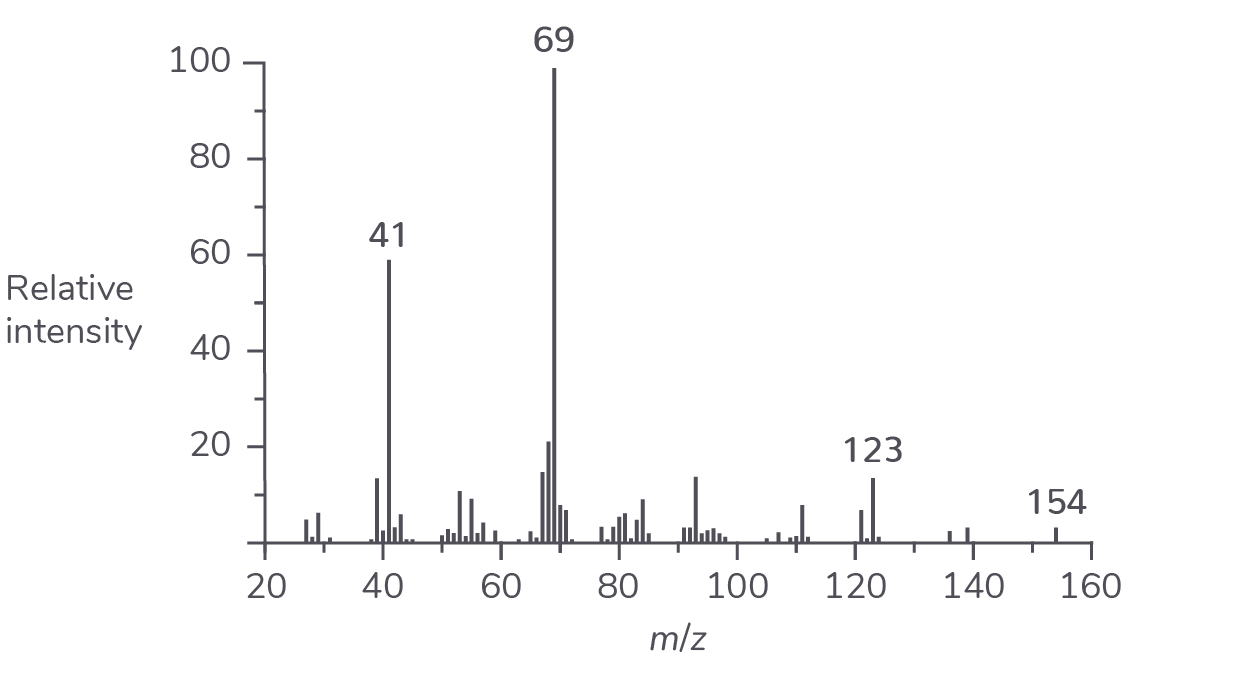
Use both diagrams to explain how the molecular mass of geraniol can be confirmed by mass spectrometry.