Mass Spectrometry - exam practice
Mass Spectrometry
Question 1 of 3
The diagram below shows the mass spectrum of an alkene.
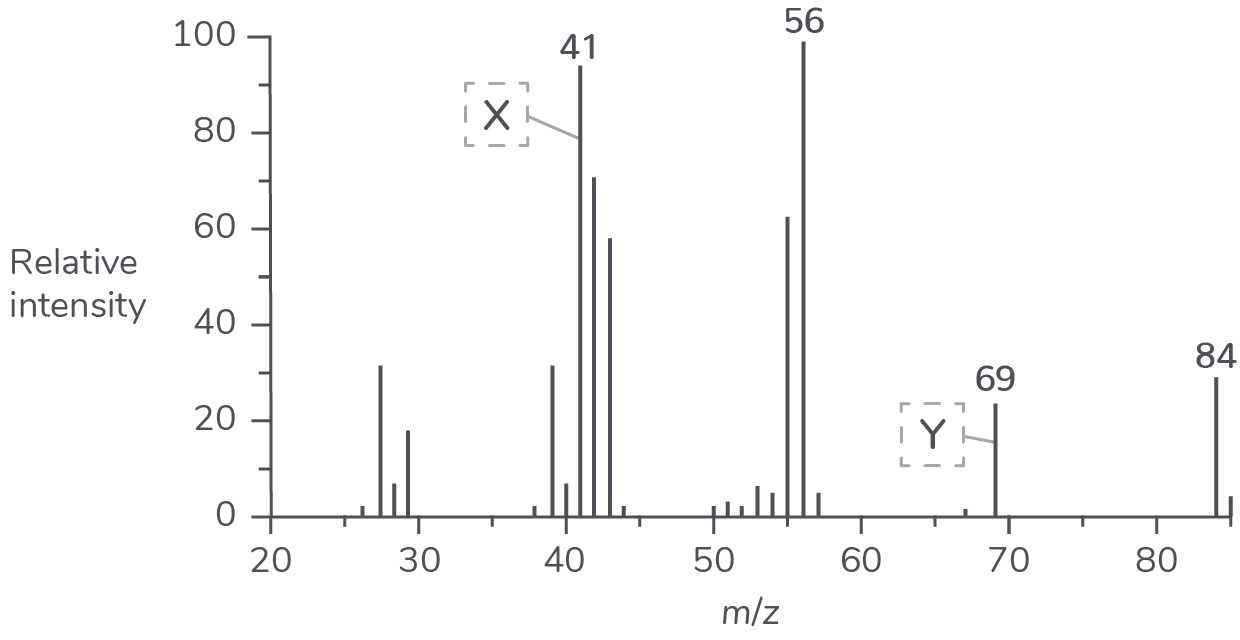
What is the molecular mass of the alkene?
The empirical formula of the alkene is CH2.
Determine the molecular formula of the alkene.
The compound with molecular formula C6H12 was found to be hex-2-ene.
Suggest the structures of the ions responsible for the peaks labelled X and Y.
Complete the table below to show the type of bond and functional group responsible for each of the three absorptions.
The diagram below shows the infrared spectrum of 2-bromopropane. The peak due to the C-Br bond has been labelled.
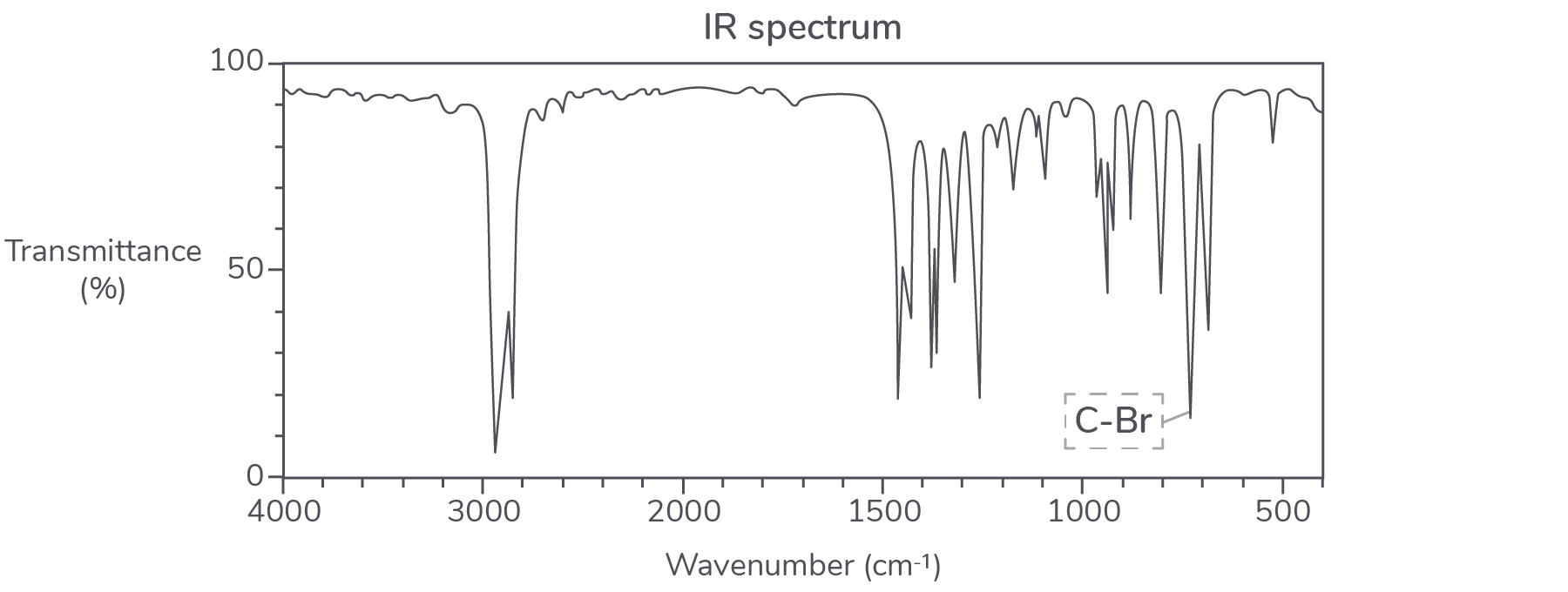
2-Bromopropane is then reacted with aqueous NaOH to form an alcohol.
Explain how IR spectroscopy could be used to show the reaction is complete.
An organic compound is analysed and found to have the following percentage composition by mass:
C 70.58%, H 5.92%, O 23.50%
The mass spectrum of this compound is shown in the diagram below.
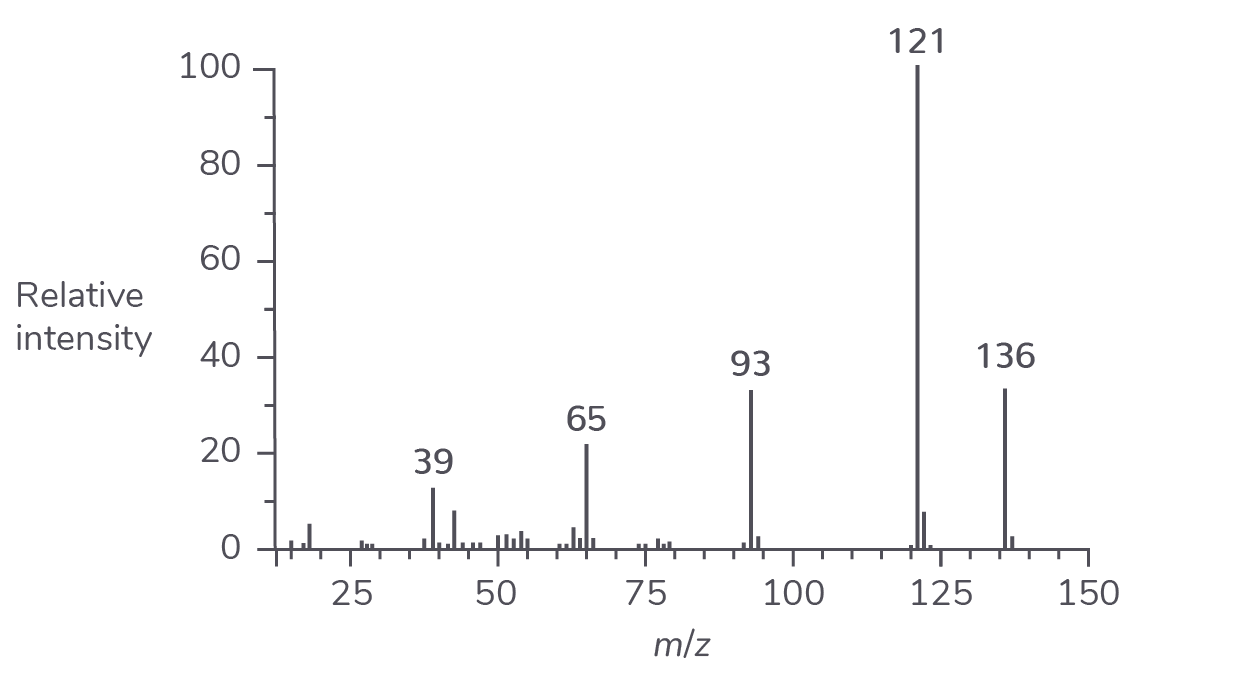
Use this information to determine the molecular formula of this compound.
Compound X contains a carbon-carbon double bond (C=C) but does not show E/Z stereoisomerism. It has empirical formula C2H3O.
Compound X was analysed by infrared spectroscopy and mass spectrometry and the results are shown in the diagrams below.
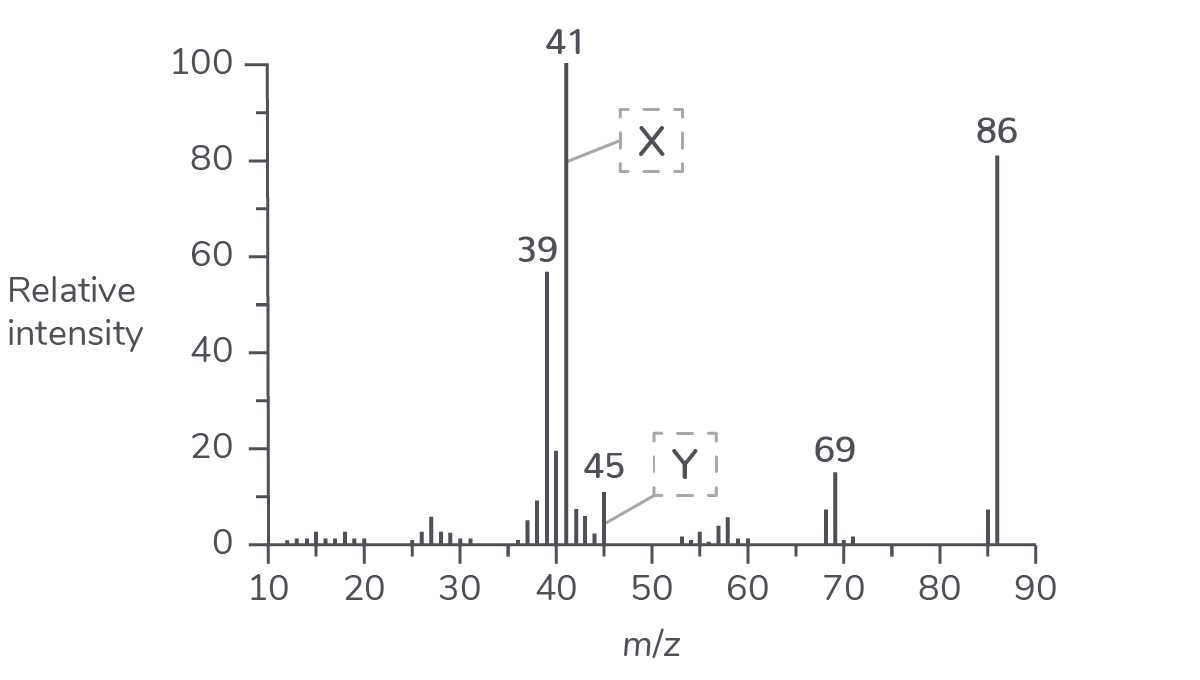
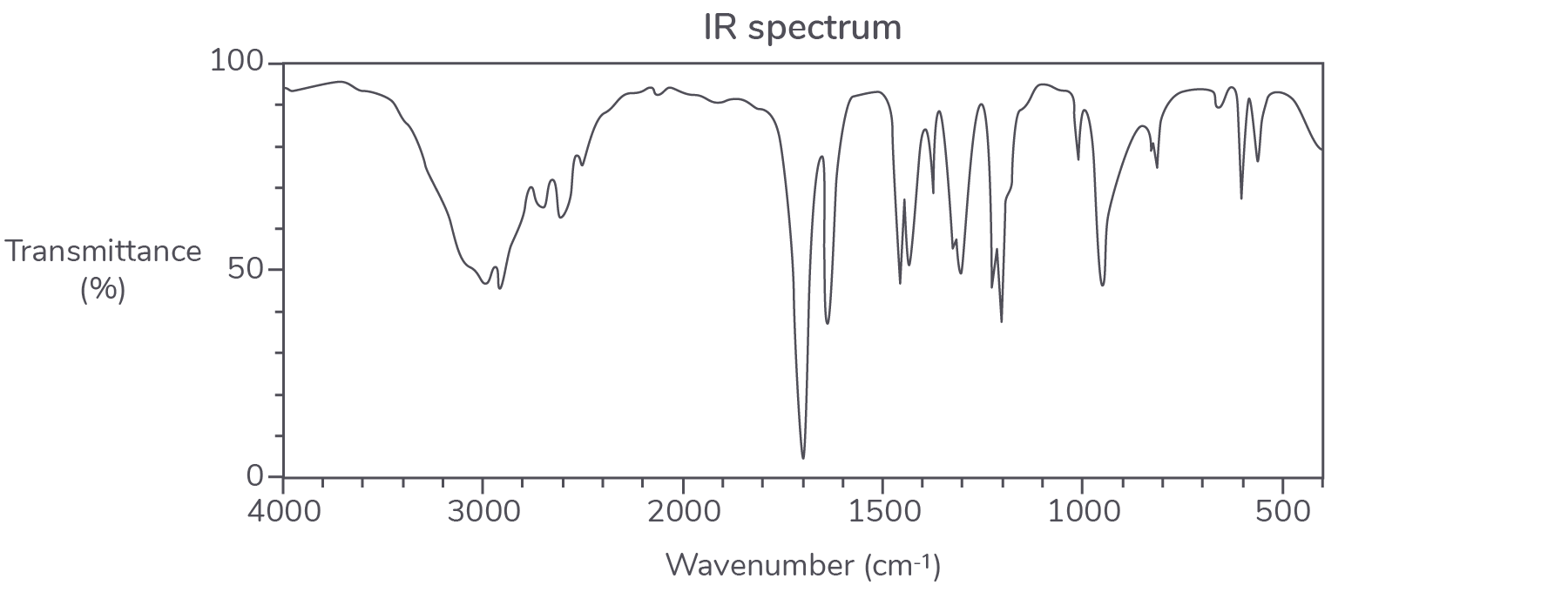
Use the information above to determine:
- the molecular formula of X,
- the ions responsible for the peaks labelled X and Y in the mass spectrum,
- the structure of X.
Compound M is an unknown organic compound with the following percentage composition by mass:
carbon 54.5%; hydrogen 9.10%; oxygen 36.4%
Calculate the empirical formula of compound M.
Use the mass spectrum of compound M, shown in the diagram below, and your answer to part a), to determine the molecular formula of M.
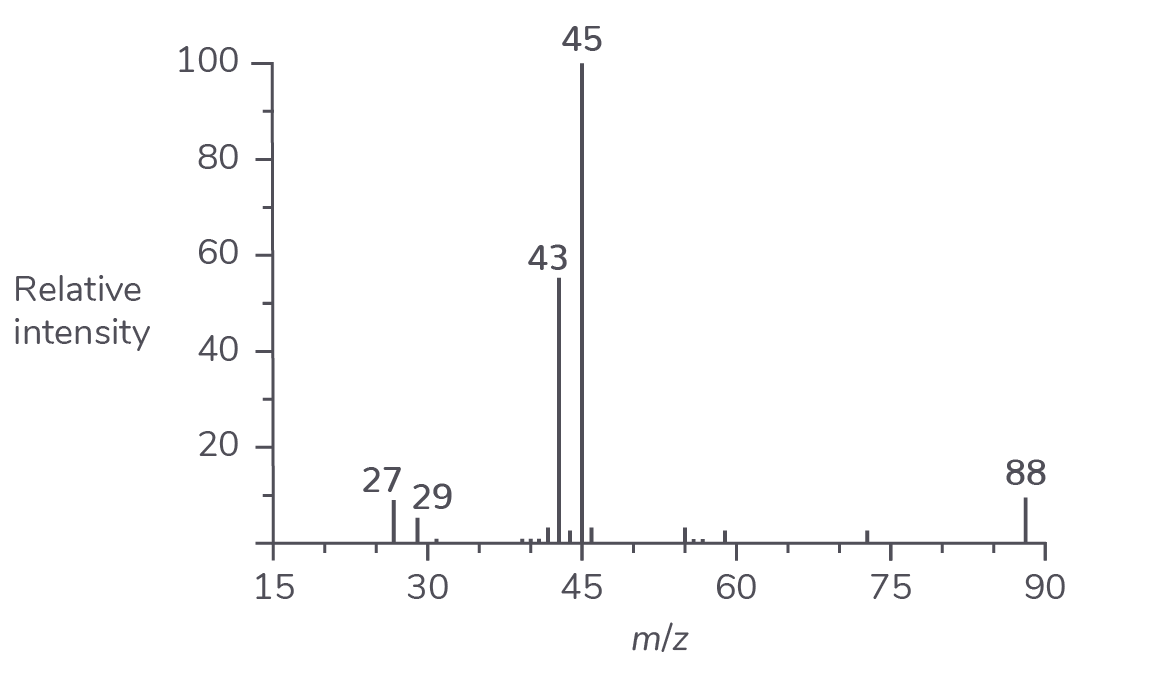
The infrared spectrum of compound M shows a broad peak at 3500 cm-1 and a sharp peak at 1700 cm-1.
Identify the bond responsible for producing each peak.
Compound M is a neutral compound, has no effect on Tollens' reagent, and turns acidified potassium dichromate(VI) from orange to green.
Use this information and your answer to part c) to name the two functional groups in compound M.