Principles of Transition Metal Chemistry - exam practice
Principles of Transition Metal Chemistry
Question 1 of 8
Explain what is meant by the term transition element.
Draw electrons in the boxes below to show the electronic configurations of Cu, Cu+ and Cu2+.
Complete the table by predicting the appropriate metal ions, co-ordination numbers, formulae and charges for the complexes A-D.
Explain why complexes formed from transition metal ions are coloured.
This diagram represents the energy change that occurs when a d electron in a transition metal ion is excited by visible light.
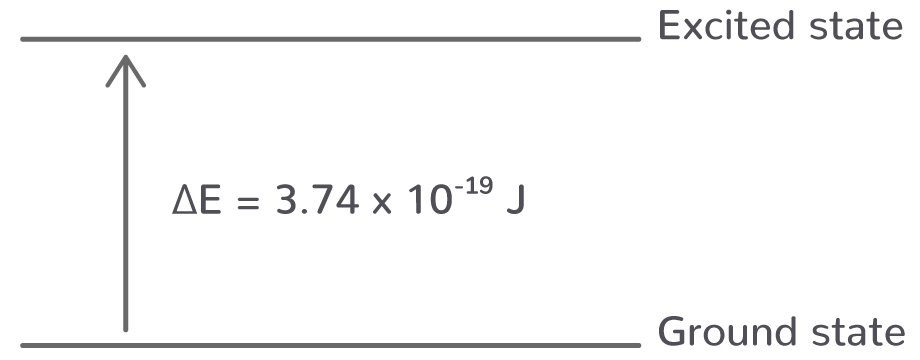
The energy change shown in the diagram represents the energy of green light and results in a solution that appears violet.
Violet light has a higher frequency than green light.
Suggest how the energy change, ΔE,will differ for a transition metal ion that forms a green solution.
Explain your answer.
State 3 different features of transition metal complexes that cause a change in the value of ΔE.
Steel pipelines carrying natural gas can corrode to form ‘green rust’, Fe(OH)2.
After some time, green rust can change into ‘black rust’ via the equation shown below.
3Fe(OH)2 ➔ Fe2+Fe3+2O4 + H2 + 2H2O
Use oxidation states to show that this is a redox reaction.
If seawater is present, the green rust is often oxidised to [FeCl4]- ions.
Draw diagrams to show two possible shapes for [FeCl4]-.
Name the shapes.
State the type of bonding between the chloride ligands and the iron ion in [FeCl4]-.
Cu+ also forms complexes with chloride ligands.
One example is the colourless complex [CuCl2]-.
Explain why [CuCl2]- ions are colourless.
Transition metals have characteristic properties due to their electron arrangements.
Give two characteristic properties of transition metals.
Give the electronic configurations of a chromium atom, a Cr2+ ion and a Cr3+ ion.
Explain why chromium has variable oxidation states.
Ammonium hexachloroplatinate, (NH4)2PtCl6, is a complex of platinum used in platinum plating. Ammonium hexachloroplatinate contains the hexachloroplatinate ion.
Draw a 3D diagram to show the shape of a hexachloroplatinate ion.
On your diagram, show:
- the name of the shape
- the charge on the ion
- the value of the bond angle.
Platin, Pt(NH3)2Cl2, is a neutral complex of platinum(II).
Explain why Pt(NH3)2Cl2 has no overall charge.
Pt(NH3)2Cl2, displays cis-trans isomerism.
Draw the structure of cis-platin. State its shape and give a value of the Cl-Pt-Cl bond angle.
The use of cis-platin can cause side effects so oxaliplatin has been developed.
The structure of oxaliplatin is shown below.
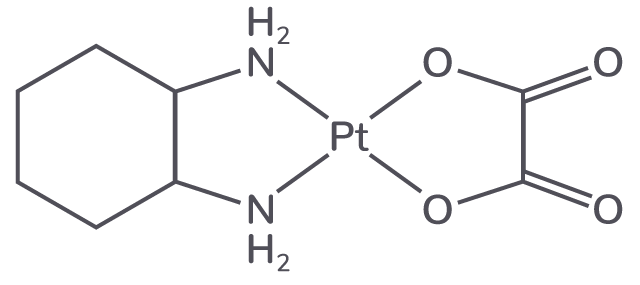
Draw the structures of the two bidentate ligands in oxaliplatin.
This question look at the ions and complexes of cobalt.
An octahedral complex ion Y, C9H30N6Co3+, exists as two optical isomers.
In complex ion Y, Co3+ is bonded to three molecules of a bidentate ligand L.
Write the molecular formula of the bidentate ligand L.
The diagram below shows the skeletal formula of L.
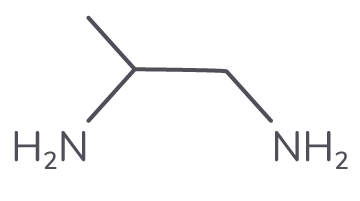
Explain how L is able to act as a bidentate ligand.
Draw a diagram that shows the shape of the complex ion Y and shows the type of bond between the ligand L and the cobalt.
The compounds [Co(NH3)5Br]SO4 and [Co(NH3)5SO4]Br are structural isomers.
Define the term structural isomer.
What is the oxidation number of cobalt in [Co(NH3)5Br]2+?
The complex [Co(NH3)4Cl2]+ shows isomerism.
Suggest the type of isomerism shown in [Co(NH3)4Cl2]+ and draw 3D structures of the two isomers.
The diagram below shows the structure of ethane-1,2-diamine, en.
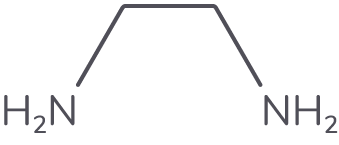
en is an example of a bidentate ligand.
Explain what is meant by the term bidentate ligand.
Ethanal is oxidised to ethanoic acid by oxygen. The equation for this reaction is:
2CH3CHO + O2 ➔ 2CH3COOH
This redox reaction is slow at room temperature but speeds up in the presence of cobalt compounds.
Explain why a cobalt compound is able to act as a catalyst for this process.
This question looks at the biological applications of transition metal complexes.
Red blood cells contain haemoglobin.
Explain using ligand substitutions:
- how haemoglobin transports oxygen around the body
- why carbon monoxide is toxic.
Cis-platin, Pt(NH3)2Cl2, is an effective anti-cancer drug.
Describe the action of cis-platin in this role.
The use of cis-platin can cause side effects so nedaplatin has been developed.
Nedaplatin can be synthesised from cis-platin, as shown below.
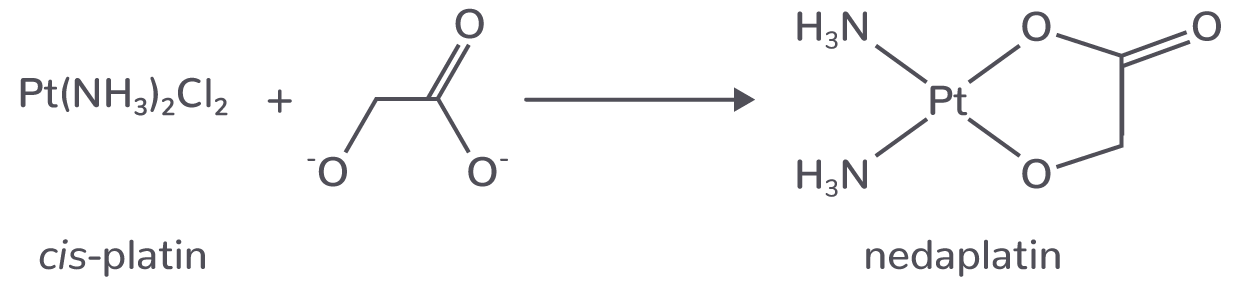
Name the type of reaction that is occuring.