Energetics - exam practice
Energetics
Question 1 of 13
A student uses a calorimetry experiment to determine the standard enthalpy of combustion of ethanol.
Define the term standard enthalpy change of combustion.
In the experiment, 0.230 g of ethanol was completely burned and the temperature of 100 g of water was found to rise by 15.2 °C.
Calculate the standard enthalpy change of combustion, ΔcH, of ethanol. Give your answer in kJ mol-1 to the nearest whole number.
The specific heat capacity of water, c, is 4.18 J g-1 K-1.
The experimental value for ΔcH is found to be lower than the data book value. Suggest one reason for this.
The table below shows some enthalpy change of combustion values.
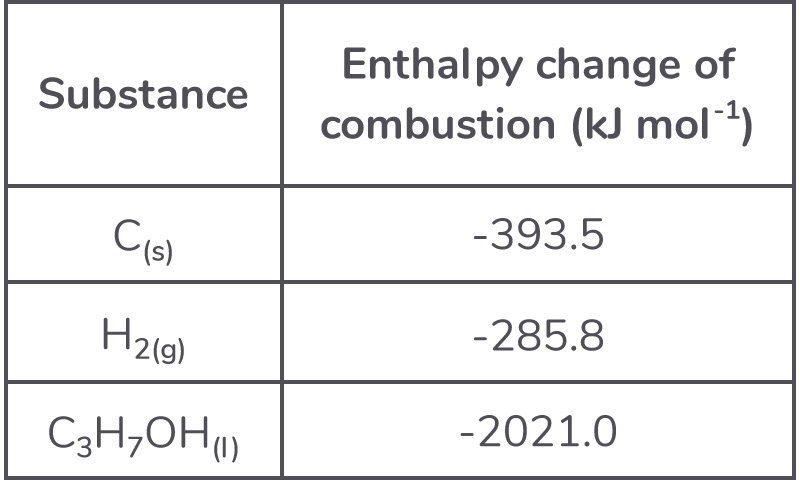
The equation for the formation of propanol is shown below.
Use the equation and the table to construct a Hess cycle and calculate the enthalpy change of formation of propanol, ΔfH.
Hydrogen iodide, HI, is a gas that can be produced in a reversible reaction between hydrogen and iodine.
H2(g) + I2(g) ⇌ 2HI(g) ΔH = -9 kJ mol-1
Complete the enthalpy profile diagram below for the forward reaction. Include labels for the activation energy (Ea), the enthalpy change of reaction (ΔH) and the formulae of the reactants and products.
The activation energy for the forward reaction is +173 kJ mol-1.
Calculate the activation energy for the reverse reaction.
The value for the enthalpy change of this reaction is negative.
Explain why this means the reaction is exothermic. Use ideas about bond breaking and bond making in your answer.
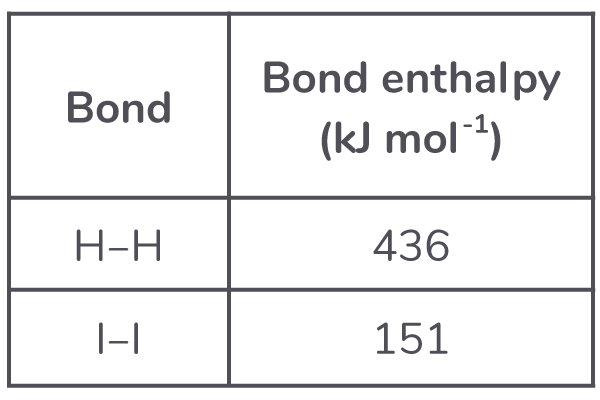
The table below shows some bond enthalpy data.
Use the table to calculate a value for the bond enthalpy of the H-I bond.
The enthalpy change for the reaction between sodium carbonate and hydrochloric acid can bet determined using calorimetry.
Na2CO3(s) + HCl(aq) ➔ 2NaCl(aq) + CO2(g) + H2O(l)
In the experiment, 3.35 g of sodium carbonate is added to 50.0 g of 2.00 mol dm-3 HCl so that the HCl is in excess. The temperature of the reaction is found to increase by 5.7 °C.
Calculate the standard enthalpy change of reaction, ΔrH, giving your answer in kJ mol-1 and to 3 significant figures.
The specific heat capacity of the reaction mixture, c, is 4.18 J g-1 K-1.
What is meant by the term standard enthalpy of formation?
The table below shows some standard enthalpy of formation values.
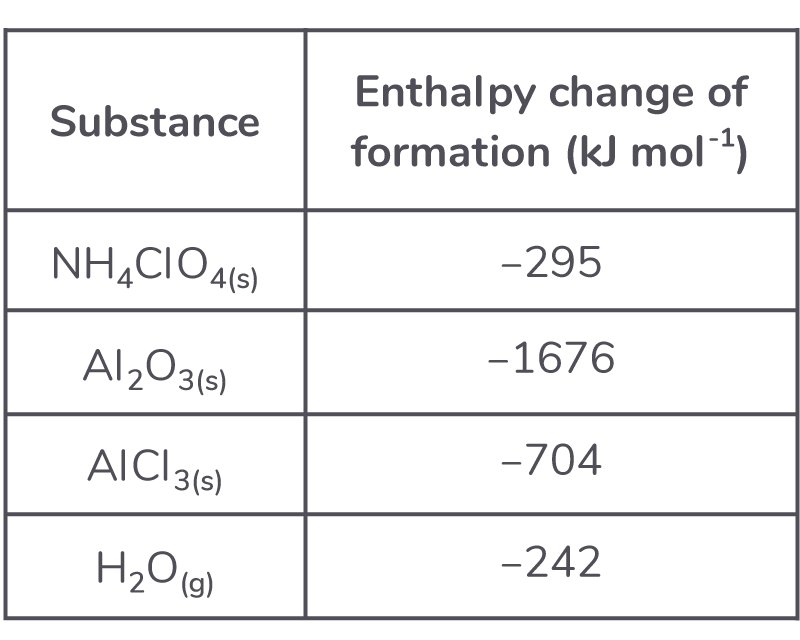
Use the equation below and the data in the table to set up a Hess cycle and calculate a value for the standard enthalpy of formation, ΔfH, for NO.
Ammonia is produced by the Haber process from nitrogen and hydrogen.
N2(g) + 3H2(g) ⇌ 2NH3(g) ΔH = −92 kJ mol-1
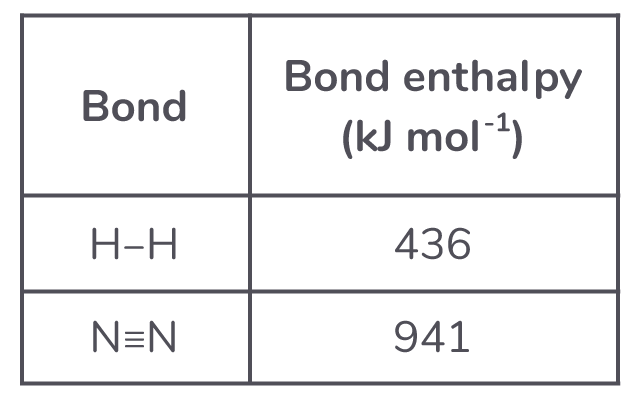
The table below shows the bond enthalpy values for nitrogen and hydrogen.
Explain the meaning of the term bond enthalpy.
Use the equation and the table above to calculate a value for the bond enthalpy of the N−H bond.
Give your answer to the nearest whole number.
The data book value for the N−H bond is 388 kJ mol-1.
Give one reason for the difference between this value and the value you calculated in part b).
The table below shows some standard enthalpy of formation values.
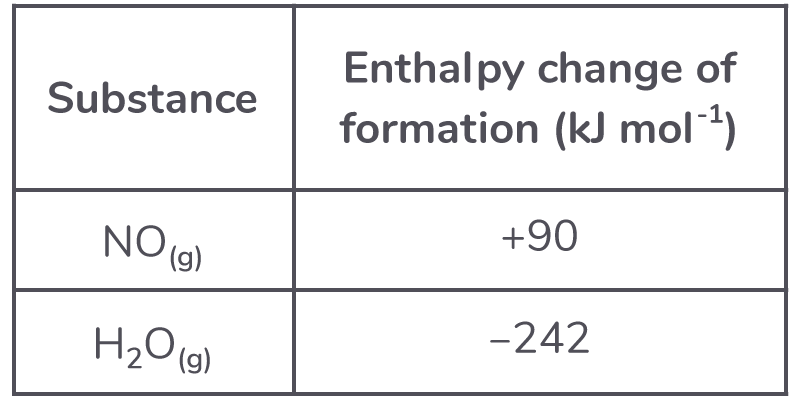
Use the table and the equation below to set up a Hess cycle to calculate a value for the enthalpy change of formation, ΔfH, of NH3.
Ethanoic acid and sodium hydroxide react according to the equation shown below.
CH3COOH(aq) + NaOH(aq) ➔ CH3COONa(aq) + H2O(l) ΔH = −56.1 kJ mol-1
A student reacted 50.0 cm3 of 2.00 mol dm-3 ethanoic acid with 50.0 cm3 of 2.00 mol dm-3 sodium hydroxide.
Calculate the temperature rise to three significant figures.
Assume both solutions started at the same initial temperature and have a density of 1.00 g cm-3.
The specific heat capacity of the reaction mixture, c, is 4.18 J g-1 K-1.
State what is meant by the term mean bond enthalpy for an O−H bond.
Calculate the enthalpy of formation of water using the bond enthalpies in the table below.
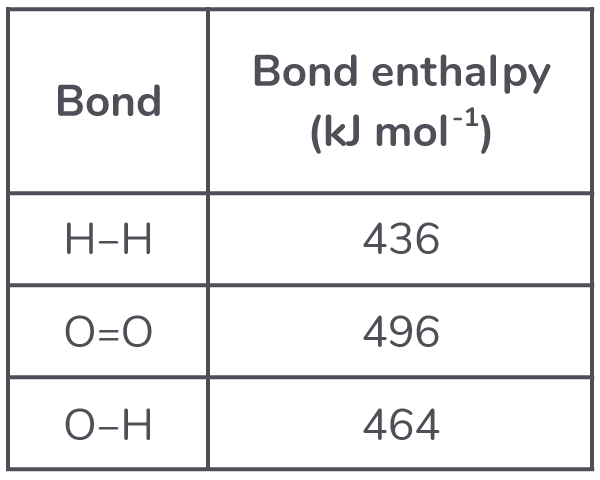
The enthalpy change of reaction, ΔrH, can be calculated using mean bond enthalpies.
Explain the meaning of the term mean bond enthalpy.
The table below shows some mean bond enthalpy data.
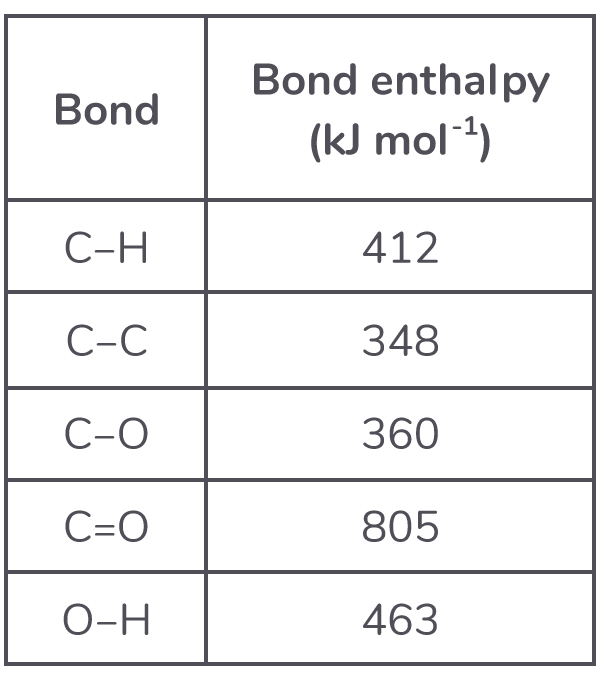
Use the table and the equation below to calculate a value for the bond enthalpy of the O=O bond.
C2H5OH(g) + 3O2(g) ➔ 2CO2(g) + 3H2O(g) ΔH = −1,279 kJ mol-1
The temperature of 75.0 g of water was found to increase by 5.80°C when 1.80 x 10⁻³ moles of pure ethanol was burned in air.
Calculate the enthalpy change of combustion, ΔcH, when 1.00 mole of ethanol is burned.
Give your answer in kJ mol-1 and to the nearest whole number.
Give two reasons why the value calculated in part c) is different from the data book value which is −1,279 kJ mol-1.
Some oxides of nitrogen and sulfur are environmental pollutants linked to acid rain.
The standard enthalpy change of formation for NO2 is +3.2 kJ mol-1.
Explain why this enthalpy change is endothermic, using ideas about bond breaking and bond making in your answer.
Draw a fully labelled enthalpy profile diagram below for the formation of NO2 from its elements. Include labels for the activation energy (Ea), the enthalpy change of reaction (ΔH) and the formulae of the reactants and products.
The bond enthalpy of the O=O bond is 496 kJ mol-1.
Use the equation below to calculate the mean bond enthalpy for the S=O bond.
Assume both SO2 and SO3 only contain S=O bonds.
2SO2(g) + O2(g) ➔ 2SO3(g) ΔH = −192 kJ mol-1
This question is about calculating enthalpy changes using Hess's Law.
State Hess's Law.
Use the standard enthalpy of formation values in the table below to calculate a value for the standard enthalpy of reaction, ΔrH, when iron oxide is reduced by carbon monoxide to produce iron.
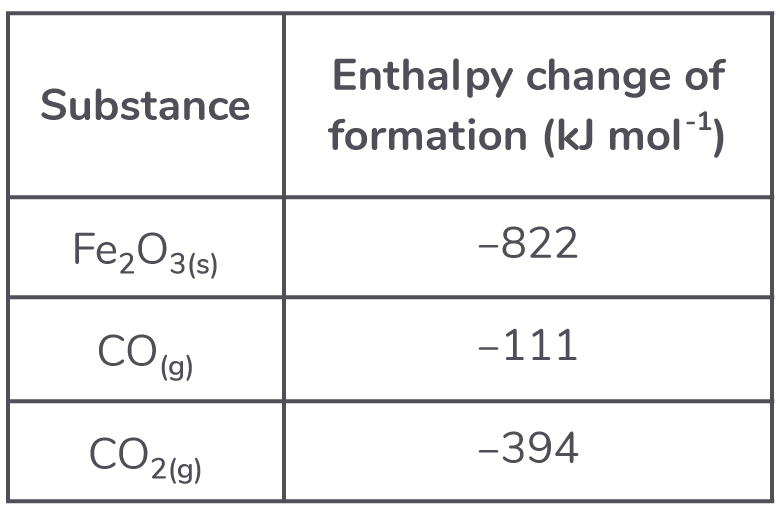
The table below shows some standard enthalpy of formation values for three substances.
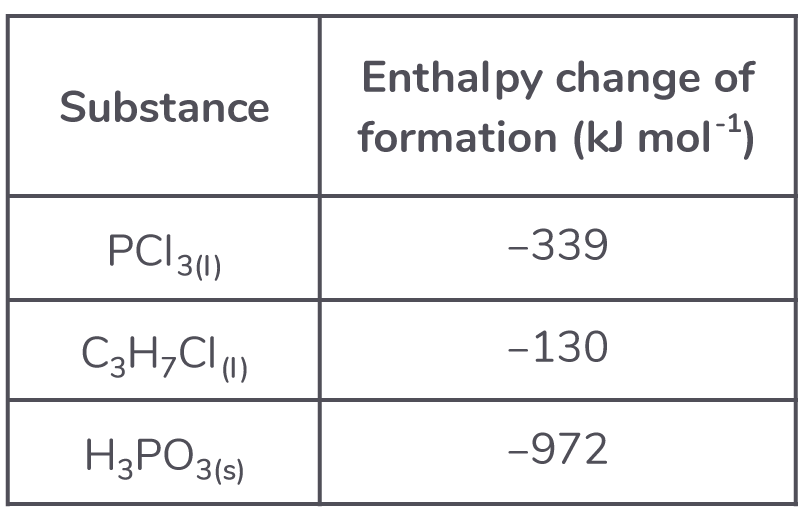
Use the equation below and the data in the table above to calculate a value for the standard enthalpy of formation, ΔfH, of propanol, C3H7OH.
This question is about enthalpy data relating to the combustion of some alkanes.
A calorimetry experiment is used to determine the standard enthalpy of combustion, ΔcH, of hexane.
Use the experimental data below to calculate a value for ΔcH of hexane, giving your answer to 3 significant figures.
Mass of hexane = 1.34 g
Mass of water heated = 150 g
Initial temperature of water = 21.6 °C
Final temperature of water = 65.8 °C
The specific heat capacity of water, c, is 4.18 J g-1 K-1.
The table below shows some standard enthalpy of formation values for three substances.
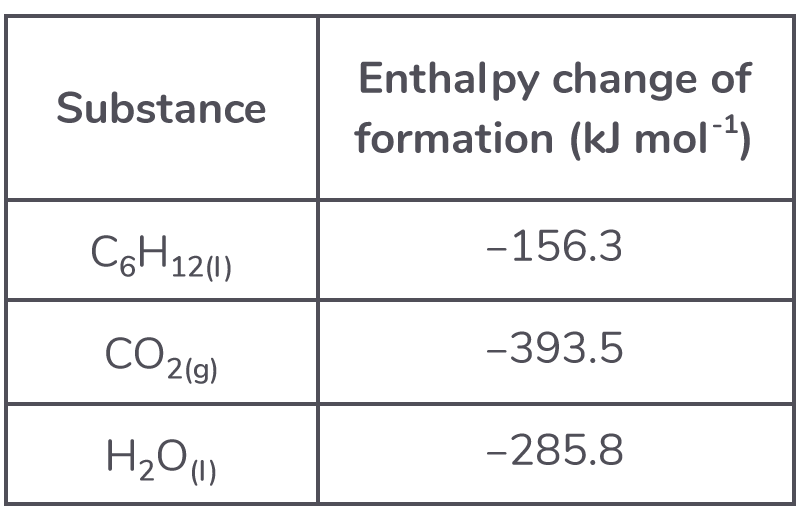
Use the equation below and data in the table above to calculate a value for the standard enthalpy of combustion, ΔcH, of cyclohexane.
Give two reasons why the value calculated in part b) may be different to the data book value.
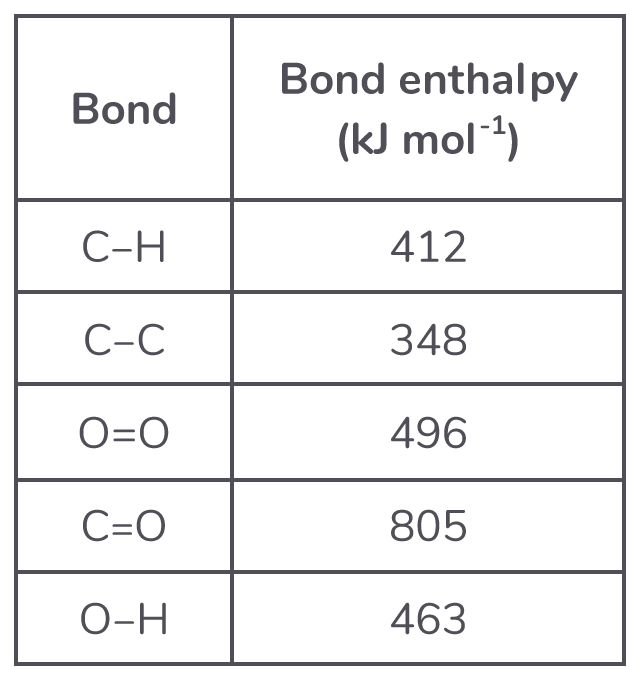
Use the bond enthalpy data in the table below to calculate a value of the bond enthalpy of the C−O bond in propanol.
C3H7OH(g) + O2(g) ➔ 3CO2(g) + 4H2O(g) ΔH = −1,893 kJ mol-1
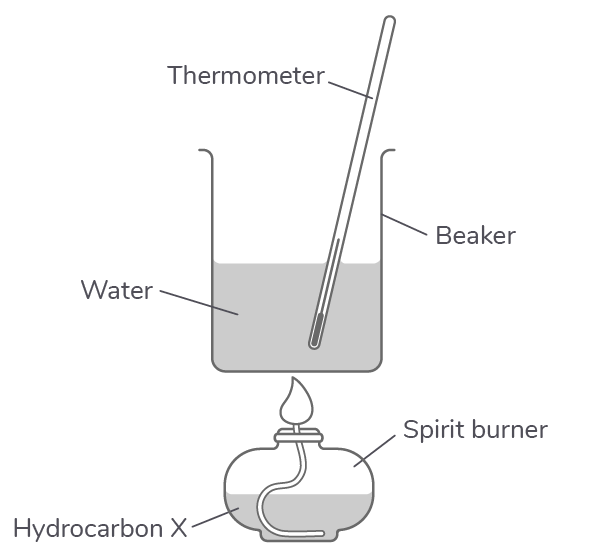
A spirit burner was filled with the liquid hydrocarbon X. The burner was weighed, lit and then used to raise the temperature of a quantity of water in a beaker, as shown in the diagram. The burner was then reweighed.
The results of this experiment are recorded in the table below.
| Result | Value |
|---|---|
| Mass of spirit burner plus hydrocarbon X before burning (g) | 130.854 |
| Mass of spirit burner plus hydrocarbon X after burning (g) | 130.596 |
| Volume of water in the beaker (cm^3^) | 200 |
| Temperature of water before heating (°C) | 22.1 |
| Temperature of water after heating (°C) | 32.5 |
| Molar mass of hydrocarbon X (g mol^-1^) | 84.0 |
Use these results to calculate the enthalpy change of combustion of hydrocarbon X in kJ mol-1.
Give your answer to 3 significant figures.
Specific heat capacity of water = 4.18 J g-1 °C-1
Density of water = 1.00 g cm-3
The beaker used in this experiment was made of copper rather than glass.
Give a reason for this.
A 250 cm3 measuring cylinder was used to measure the volume of 200 cm3 water. The uncertainty in this volume is ±1 cm3.
Calculate the percentage uncertainty in the volume of water that was measured in this experiment.
Compare and contrast the use of a 250 cm3 measuring cylinder to measure out the 200 cm3 water with the use of a 50 cm3 measuring cylinder (uncertainty ±0.5 cm3 for each volume measurement) four times to measure the same volume.
In an experiment, 0.500 g of hydrocarbon X was burned completely in oxygen to produce 1.57 g of carbon dioxide and 0.642 g of water.
Calculate the empirical formula and the molecular formula of the hydrocarbon X.
A student titrated hydrochloric acid, HCl(aq), against 50.0 cm3 of 0.840 mol dm-3 sodium hydroxide, NaOH(aq), to determine its concentration. The temperature of the reaction mixture was measured after each acid addition and plotted against the volume of acid.
Using the graph, estimate the initial temperature of the solution and the maximum temperature reached in the experiment.
Calculate the concentation of the hydrochloric acid. Give your answer to 3 significant figures.
Determine the heat change, q, in kJ, for the neutralisation reaction between hydrochloric acid and sodium hydroxide. Give your answer to 2 significant figures.
Assume the specific heat capacities of the solutions and their densities are those of water.
Specific heat capacity of water = 4.18 kJ kg-1 K-1.
Density of water = 1.00 g cm-3.
Calculate the enthalpy change, ΔH, in kJ mol-1, for the reaction between hydrochloric acid and sodium hydroxide. Give your answer to 2 significant figures.
The enthalpy change of formation, ΔfH, can be calculated indirectly from enthalpy changes of combustion, ΔcH.
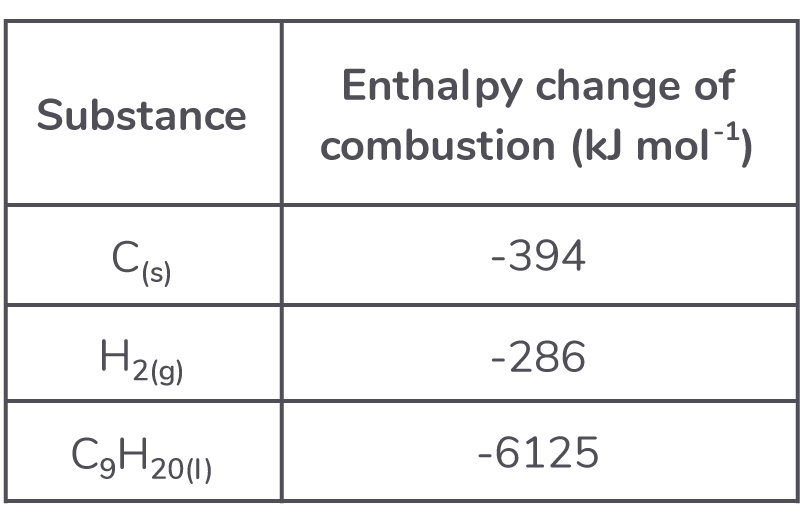
Use the enthalpy change of combustion data in the table above to calculate the enthalpy change of formation, ΔfH, of nonane.
State the standard conditions for temperature and pressure used in standard enthalpy measurements.
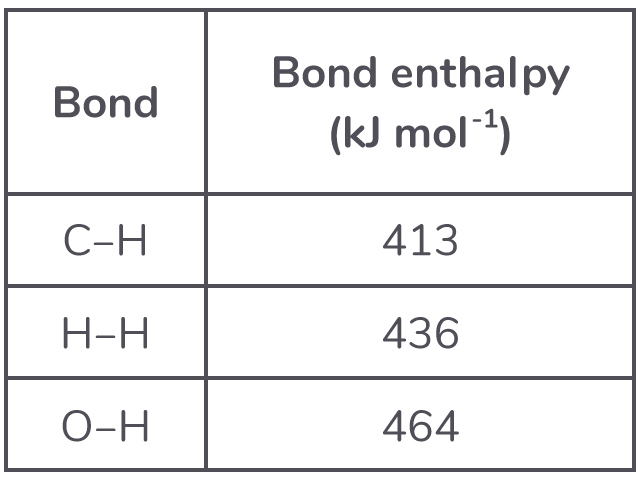
The bond enthalpy for carbon monoxide can be determined using mean bond enthalpy data for the reaction below.
CH4(g) + H2O(g) ➔ CO(g) + 3H2(g) ΔH = +210 kJ mol-1
Use the data in the table below to calculate a value for the bond enthalpy of CO.
To determine the enthalpy change of reaction when magnesium reacts with copper sulfate solution, a student sets up a calorimetry experiment.
The following method was used:
Step 1: A 1.00 m length of magnesium ribbon was weighed and cut into 10 cm lengths.
Step 2: 30 cm3 of copper sulfate solution (an excess) was placed into a polystyrene cup and the temperature measured.
Step 3: A 10 cm3 length of magnesium ribbon was added to the copper sulfate solution. The solution was stirred gently and the maximum temperature recorded.
Results:
| Measurement | Value |
|---|---|
| Mass of 1.00 m of Mg ribbon (g) | 0.86 |
| Initial temperature of solution before addition of Mg (°C) | 21.3 |
| Final temperature of solution (°C) | 29.2 |
Give a reason why an excess of copper sulfate used.
Calculate the number of moles of magnesium in the 10 cm3 length of magnesium ribbon used in this experiment. Give your answer to 2 significant figures.
Calculate the enthalpy change of reaction, ΔrH, in kJ mol-1, giving your answer to 3 significant figures.
Density of reaction mixture = 1.00 g cm-3.
Specific heat capacity of water = 4.18 J g-1 K-1.
State one assumption you made in part c).
The maximum uncertainty each time the thermometer was read was ±0.1°C.
Calculate the percentage uncertainty in measuring the temperature change in this experiment. Give your answer to 1 demical place.
Suggest one way of reducing the percentage uncertainty in measuring the temperature change without changing the apparatus or just repeating the experiment. Justify your answer.