Halogenoalkanes - exam practice
Halogenoalkanes
Question 1 of 13
Halogenoalkanes react with water to produce alcohols and halide ions.
C4H9X + H2O ➔ C4H9OH + X- + H+
Test tube experiments can be carried out to investigate the relative rates of these substitution reactions.
The halogenoalkanes 1‐chlorobutane, 1‐bromobutane and 1‐iodobutane can be used.
Some of the steps in these experiments are
- each halogenoalkane is added to a different tube containing 1 cm3 of ethanol
- the test tubes are placed in the same beaker of hot water
- aqueous silver nitrate is added to each tube and the tubes are shaken
- a precipitate forms in each tube.
State the purpose of adding ethanol to each of the test tubes.
Give one reason why the test tubes were put in the same beaker of hot water.
Give one reason why the test tubes were shaken after the addition of aqueous silver nitrate.
State how the halogen atom present in each halogenoalkane can be identified using observations from this experiment in part a).
Identify further reagents that can be added, including relevant observations, to confirm the identity of the halogen atom present in each halogenoalkane.
This question is about reaction mechanisms.
Mechanisms use curly arrows.
What does a curly arrow represent in a mechanism?
The diagram below shows part of a mechanism for the reaction between a halogenoalkane and sodium hydroxide to produce an alcohol.
Add the missing curly arrow and draw the structure of the products that would form in the reaction below.
Use the mechanism in part b) to explain what is meant by the term heterolytic fission.
The halogenoalkane 1-bromo-2-methylpropane reacts with sodium hydroxide to produce an alcohol as shown in the diagram below.

Name the alcohol and draw its skeletal formula.
This question is about the reaction of halogenoalkanes to form alkenes.
Write an equation for the reaction between 2-bromopropane and potassium hydroxide to form propene and two other products.
Name the mechanism for this reaction.
Give one condition needed to favour this mechanism instead of a nucleophilic substitution to form an alcohol.
This question is about the halogenoalkane 1-chloropentane.
1-chloropentane can be hydrolysed by aqueous sodium hydroxide.
Outline a mechanism for this reaction.
1-Chloropentane can be hydrolysed by water using aqueous silver nitrate in ethanol. This method can be used to compare the rates of hydrolysis of 1-chloropentane and 1-bromopentane.
State the measurement and observation required that would allow the rates of hydrolysis to be compared.
Explain why 1-bromopentane was found to react faster than 1-chloropentane.
1-Chloroethane can react with methoxide ions, CH3O−, by nucleophilic substitution.
Suggest how CH3O− ions can act as a nucleophile.
Outline the mechanism for this reaction.
1-Iodoethane also reacts with methoxide ions.
Explain how the use of 1-iodoethane instead of 1-chloroethane would affect the rate of reaction.
The ethanoate ion, CH3COO−, also acts as a nucleophile when it reacts with 1-chloroethane.
Name the organic product formed in this reaction and draw its skeletal formula.
This question is about the rate of hydrolysis of halogenoalkanes.
State and explain how the halogen in a halogenoalkane affects the rate of hydrolysis.
Name the halogenoalkane shown in the diagram below.
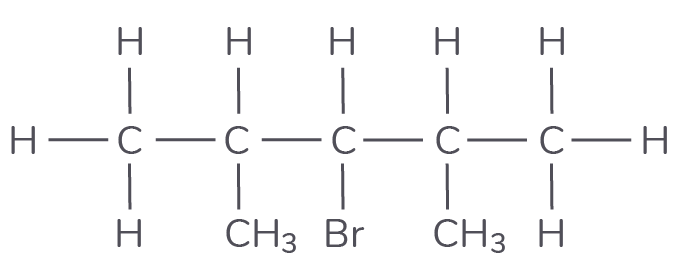
The reaction of the halogenoalkane in part b) with aqueous potassium hydroxide forms an alcohol.
Name and outline the mechanism for this reaction.
Explain why the reaction of 3-iodo-2,4-dimethylpentane with aqueous potassium hydroxide would be quicker than with the bromoalkane.
This question is about the reactions of bromoalkanes.
Complete the diagram below to show the SN2 mechanism for the reaction between 1-bromopropane and aqueous NaOH.
Explain why the reaction between 2-bromo-2-methylpropane and aqueous NaOH will react via a different mechanism to that in part a).
Bromoethane reacts with cyanide ions, CN-, to form compound X and bromide ions, Br-.
Outline the mechanism for this reaction.
Name compound X.
The diagram below shows the structure of bromoalkane X.
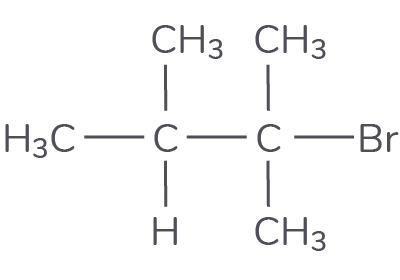
Name bromoalkane X.
Suggest one reason why 1-bromohexane has a higher boiling point than bromoalkane X.
Draw the displayed formula of 1,2-dichloro-2-methylpropane.
1-Chloro-2-methylpropane reacts with ammonia to form an amine.
Name and outline the mechanism for this reaction.
The diagram below shows some compounds made from a halogenoalkane.
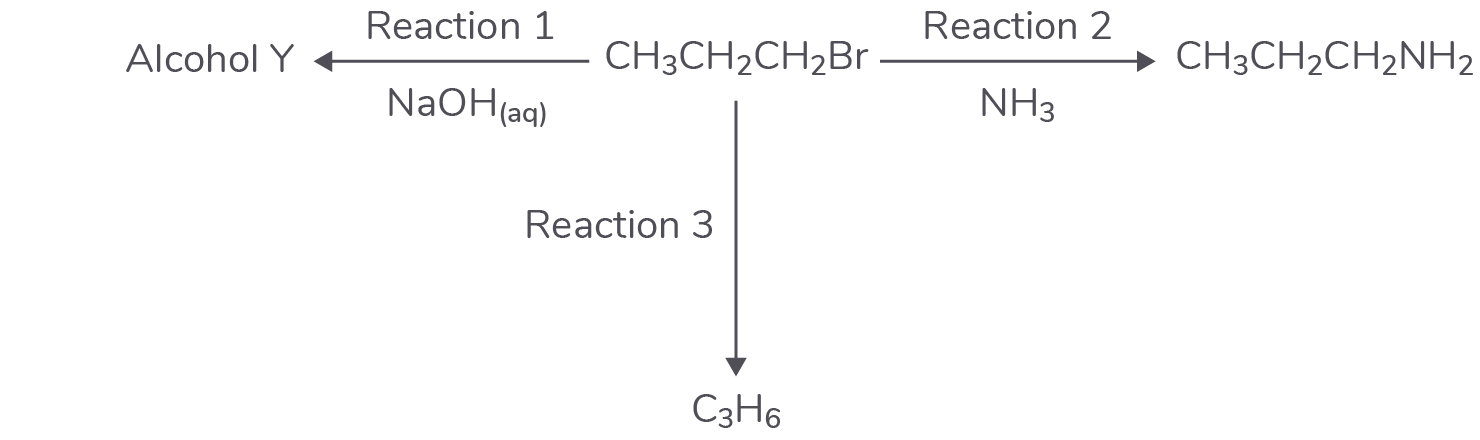
Draw the displayed formula of alcohol Y.
Name the mechanism in reaction 2 and give an essential condition required to ensure CH3CH2CH2NH2 is the major product.
When reaction 2 is carried out under different conditions a compound with the molecular formula C9H21N is formed.
Draw the skeletal formula of the compound and identify its functional group.
Identify the reagents and conditions required for reaction 3.
A student hydrolysed 1-bromobutane and 1-chlorobutane using aqueous sodium hydroxide.
State and explain the difference in the rates of hydrolysis of 1-bromobutane and 1-chlorobutane.
The molecular formula of an iodoalkane is C4H9I.
Draw the four possible structural isomers of this compound.
Outline the mechanism for the reaction between 1-iodobutane and aqueous sodium hydroxide.
Name the organic product formed in the reaction in part c).
This question is about the halogenoalkane 1-chloropropane.
Write a balanced equation for the reaction between 1-chloropropane and aqueous hydroxide ions.
The hydroxide ions act as a nucleophile in this reaction.
State two features of the hydroxide ion that enable it to act as a nucleophile.
Explain how the rate of reaction would change if 1-iodopropane was used as a reagent instead.
The halogenoalkane 1-bromopropane can be converted into propan-1-ol in a one-step reaction.
State the reagent and condition needed for this reaction.
Outline a mechanism for this reaction.
1-Bromopropane is reacted with KOH dissolved in ethanol.
Identify the reaction type and name the organic product formed.
2-Bromopropane reacts with aqueous potassium hydroxide to form potassium bromide and an alcohol.
Name the mechanism for this reaction.
Outline the mechanism for this reaction.
Name the alcohol formed in the reaction.
Identify the characteristic of the halogenoalkane that enables it to undergo this reaction.