Alcohols - exam practice
Alcohols
Question 1 of 10
Alcohols can be oxidised using acidified potassium dichromate(VI), K2Cr2O7.
Draw the product formed when 2-methylpropan-1-ol is refluxed with acidified potassium dichromate(VI).
Name the alcohol shown in the diagram below.
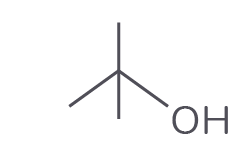
Explain why the alcohol shown in the diagram in part b) cannot be oxidised by acidified potassium dichromate(VI).
Write an equation for the complete combustion of butan-2-ol.
This question is about the reactions of alcohol X, shown in the diagram below.
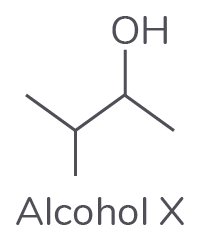
Name alcohol X.
Alcohol X is heated with an acid catalyst to form a mixture of two alkenes.
Draw the structures of the two alkenes formed in this reaction.
Complete and balance the equation below for the reaction when alcohol X is refluxed with acidified potassium dichromate(VI).
The table below shows the boiling points of alcohol X and its structural isomer, pentan-1-ol.
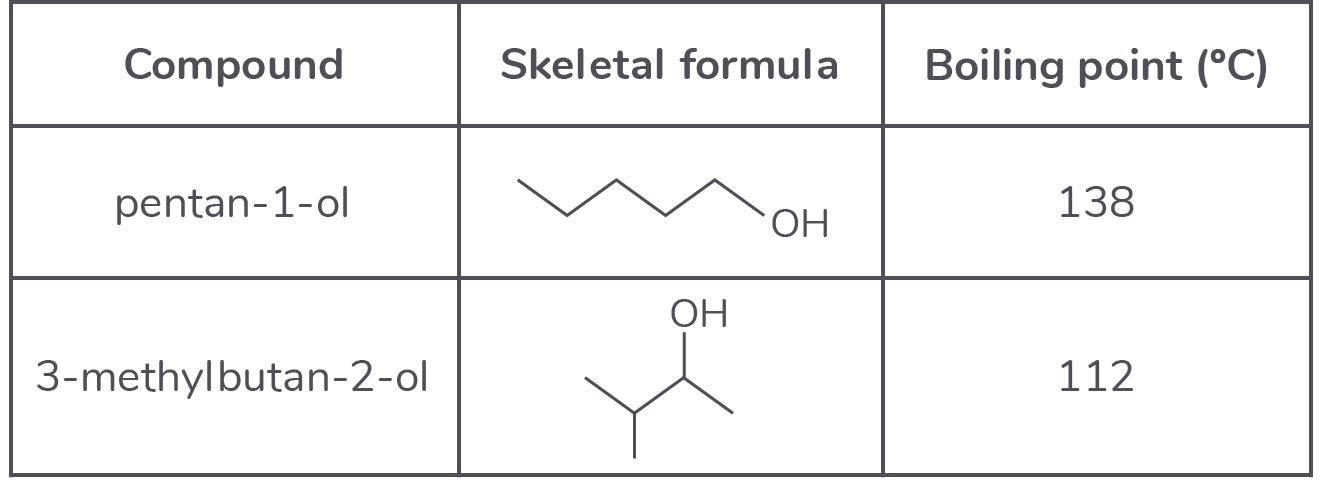
Explain why the boiling points are different.
Label the diagram below to show why ethanol is soluble in water.
Include relevant dipoles and lone pairs of electrons.
Write an equation for the complete combustion of ethanol.
Propan-1-ol can be oxidised to form two different organic products depending on the conditions used.
Describe both oxidation reactions of propan-1-ol, including the following points in your answer:
- the name of the organic product formed
- a balanced equation for the oxidation reaction
- the reaction conditions required Use [O] to represent the oxidising agent.
The skeletal formula of alcohols A-F are shown below.
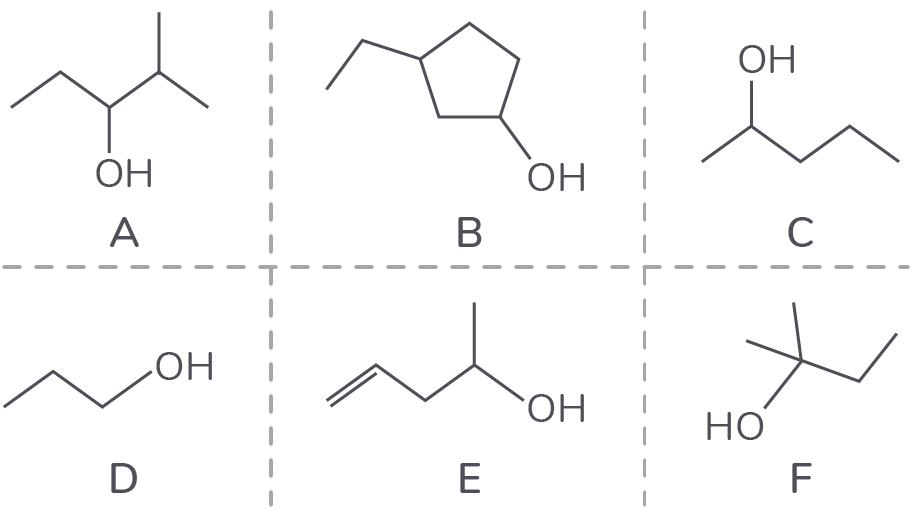
Which two alcohols are structural isomers of each other?
Which alcohol can be oxidised to a carboxylic acid using K2Cr2O7/H+?
Which alcohol would show no colour change when oxidised with K2Cr2O7/H+?
Name alcohol A.
Complete the diagram below to show the organic product formed in each reaction of alcohol B.
The diol HO(CH2)4OH can be oxidised to a dicarboxylic acid.
Write an equation for this reaction using [O] to represent the oxidising agent.
Label the diagram below to show why HOOC(CH2)2COOH is soluble in water.
Include relevant dipoles and lone pairs of electrons in your answer.
The diagram below shows alcohol Z.
Name alcohol Z.
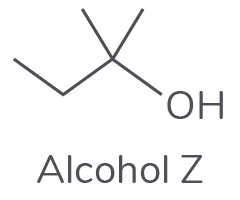
Write an equation for the complete combustion of alcohol Z.
The structural formula of butane-1,2-diol is CH3CH2CH(OH)CH2OH.
Draw the skeletal formula of butane-1,2-diol.
Complete and balance the equation for the oxidation of butane-1,2-diol with excess acidified potassium dichromate(VI) under reflux.
Use [O] to represent the oxidising agent.
Draw the structure of an alternative organic oxidation product of butane-1,2-diol that would form when the potassium dichromate(VI) is not in excess.
What colour change would be observed in the oxidation reaction of butane-1,2-diol?
The diagram below shows the structure of alcohol X.
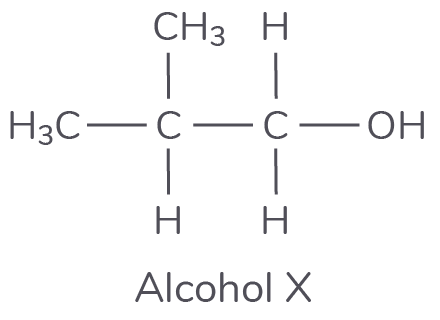
Name alcohol X.
Complete the flow chart in the diagram below to show the structures of the organic products formed in each of the reactions.
Name the type of reaction that forms products B and C, and state the colour change that would be observed in this reaction.
Alcohol X is reacted with CH3CH2COOH.
Draw the structure of the product formed.
This question is about the oxidation reactions of alcohols.
Draw the structures of the two straight-chain isomeric alcohols with the molecular formula C4H10O.
Draw the structures of the organic products formed when the two alcohols in part a) are oxidised with acidified potassium dichromate(VI).
Write an equation for the oxidation of butan-1-ol to a carboxylic acid.
Use [O] to represent the oxidising agent.
Name and draw the structure of the alcohol with molecular formula C4H10O that would be resistant to oxdidation by acidified potassium dichromate(VI).
This question is about the reactions of pentan-2-ol.
Write an equation for the elimination reaction of pentan-2-ol to form an alkene.
Name a suitable catalyst for the elimination reaction in part a).
Write an equation to show the oxidation of pentan-2-ol under reflux with acidified potassium dichromate(VI).
Use [O] to represent the oxidising agent.
Pentan-2-ol is reacted with phosphorus(V) chloride, PCl5.
Write a balanced equation for this reaction.
This question is about pentan-2-ol and pent-1-ene.
The table below shows the boiling points of pentan-2-ol and pent-1-ene.
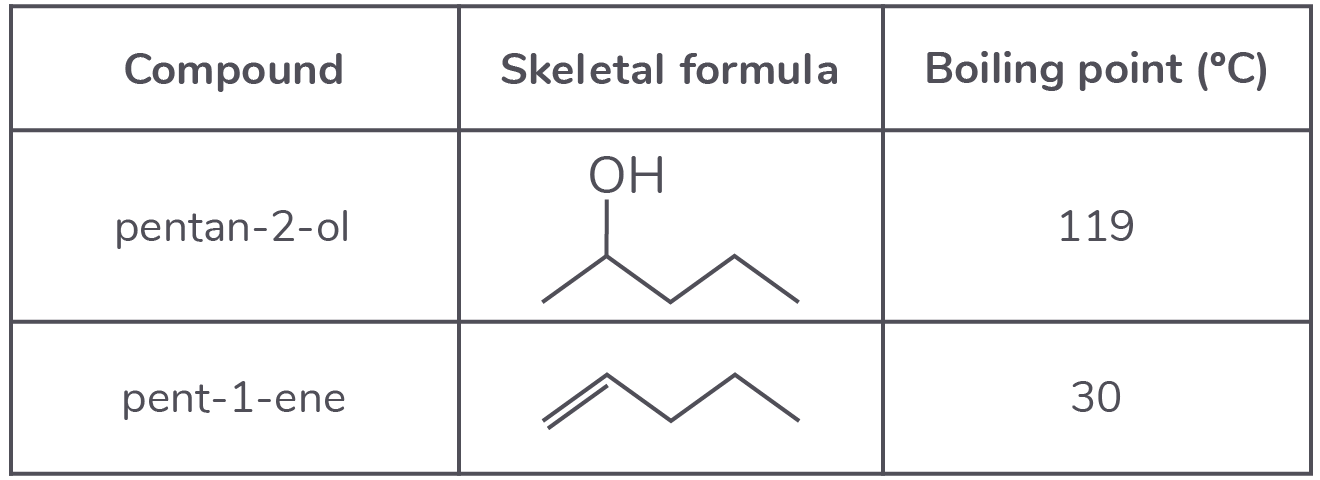
Explain why the boiling point of pentan-2-ol is higher than pent-1-ene.
Draw the structure of the organic product formed when pentan-2-ol is oxidised with acidified potassium dichromate(VI).
Write an equation for the reaction of pentan-2-ol with phosphorus triiodide, PI3