Carbonyl Compounds - exam practice
Carbonyl Compounds
Question 1 of 22
1 of 22
Which carbonyl compound reacts with iodine in the presence of alkali to form a yellow solid?
Question 2 of 22
2 of 22
Propanone has a much higher boiling temperature than butane.
The main reason for this is
Question 3 of 22
3 of 22
Ethanal may be prepared by
Question 4 of 22
4 of 22
CH3CH2COCH2CH3 reacts with hydrogen cyanide to form an organic product called a hydroxynitrile.
Which feature applies to the hydroxynitrile product?
Question 5 of 22
5 of 22
Which reagent will give similar results with both butanone and butanal?
Question 6 of 22
6 of 22
3-methylbutanone is treated with alkaline aqueous iodine. The mixture of products is then acidified.
Which compound is present in the final mixture of products?
Question 7 of 22
7 of 22
Ketones react with hydrogen cyanide, HCN, in the presence of cyanide ions, CN-.
Which of these ketones does not form a racemic mixture in this reaction?
Question 8 of 22
8 of 22
Ketones react with hydrogen cyanide, HCN, in the presence of cyanide ions, CN-.
This type of reaction is classified as
Question 9 of 22
9 of 22
Name the functional group in HCHO.
Question 10 of 22
10 of 22
Which of the following compounds would form an orange-red precipitate when heated with Fehling’s solution?
Question 11 of 22
11 of 22
Which alcohol could not be produced by the reduction of an aldehyde or a ketone?
Question 12 of 22
12 of 22
Which compound forms optically active compounds on reduction?
Question 13 of 22
13 of 22
What is the functional group in C6H5COCH3?
Question 14 of 22
14 of 22
Compound X contains two functional groups.
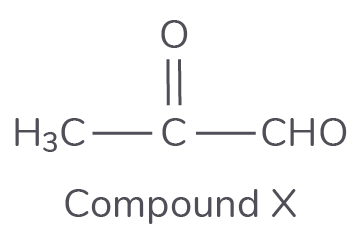
Which reagent will react with only one of the functional groups?
Question 15 of 22
15 of 22
Structural isomerism and stereoisomerism should be considered when answering this question.
Each of the following carbonyl compounds is reacted with LiAlH4. The product of each reaction is heated with concentrated phosphoric acid at 170°C, generating one product or a mixture of isomers.
Which carbonyl compound will produce the most isomers?
Question 16 of 22
16 of 22
What is the formula of the pale yellow solid formed when propanone reacts with iodine in the presence of sodium hydroxide?
Question 17 of 22
17 of 22
Which compound reacts with 2,4-dinitrophenylhydrazine reagent but does not react with Tollens’ reagent?
Question 18 of 22
18 of 22
Compound X, CH3CH(OH)CH(CHO)CH3, is heated under reflux with an excess of acidified K2Cr2O7 to form compound Y.
Both X and Y are separately warmed with Fehling’s solution and the observations noted.
What are the observations?
Question 19 of 22
19 of 22
Alcohol Y gives product Z after mild oxidation. Z gives a positive result with Tollens’ reagent and with 2,4-dinitrophenylhydrazine reagent.
What could be the identity of alcohol Y?
Question 20 of 22
20 of 22
Which reagent cannot be used to distinguish between ethanal and propanone?
Question 21 of 22
21 of 22
A compound, Q, gives an orange precipitate with 2,4-dinitrophenylhydrazine.
Compound Q is resistant to oxidation.
On reduction, Q gives a product made up of a pair of optical isomers.
Which of the following compounds could be compound Q?
Question 22 of 22
22 of 22
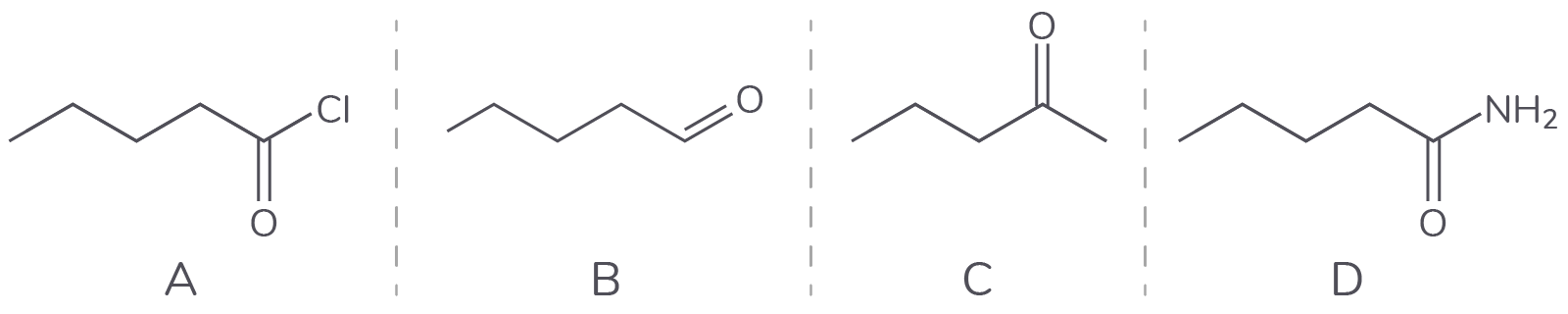
Which of these compounds reacts with iodine and sodium hydroxide in solution to produce a pale yellow precipitate?