Acid-base Equilibria - exam practice
Acid-base Equilibria
Question 1 of 19
1 of 19
Which equation is not a neutralisation reaction?
Question 2 of 19
2 of 19
Which are the Brønsted-Lowry acids in the following equilibrium?
CH3COOH + C2H5COOH ⇌ CH3COO- + C2H5COOH2+
Question 3 of 19
3 of 19
A solution of hydrochloric acid has pH = 2.
The solution is diluted to one tenth of its original concentration.
What is the pH of the diluted solution?
Question 4 of 19
4 of 19
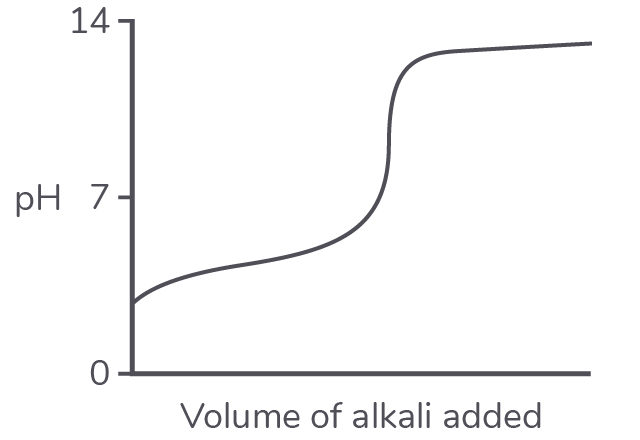
Which two solutions, both of concentration 0.10 mol dm-3, have been used to produce this titration curve?
Question 5 of 19
5 of 19
When equimolar amounts of the solutions below are mixed, which forms a buffer solution with a pH less than 7?
Question 6 of 19
6 of 19
Ammonia reacts with water in a reversible reaction. Which are the Brønsted-Lowry bases?
Question 7 of 19
7 of 19
The indicator methyl orange is a weak acid and may be represented by the formula HA(aq). The equation for its dissociation is shown below.
HA(aq) ⇌. A- + H+(aq)
Colour: Red Yellow
Under certain conditions, at equilibrium, a solution of HA has a yellow colour.
On addition of a small volume of dilute sodium hydroxide, the colour of this solution would
Question 8 of 19
8 of 19
20 cm3 of 0.10 mol dm-3 hydrochloric acid is added to 10 cm3 of 0.10 mol dm-3 sodium hydroxide.
What is the pH of the resulting mixture?
Question 9 of 19
9 of 19
The equation shows the dissociation of the acid H3AsO4 in water.
H3AsO4 + H2O ⇌ H2AsO4- + H3O+
Which pair is a conjugate acid–base pair?
Question 10 of 19
10 of 19
A buffer solution is prepared by mixing 200 cm3 of 2.00 mol dm-3 propanoic acid, CH3CH2COOH, with 600 cm3 of 1.00 mol dm-3 sodium propanoate, CH3CH2COONa.
Ka for CH3CH2COOH = 1.32 × 10⁻⁵ mol dm-3
What is the pH of the buffer solution?
Question 11 of 19
11 of 19
2,4,6-Trichlorophenol is a weak monoprotic acid, with Ka = 2.51 × 10⁻⁸ mol dm-3 at 298 K.
What is the concentration, in mol dm-3, of hydrogen ions in a 2.00 × 10⁻³ mol dm-3 solution of 2,4,6-trichlorophenol at 298 K?
Question 12 of 19
12 of 19
What is the pH of a 0.46 mol dm-3 solution of potassium hydroxide at 298 K?
Kw = 1.0 × 10⁻¹⁴ mol2 dm-6 at 298 K.
Question 13 of 19
13 of 19
The diagram shows a pH curve produced by adding a strong alkali to a weak acid.
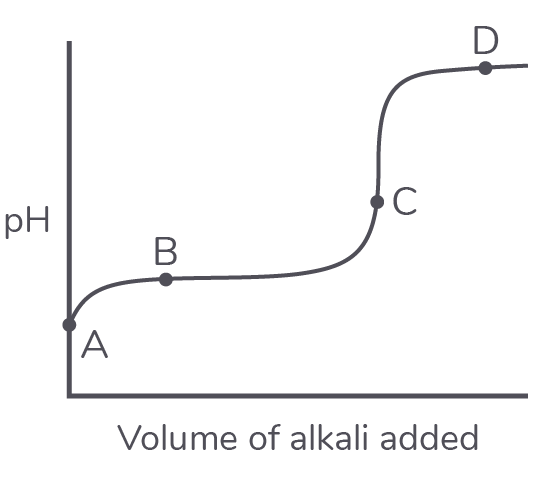
Which point on the curve represents a solution that can act as a buffer?
Question 14 of 19
14 of 19
The acid dissociation constant, Ka, of a weak acid HA has the value 2.56 × 10⁻⁴ mol dm-3
What is the pH of a 4.25 × 10⁻³ mol dm-3 solution of HA?
Question 15 of 19
15 of 19
A 0.10 mol dm-3 aqueous solution of an acid is added slowly to 25 cm3 of a 0.10 mol dm-3 aqueous solution of a base.
Which acid–base pair has the highest pH at the equivalence point?
Question 16 of 19
16 of 19
Which is the concentration of NaOH(aq), in mol dm-3, that has pH = 14.30?
Kw = 1.00 × 10⁻¹⁴ mol2 dm-6 at 25°C
Question 17 of 19
17 of 19
What is the pH of 0.015 mol dm-3 sulfuric acid?
Question 18 of 19
18 of 19
A buffer solution always...
Question 19 of 19
19 of 19
How are 20 cm3 of 0.05 mol dm-3 H2SO4(aq) and 20 cm3 of 0.10 mol dm-3 CH3COOH(aq) alike?
Both solutions...