Entropy - exam practice
Entropy
Question 1 of 15
1 of 15
Which of these changes has the largest increasein the entropy of the system?
Question 2 of 15
2 of 15
Four changes W, X, Y and Z have the following signs for their ∆H and ∆S values.
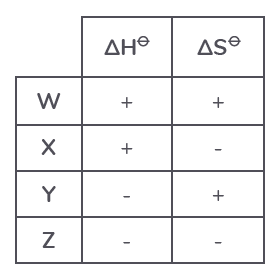
Which of the following is a correct statement?
Question 3 of 15
3 of 15
The table below shows standard entropies, Sө.
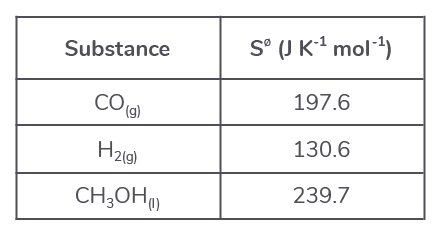
What is the entropy change, ∆Sө, in J mol-1 K-1, for the following reaction?
CO(g) + 2H2(g) ➔ CH3OH(l)
Question 4 of 15
4 of 15
A reaction is exothermic and has a negative entropy change.
Which statement is correct?
Question 5 of 15
5 of 15
Which is correct for the reaction H2O(g) ➔ H2O(l)
Question 6 of 15
6 of 15
Which is correct for a reaction with a positive change in Gibbs free energy, ΔG⦵?
Question 7 of 15
7 of 15
Which statement is correct?
Question 8 of 15
8 of 15
Which statement is correct for a spontaneous reaction?
Question 9 of 15
9 of 15
Which combination of ΔH⦵ and ΔS⦵ will result in a non-spontaneous reaction at all temperatures?
Question 10 of 15
10 of 15
Which combination of entropy (S) and Gibbs free energy (G) values describe a system at equilibrium?
Question 11 of 15
11 of 15
The table shows the variation of standard Gibbs energy with temperature for a reversible reaction.
ΔG⦵ = ΔH⦵ TΔS⦵
ΔG⦵ = RTlnK
| Temperature (K) | ΔG^⦵^ (kJ mol^-1^) |
|---|---|
| 298 | 5.4 |
| 350 | -3.9 |
| 400 | -12.9 |
What can be concluded about the reaction?
Question 12 of 15
12 of 15
Which reaction becomes more spontaneous as temperature increases?
Question 13 of 15
13 of 15
Which change results in the largest negative value of ΔSsys?
Question 14 of 15
14 of 15
Which system has the most negative entropy change, ΔSsys, for the forward reaction?
Question 15 of 15
15 of 15
What is the expression for ΔStotal?