Redox - exam practice
Redox
Question 1 of 21
1 of 21
Which is a redox reaction?
Question 2 of 21
2 of 21
The standard reduction potentials of two systems are
Sn4+(aq) + 2e- ⇌ Sn2+(aq) E⦵ = +0.15 V
Fe3+(aq) + e- ⇌ Fe2+(aq) E⦵ = +0.77 V
What is the value of E⦵cell for the system below?
Sn4+(aq) + 2Fe2+(aq) ➔ Sn2+(aq) + 2Fe3+(aq)
Question 3 of 21
3 of 21
In a hydrogen-oxygen fuel cell, the oxygen is
Question 4 of 21
4 of 21
The reaction between acidified dichromate(VI) ions, Cr2O72-, and aqueous Fe2+ ions results in the dichromate(VI) ions being reduced to Cr3+ ions.
What is the correct equation for this reaction?
Question 5 of 21
5 of 21
The acid used in a standard hydrogen electrode to provide a 1 mol dm-3 solution of hydrogen ions is
Question 6 of 21
6 of 21
To measure the standard electrode potential for the Ag+(aq) | Ag(s) electrode, the most suitable chemical for the solution in a salt bridge to connect the two half cells is
Question 7 of 21
7 of 21
An electrochemical cell consists of a standard hydrogen electrode and a Cu2+(aq) | Cu(s) electrode which uses copper(II) sulfate solution.
Which one of the following does not affect the e.m.f. of the cell?
Question 8 of 21
8 of 21
The standard electrode potentials of two half reactions are shown below.
Cl2 + e- ⇌ Cl- E⦵ = +1.36 V
Co3+ + e- ⇌ Co2+ E⦵ = +1.82 V
Which of the following processes is thermodynamically favourable? The reaction of
Question 9 of 21
9 of 21
A solution of potassium manganate(VII) was used to determine the concentration of iron(II) ions in solution by titration in the presence of excess dilute sulfuric acid.
With the potassium manganate(VII) in the burette, the end-point of the reaction is when the solution in the conical flask turns
Question 10 of 21
10 of 21
Which of the statements about a standard hydrogen electrode, for which E⦵ = 0 V, is correct?
Question 11 of 21
11 of 21
The table below gives the standard electrode potentials of three half cells.
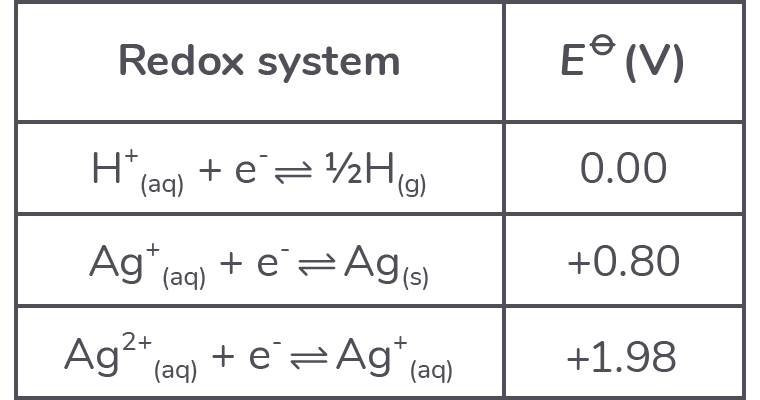
From these data it may be deduced that, under standard conditions,
Question 12 of 21
12 of 21
Which of the following statements about fuel cells is not true?
Question 13 of 21
13 of 21
A student is given the electrode potentials below.
Cu2+ + 2e- ⇌ Cu E⦵ = +0.34 V
Ag+ + e- ⇌ Ag E⦵ = +0.80 V
The student sets up a cell from the two half cells.
Which statement is correct?
Question 14 of 21
14 of 21
The redox equilibria for a hydrogen-oxygen fuel cell in alkaline solution are shown below.
2H2O(l) + 2e- ⇌ H2(g) + 2OH-(aq) E⦵ = –0.83 V
O2(g) + H2O(l) + 2e- ⇌ 2OH-(aq) E⦵ = +0.40 V
What is the equation for the overall cell reaction?
Question 15 of 21
15 of 21
The following cell has an e.m.f. of +0.46 V.
Cu | Cu2+ || Ag+ | Ag
Which statement is correct about the operation of the cell?
Question 16 of 21
16 of 21
The values for two electrodes are shown.
Fe2+(aq) + 2e- ⇌ Fe(s) E⦵ = -0.44 V
Cu2+(aq) + 2e- ⇌ Cu(s) E⦵ = +0.34 V
What is the e.m.f. of the cell Fe(s) | Fe2+(aq) || Cu2+(aq)| Cu(s)?
Question 17 of 21
17 of 21
Which describes the flow of electrons in a voltaic cell?
Question 18 of 21
18 of 21
Which is not a requirement of the standard hydrogen electrode (SHE)?
Question 19 of 21
19 of 21
Where does oxidation occur in a voltaic cell?
Question 20 of 21
20 of 21
Consider the following half-equations:
I2(s) + 2e- ⇌ 2I-(aq)
(brown) (colourless)
MnO4-(aq) + 8H+(aq) + 5e- ⇌ Mn2+(aq) + 4H2O(l)
(purple) (colourless)
Which statement is correct for the reaction between KMnO4(aq) and KI(aq) in acidic conditions?
Question 21 of 21
21 of 21
A voltaic cell is constructed from zinc and copper half-cells. Zinc is more reactive than copper.
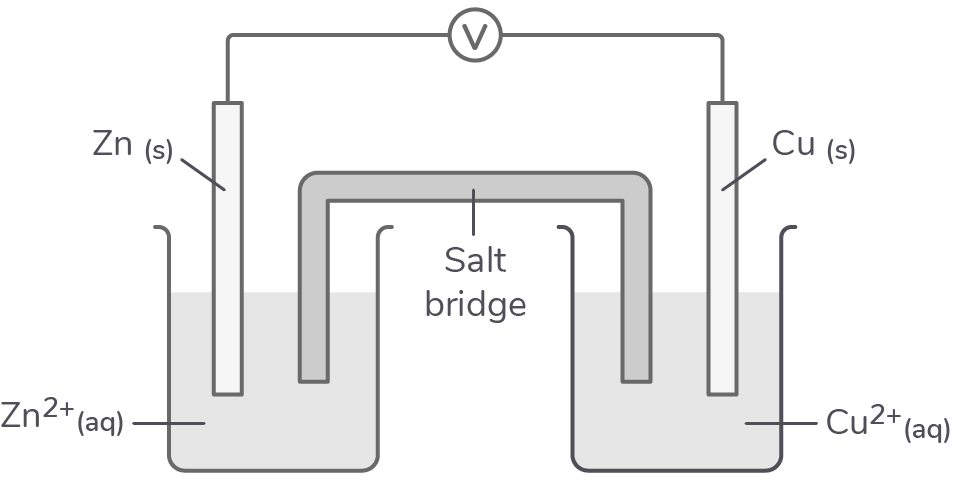
Which statement is correct when this cell produces electricity?