5.3 - Hess' Law
- 1
What Hess' law states
- 2
How enthalpy change can be calculated using enthalpies of reaction
- 3
How enthalpy change can be calculated using enthalpies of formation
- 4
How enthalpy change can be calculated using enthalpies of combustion
Hess' law says route doesn't affect ΔH
Hess' law states that the overall standard enthalpy change (ΔH⦵) of a reaction is the same, regardless of whether the reaction takes place in one step or several steps.
This allows you to break a reaction into component steps and add up their enthalpy changes to find the total ΔH⦵ for the overall reaction.
Worked example 1 - Calculating ΔH⦵ using enthalpy of reaction data
Calculate ΔH⦵r for the reaction: 2C(s) + 2H2(g) + O2(g) ➔ CH3COOH(l) using the following equations:
| Equation | ΔH^⦵^ (kJ mol^-1^) |
|---|---|
| CH_3_COOH_(l)_ + 2O_2(g)_ ➔ 2CO_2(g)_ + 2H_2_O_(l)_ | -875 |
| C_(s)_ + O_2(g)_ ➔ CO_2(g)_ | -394 |
| H_2(g)_ + ½O_2(g)_ ➔ H_2_O_(l)_ | -286 |
Step 1: Draw an enthalpy cycle diagram
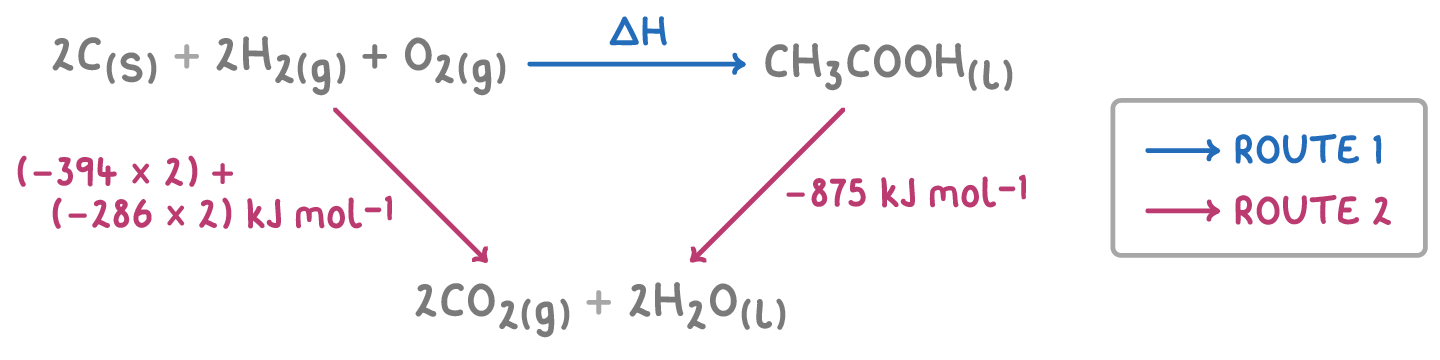
Step 2: Apply Hess' law
ΔH(route 1) = ΔH(route 2)
Step 3: Substitution and correct evaluation
.
Using enthalpies of formation
Standard enthalpies of formation (ΔH⦵f) can be used with Hess' law to determine unknown ΔH⦵ values.
- ΔH⦵f values are known for many compounds.
- ΔH⦵f for elements in their standard states is defined as 0 kJ mol^−1^.
To calculate the standard enthalpy change of a reaction (ΔH⦵r), use the equation:
ΔH⦵r = ΣΔH⦵f(products) - ΣΔH⦵f(reactants)
where Σ = sum of
Worked example 2 - CalculatingΔH⦵ using enthalpy of formation data
Calculate ΔH⦵r for the reaction:
SO2(g) + 2H2S(g) ➔ 3S(s) + 2H2O(l)
Given:
ΔH⦵f(SO2(g) = 297 kJ mol-1
ΔH⦵f(H2S(g)) = 20.2 kJ mol-1
ΔH⦵f(H2O_(l)_) = 286 kJ mol^-1^
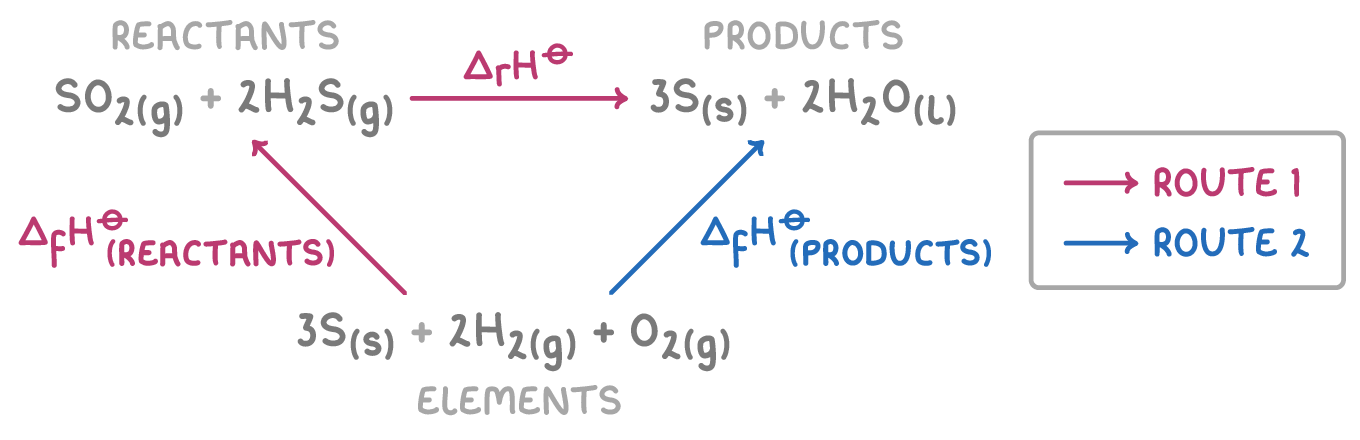
This diagram shows the reaction pathway from reactants to products. We can use Hess' law and known enthalpy values to calculate ΔH⦵ for this reaction.
Step 1: Equation
ΔH⦵r = ΣΔH⦵f(products) ΣΔH⦵f(reactants)
Step 2: Substitution and correct evaluation
ΔH⦵f(products) = 3(0) + 2(286) = 572 kJ mol^-1^
ΔH⦵f(reactants) = -297 + 2(20.2) = 337.4 kJ mol^-1^
Step 3: Determine the overall ΔH⦵
ΔH⦵ = -572 + 337.4 = 234.6 kJ mol^-1^
Therefore, the ΔH⦵ for the reaction is 235 kJ mol^-1^
Using enthalpies of combustion
In a similar way, standard enthalpies of combustion can be used to find unknown ΔH⦵r values for reactions.
To calculate the standard enthalpy change of a reaction (ΔH⦵r), use the equation:
ΔH⦵r = ΣΔH⦵c(reactants) ΣΔH⦵c(products)
where Σ = sum of
Worked example 3 - Calculating ΔH⦵ using enthalpy of combustion data
Calculate ΔH⦵r for the reaction:
C2H5OH(l) + 3O2(g) ➔ 2CO2(g) + 3H2O(l)
Given:
ΔH⦵c(C_2_H_5_OH) = 1,367 kJ mol^−1^
ΔH⦵c(C) = 394 kJ mol^−1^
ΔH⦵c(H_2_) = 286 kJ mol^−1^
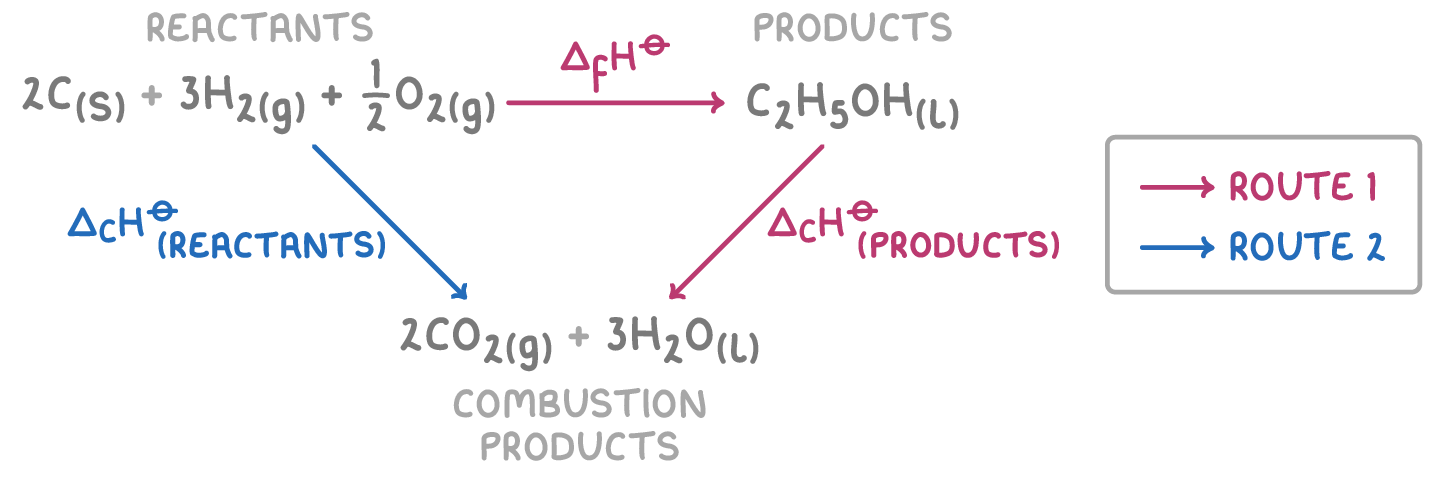
This diagram shows the reaction pathway from reactants to products. We can use Hess' law and known enthalpy values to calculate ΔH⦵ for this reaction.
Step 1: Equation
ΔH⦵r = ΣΔH⦵c(reactants) ΣΔH⦵c(products)
Step 2: Substitution and correct evaluation
ΔH⦵c(reactants) = 2(-394) + 3(-286) = 1,646 kJ mol^-1^
ΔH⦵c(products) = 1,367 kJ mol^-1^
Step 3: Determine the overall ΔH⦵
ΔH⦵ = -1,646 (1,367) = 279 kJ mol^-1^
Therefore, the ΔH⦵ for the formation of ethanol is 279 kJ mol^-1^.