The Periodic Table: Chemical Periodicity - exam practice
The Periodic Table: Chemical Periodicity
Question 1 of 15
Elements and their compounds exhibit similarities and differences based on their respective positions within the Periodic Table.
Considering only the elements in periods 1-3, name the element with the largest atomic radius.
Considering only the elements in periods 1-3, name the element with the largest ionic radius.
Considering only the elements in periods 1-3, name the element with the highest first ionisation energy.
Considering only the elements in periods 1-3, name the element with the largest electronegativity.
Describe what you would observe when magnesium is heated in steam.
Write an equation for the reaction that occurs.
Describe what you would observe when silicon(IV) chloride reacts with water.
Write an equation for the reaction that occurs.
Suggest the pH of the resulting solution.
The elements in period 3, from sodium to phosphorus, can react with chlorine to form chlorides.
State and explain the changes in oxidation states which occurs when chlorine reacts with other period 3 elements.
Write an equation to show the reaction of sodium chloride when added to water.
Write an equation to show the reaction of phosphorus(V) chloride when added to water.
Complete the table to describe the structure and bonding in magnesium chloride, anhydrous aluminium chloride and phosphorus(V) chloride.
State the meaning of the term periodicity.
Identify the element in period 3 with the highest electronegativity value.
Identify the element in period 3 with the largest atomic radius.
Explain your answer.
Melting points show a trend across a period.
The melting points of some period 3 elements are shown in the table below.

Explain the trend shown in melting point, in terms of structure and bonding.
Define the term first ionisation energy.
State and explain the trend in first ionisation energy of the elements in group 2.
The first ionisation energy of aluminium is lower than that of magnesium.
Give the full electronic configurations of an atom of aluminium and an atom of magnesium.
Explain the difference in the first ionisation energies of the two metals.
Successive ionisation energies provide evidence for the existance of different electron shells in atoms.
Write an equation to represent the third ionisation energy of nitrogen
Describe what can be deduced about the electronic structure of nitrogen from its successive ionisation energies.
On the axes below, add crosses to estimate the successive ionisation energies of nitrogen.
Explain why the first ionisation energy of nitrogen is higher than the first ionisation energy of carbon.
This question is about the periodicity of the period 3 elements.
State and explain the general trend in first ionisation energy across period 3.
Give one example of an element which deviates from the general trend in first ionisation energy across Period 3.
Explain why this deviation occurs.
Identify the element in period 3 that has the highest melting point.
Explain your answer in terms of structure and bonding.
Identify the metallic element in period 3 that has the highest melting point.
Explain your answer in tems of structure and bonding
The log of the third ionisation energy for six elements is shown in the table below.
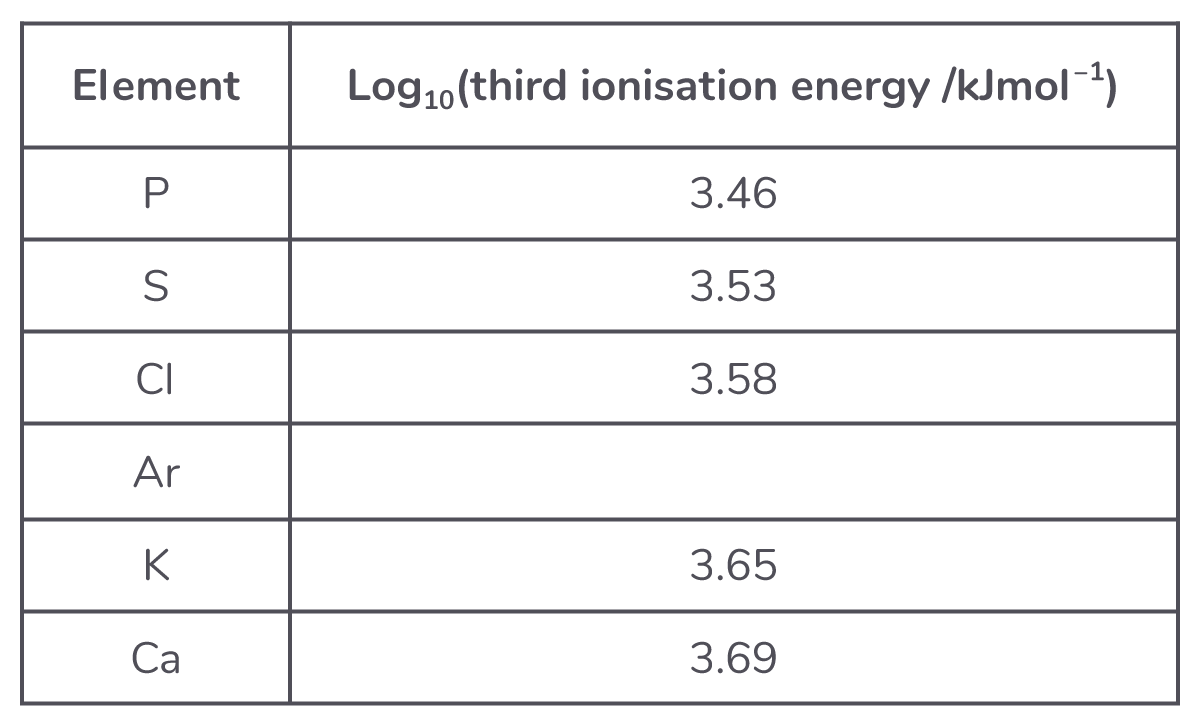
Plot a graph of these data
Use the graph in part a) to estimate the third ionisation energy for argon, in kJ mol-1.
Give your answer to the nearest whole number.
Suggest why the third ionisation energy of chlorine and argon are similar in magnitude.
The melting points of the period 3 elements are shown in the table below.

Explain the trend in melting points across the elements of period 3 in terms of their structure and bonding.
This question is about some period 3 elements and their oxides.
Write an equation for the reaction of phosphorus with an excess of oxygen.
Describe a chemical test you could carry out to distinguish between phosphorus oxide and sodium oxide.
Element X forms an amphoteric oxide that has a very high melting point.
Write the formula of this amphoteric oxide.
State the meaning of the term amphoteric.
Write two equations to show the amphoteric nature of aluminium oxide when it reacts with hydrochloric acid and with sodium hydroxide.
State symbols are not required.
Period 3 oxides can exhibit acidic and/or basic properties depending on the identity of the period 3 element.
Write an equation for the reaction of sulfur trioxide with potassium hydroxide solution.
Write an equation for the reaction of an excess of magnesium oxide with phosphoric acid.
Write an equation for the reaction of sodium oxide with phosphorus(V) oxide in the absence of water.
Sulfur dioxide reacts with water to form a weakly acidic solution.
Ions are formed when sulfur dioxide reacts with water.
Write an equation for this reaction.
Suggest why sulfur dioxide forms a weakly acidic solution.
Refer to the equation in part a).
Suggest why silicon dioxide is described as an acidic oxide even though it doesn't dissolve in water.
Explain why sodium oxide and magnesium oxide form alkaline solutions when added to water.
Give the approximate pH values of the resulting solutions formed when sodium oxide and magnesium oxide are added to water.
Explain your reasoning.
The elements from sodium to sulfur in period 3 all react with oxygen to form oxides.
Describe two observations for the reaction that takes place when sodium is heated in oxygen.
Write an equation for this reaction.
Describe two observations for the reaction that takes place when phosphorus is heated in oxygen.
Write an equation for this reaction.
Describe two observations for the reaction that takes place when magneisum is heated in steam.
Write an equation for this reaction.
The question is about the elements of period 3 from sodium to phosphorus.
Element X forms an oxide that has a very high melting point. This oxide reacts very slowly with water to form a weakly alkaline solution.
Deduce the type of bonding in this oxide of X.
Identify element X.
Write a balanced symbol equation for the reaction between element X and hydrochloric acid.
Element Y forms an oxide that has a low melting point. This oxide dissolves in water to form an acidic solution.
Deduce the type of bonding in this oxide of Y.
Identify element Y.
Write an equation for the reaction between this oxide of Y and water.
Element Z forms an oxide that is insoluble in water.
This oxide reacts with hydrochloric acid and with aqueous sodium hydroxide.
Identify element Z.
Give the formula for this oxide.
Give an equation for the reaction of this oxide with hydrochloric acid.