Hydroxy Compounds - exam practice
Hydroxy Compounds
Question 1 of 3
This question is about phenol.
Draw the structure of phenol.
The diagram below shows the reaction of phenol with the electrophile NO2+ to produce 4-nitrophenol.
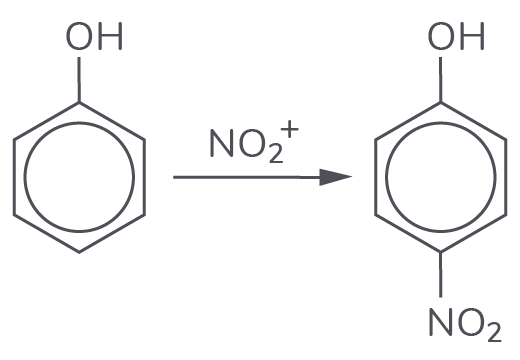
Outline a mechanism for this reaction.
Name the mechanism involved in the nitration of phenol.
Explain why phenol is nitrated more readily than benzene.
Complete the diagram below to show the structure of the organic product formed when phenol is reacted with bromine.
Describe how the orbitals from carbon atoms interact to form the bonds in a benzene ring.
Compare and contrast the bromination of phenol with the bromination of benzene.
The diagram below shows the nitration of benzoic acid to form 3-nitrobenzoic acid.
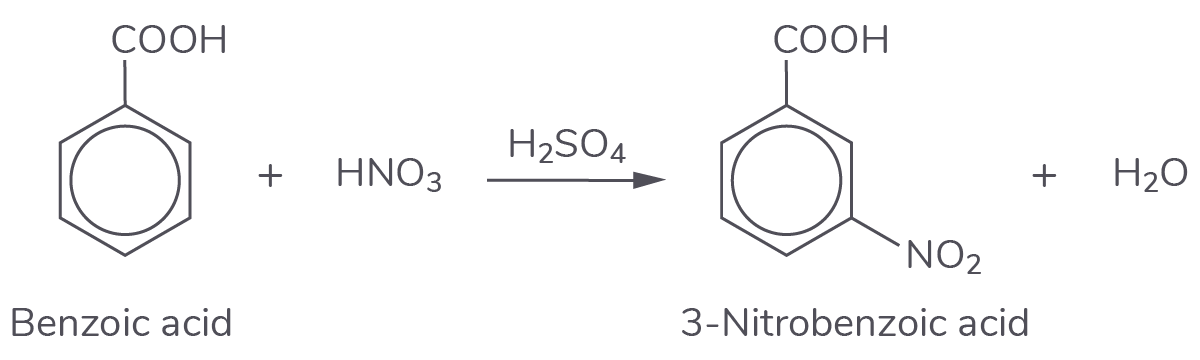
Write an equation to show the formation of the electrophile from H2SO4 and HNO3.
Outline a mechanism for the nitration of benzoic acid.
Write an equation to show the regeneration of the H2SO4 catalyst.
Complete the diagram below to show the organic products that would form in the nitration of phenol.
The diagram below shows the structure of benzaldehyde, the simplest aromatic aldehyde.
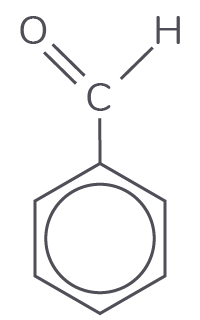
Write an equation for the formation of the electrophile from H2SO4 and HNO3 in the nitration of benzaldehyde.
Outline a mechanism for the formation of 3-nitrobenzaldehyde.
The diagram below shows the structure of methoxybenzene. Methoxybenzene reacts in a similar way to phenol.
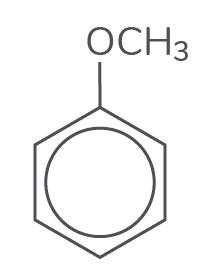
Draw the structure of the organic product that would form when methoxybenzene is reacted with excess bromine.
Explain why the reaction of methoxybenzene with bromine does not require a halogen carrier.
Two of the hazard warning signs for methoxybenzene are
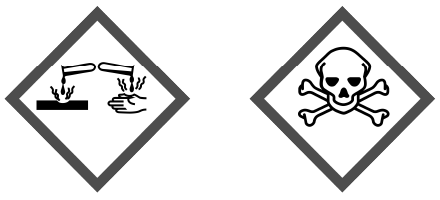
State the most important hazard associated with phenol in this experiment and the precaution you would take to reduce the risk, apart from wearing safety goggles and a laboratory coat.