Organic Synthesis - exam practice
Organic Synthesis
Question 1 of 6
Organic compounds can be prepared in the laboratory using synthetic routes with one or more stages.
A 2-stage synthesis is used to prepare cyclohexene from bromocyclohexane as shown in the diagram below.
Draw the structure of the intermediate and give the reagent(s)/conditions required for step 2.
Cyclohexene is reacted with bromine to prepare an organic compound.
Name and draw the structure of this product
Outline a 2-stage synthesis of 2-bromobutane from 1-bromobutane.
Draw the structure of the intermediate and give the reagent(s) or conditions required for each stage.
Propene can be converted into propan-2-ol by two different synthetic routes.
Give the reagent(s) and conditions that would be required to convert propene into propan-2-ol using a one-step synthesis.
Write an equation for the one-step synthesis of propan-2-ol from propene.
Complete the reaction scheme below to show the intermediate and the reagent(s) or conditions required for the two-step synthesis of propan-2-ol from propene.
Identify the functional groups in each of the following compounds:
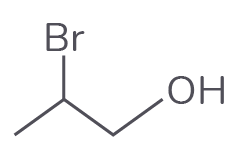
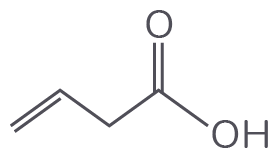
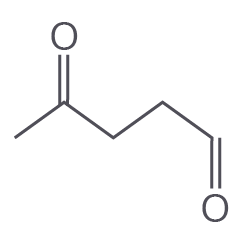
Describe how each of the compounds below can be synthesised from butan-1-ol in one step.
Include equations and reagent(s) or conditions in your answer.
But-1-ene
Butanoic acid
1-Bromobutane
State the reagents, conditions, and give equations for each of the following two-stage organic syntheses.
Propene to propanone
Propan-2-ol to propane
Propene to propane-1,2-diol.
A multi-stage synthesis starting from butan-1-ol is shown in the diagram below.
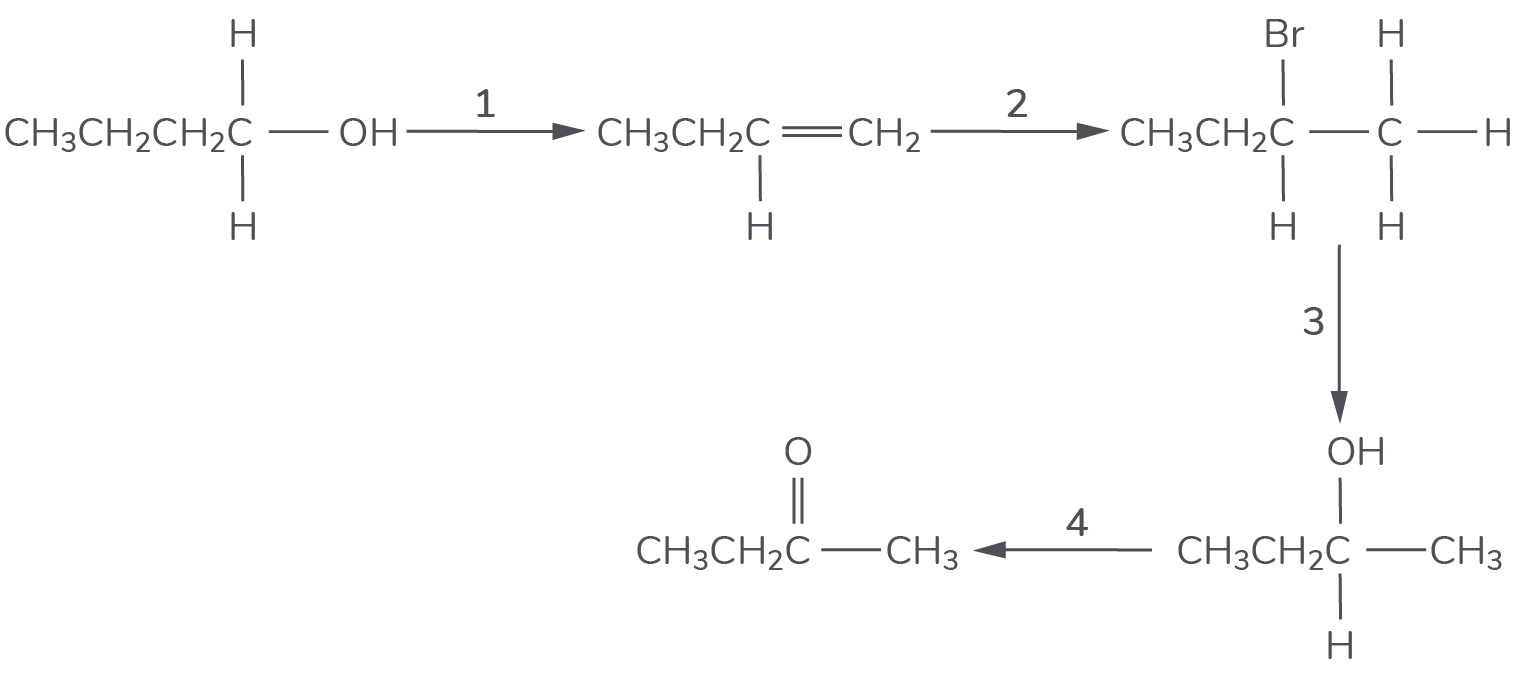
For each step, identify the reagent(s) and conditions required.
State the type of reaction occurring in step 1.
What would be observed in step 4?
How could the product of step 1 be converted into an alkane?