Nitrogen Compounds - exam practice
Nitrogen Compounds
Question 1 of 7
Amines can be prepared from halogenoalkanes.
Outline a mechanism for the reaction of NH3 with 1-bromohexane to form an amine.
Name the mechanism for the reaction in part a).
Draw the structures of a secondary amine and a tertiary amine that could form in the reaction in part a) if 1-bromohexane is in excess.
Primary amines can also be formed from the reduction of nitriles.
Use your answer to part c) to suggest why reduction might be the preferred method for the formation of primary amines.
Name the compound with the structural formula (CH3)2NH.
(CH3)2NH can be formed by reacting CH3Br with an excess of CH3NH2.
Outline a mechanism for this reaction.
Draw the structure of the product formed if a large excess of CH3Br is reacted with CH3NH2.
The diagram below shows a compound containing an aldehyde functional group.
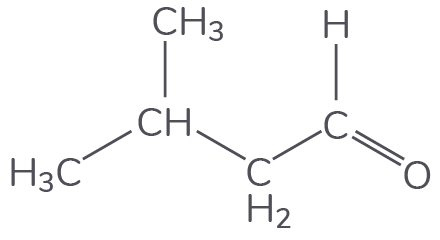
Describe a suitable chemical test, including the observation that would be made, to identify the aldehyde functional group in this compound.
Outline a mechanism for the reaction shown in the diagram below.
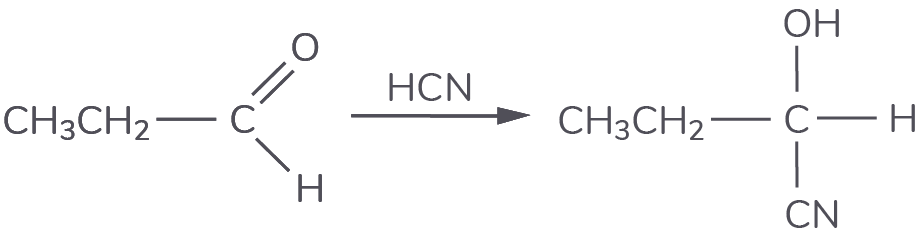
Name the product formed in the reaction in part b).
Propanone reacts with HCN and dilute acid to form a hydroxynitrile. The reaction is usually carried out with KCN instead of HCN.
Suggest why KCN is used instead of HCN.
Outline the mechanism for the reaction of propanone with KCN and dilute acid.
Explain why the reaction in part b) does not produce a racemic mixture.
Which of the following compounds produces a racemic mixture when reacted with KCN and dilute acid?
The carbon chain of a compound can be extended by reaction with the cyanide ion, CN-.
Write an equation for the reaction of bromoethane with potassium cyanide.
Outline a mechanism for the reaction of bromoethane with potassium cyanide.
Write an equation for the reaction between propanal and hydrogen cyanide.
Outline a mechanism for the reaction between propanal and hydrogen cyanide.
The diagram below shows the structure of lactic acid, a naturally occurring chemical that can be synthesised from ethanal.
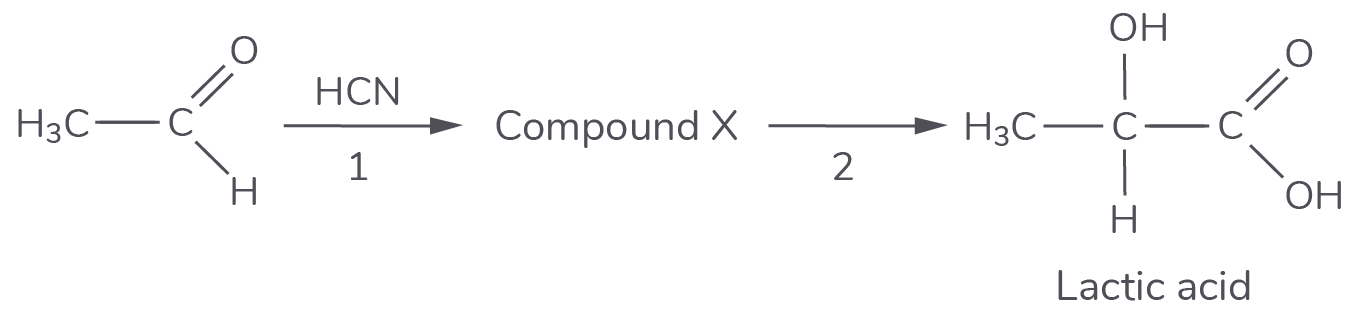
Draw the structure of compound X.
Suggest a reagent for step 2.
Compound X is reduced using H2 and a nickel catalyst.
Draw the skeletal formula of the product.
This question is about amine X with the empirical formula C3H9N.
Isomers of amine X include a primary, a secondary, and a tertiary amine.
Draw the structures of each of these three isomers.
Propan-1-amine is formed from the reaction between ammonia and a bromoalkane.
Write an equation for this reaction.
Name the type of reaction occuring in part b).