Polymerisation - exam practice
Polymerisation
Question 1 of 3
This question is about the alkene 2-bromopropene.
Three reactions of 2-bromopropene are shown in the diagram below.
Complete the flowchart to show the product formed in each reaction.
Suggest a suitable catalyst for reaction C.
State the name of the process used to produce poly(2-bromopropene) from 2-bromopropene.
Complete the equation below to show the polymerisation of 2-bromopropene.
Give one advantage and one disadvantage of the disposal of poly(2-bromopropene) by incineration.
This question is about the reactions of some alkenes.
Explain why alkenes are generally more reactive than alkanes.
Complete the table below to show the structures of the products formed and the type of each reaction when propene reacts with the following reagents.
The diagram below shows the structure of the polymer polystyrene.
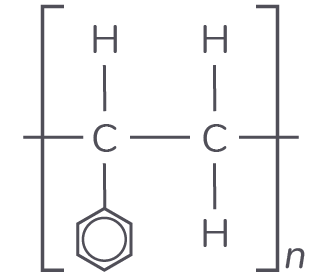
Draw the structure of the monomer used to produce polystyrene.
Waste polymers can be disposed of by combustion.
State one problem with the disposal of polymers containing the element chlorine by combustion.
Pent-2-ene and cyclopentane are structural isomers with the molecular formula C5H10.
Identify a suitable reagent that could be used to distinguish between separate samples of these two hydrocarbons.
State the observations you would make in each case.
2-methylbut-2-ene also has the molecular formula C5H10.
Outline a mechanism for the formation of 2-chloro-2-methylbutane from the reaction between 2-methylbut-2-ene and HCl.
Explain why 2-chloro-3-methylbutane would also be formed in this reaction but in a smaller quantity.
Poly(chloroethene) is commonly known as PVC.
Complete the equation below to show the formation of poly(chloroethene) from chloroethene.