Nitrogen and Sulfur - exam practice
Nitrogen and Sulfur
Question 1 of 5
Nitrogen, N2, is an inert gas that makes up 78% of the Earth’s atmosphere.
Explain why nitrogen is inert.
Draw a dot and crossdiagram of a nitrogen molecule, showing the outer electrons only.
During lightning strikes, nitrogen, N2, and oxygen, O2, react together in the air to form nitrogen monoxide, NO.
Explain why the reaction of N2 and O2 occurs during lightning strikes.
Write an equation for this reaction, including state symbols.
Write two equations, including state symbols, to suggest how the nitrogen monoxide formed reacts further to produce nitric acid, HNO3.
This question is about ammonia and its compounds.
Draw the shape of a molecule of ammonia, NH3.
State the name of the shape and give a value of the bond angle.
The following reaction shows the formation of the ammonium ion, NH4+, from ammonia:
NH3 + H+ ➔ NH4+
Explain the role of ammonia in this reaction.
Draw a dot and cross diagram of the ammonium ion.
Some soils have compounds such as ammonium nitrate, calcium carbonate, and calcium hydroxide added to them.
Suggest why ammonium nitrate is added to soils.
Suggest why calcium hydroxide is added to soils.
Calcium ammonium nitrate, is a fertiliser formed when solid calcium carbonate is added to a mixture of aqueous ammonium nitrate and dilute nitric acid.
Suggest two observations that could be made when this reaction occurs.
Calcium nitrate decomposes at a higher temperature than calcium ammonium nitrate.
Write an equation, including state symbols, for the thermal decomposition of calcium nitrate.
Name a group 2 metal nitrate that decomposes at a lower temperature than calcium nitrate.
A pupil investigates the reaction between calcium hydroxide and ammonium nitrate.
A diagram of their apparatus is shown below.
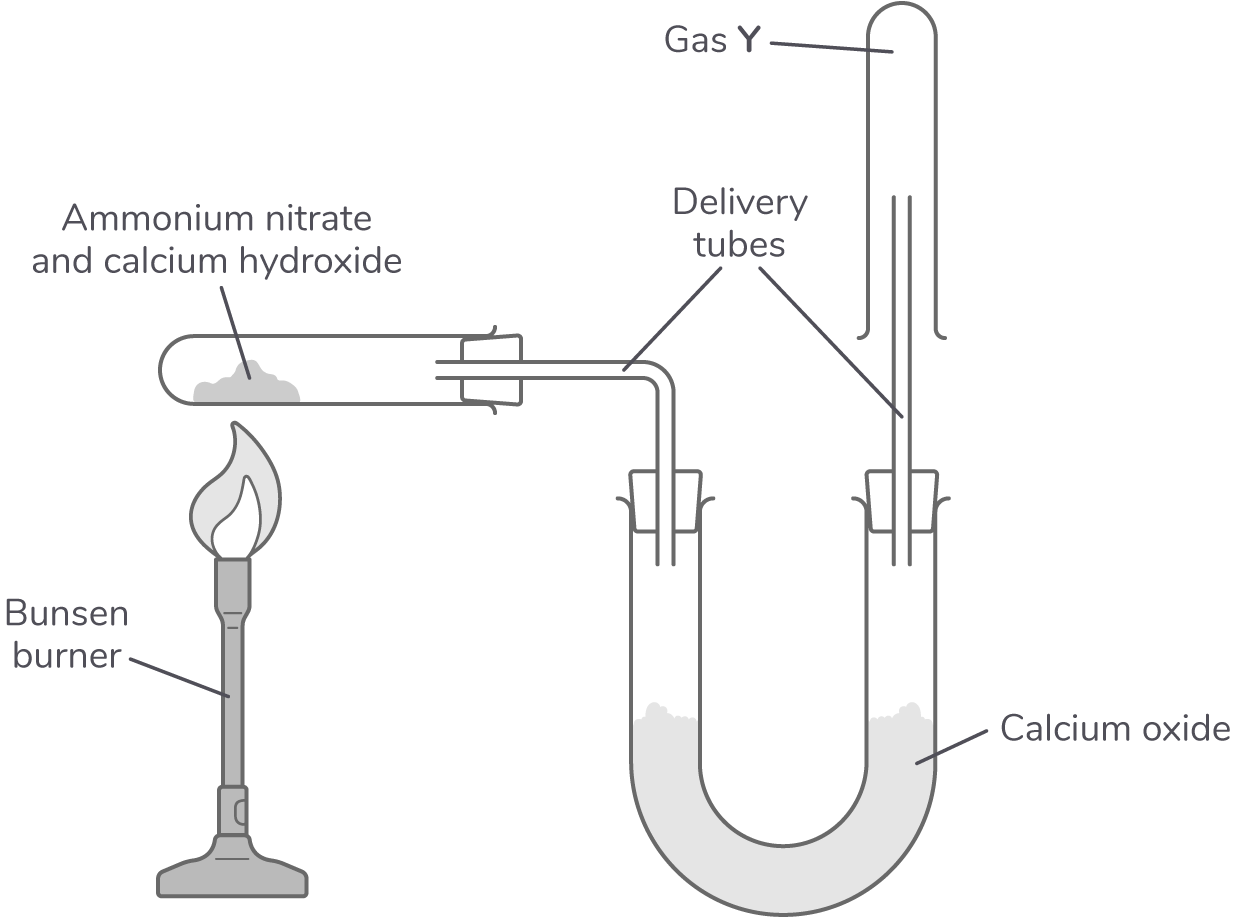
The pupil collects an unknown gas Y in the reaction.
State the identity of gas Y and explain why the reaction occurs.
Describe a test the pupil could carry out to confirm that gas Y is ammonia.
Write an equation, including state symbols, for the reaction between calcium hydroxide and ammonium nitrate.
Explain, with the use of an equation, the role of calcium oxide in this experiment.
This quetion is about the environmental consequences of nitrogen oxides.
Nitrogen(II) oxide and carbon monoxide are pollutants produced by the internal combustion engines of motor vehicles.
Write an equation to show the removal of nitrogen(II) oxide and carbon monoxide from exhaust gases by catalytic converters.
The main cause of acid rain is sulfuric acid, H2SO4. The flowchart below shows how sulfuric acid is formed by a two-step reaction via the sulfur trioxide, SO3, intermediate.

Sulfur dioxide, SO2, is oxidised to sulfur trioxide, SO3, in step A. Oxides of nitrogen play an important role this reaction.
Explain the role of nitrogen oxides in step A.
Include relevant equations in your answer.
Explain, with the use of oxidation states, why the reaction in step A is a redox process:
SO2(g) + NO2(g) ➔ SO3(g) + NO(g)
Write an equation for step B.
Include state symbols.
Nitrogen oxides can react with substances in the air to make secondary pollutants.
One of these secondary pollutants is peroxyacetyl nitrate (PAN).
State the type of compounds that react with nitrogen oxides to produce PAN.
PAN is a component of photochemical smog.
Explain why smog is described as photochemical.