Group 2 - exam practice
Group 2
Question 1 of 6
This question is about the solubility of group 2 sulfates.
Describe and explain the trend in the solubilities of the sulfates of group 2 from Mg to Ba.
The solubility products, Ksp, of some group 2 carbonates are shown in the table below.
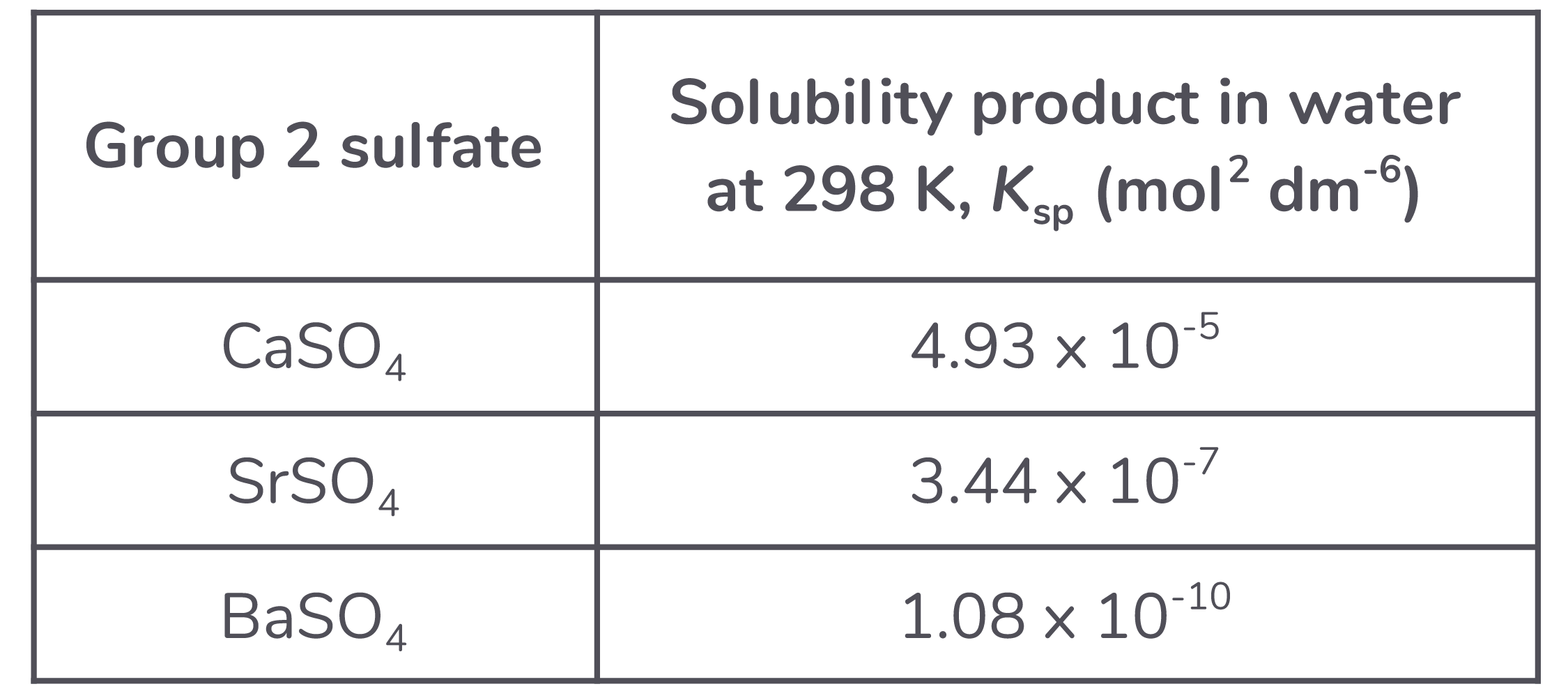
Write an equation, including state symbols, to show the equilibrium for the solubility product for CaSO4.
Using the equation from b), predict what is observed when 3 cm3 of a concentrated solution of Mg(SO4)(aq) is added to a saturated solution of CaSO4.
Explain your answer.
Use data in the table to calculate the solubility of CaSO4 in water at 298 K, in g dm-3.
Give your answer to 3 significant figures.
State the meaning of the term enthalpy of solution, ΔHsol.
The following table lists some enthalpy changes for compounds of magnesium and barium.
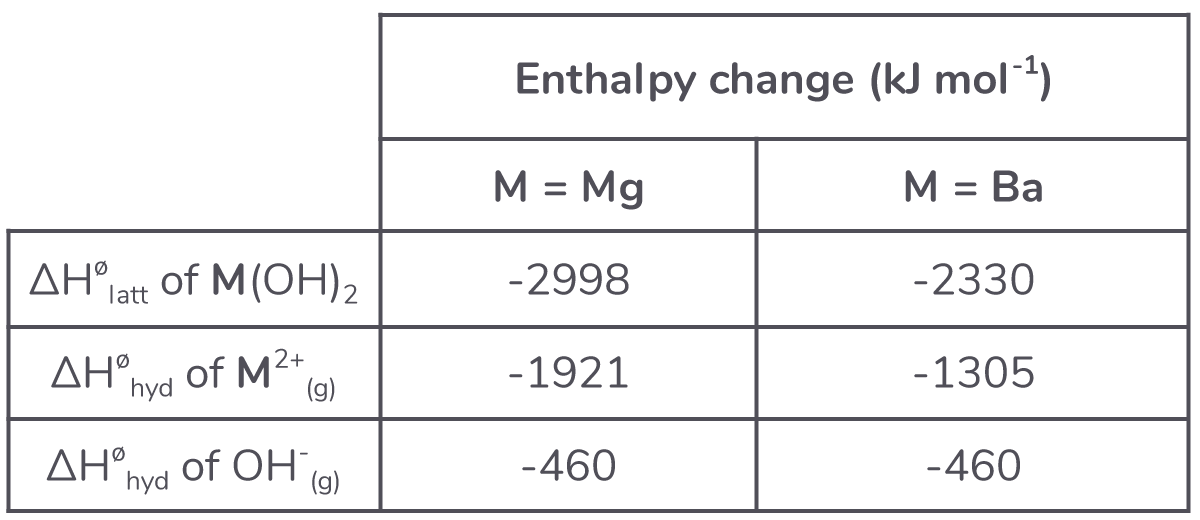
Use data in the table above to calculate the values, in kJ mol-1, of ΔHsol for Mg(OH)2 and Ba(OH)2.
Use your results to part b) to suggest whether Mg(OH)2 is more or less soluble than Ba(OH)2.
Explain your answer.
This question is about the thermal stability of group 2 nitrates.
Write an equation, including state symbols, for the thermal decomposition of magnesium nitrate.
Calcium nitrate can be thermally decomposed to produce calcium oxide, nitrogen dioxide and oxygen.
The equation for the reation is:
Ca(NO3)2(s) ➔ CaO(s) + 2NO2(g) + O2(g) ΔH = +235 kJ mol-1
The table below shows the standard entropy values of each substance.
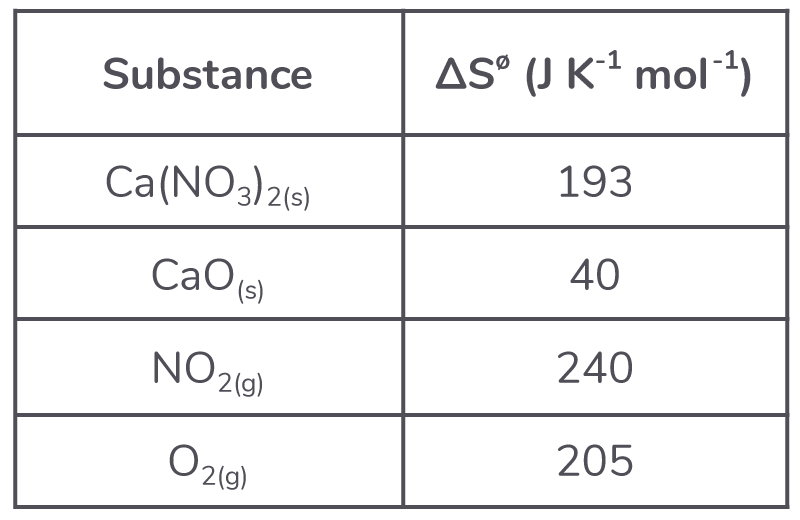
Use data in the table above to show that calcium nitrate is stable at 298 K.
Calculate the minimum temperature, in °C needed to decompose calcium nitrate.
Give your answer to the nearest integer.
The ionic radii of three ions are shown in the table below.
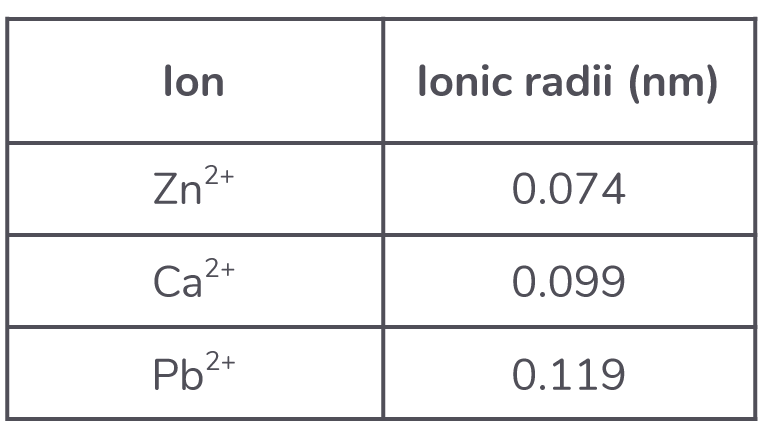
Suggest how the thermal stability of zinc nitrate might compare to that of calcium nitrate.
Explain your answer.
Suggest how the thermal stability of lead nitrate might compare to that of calcium nitrate.
Explain your answer.
All of the group 2 carbonates can be decomposed upon heating.
Write an equation for the thermal decomposition of calcium carbonate.
The thermal stability of the group 2 carbonates changes down the group.
Describe and explain the trend in thermal stability of group 2 carbonates.
Calcium carbonate was heated in an open boiling tube.
Suggest two reasons why it was difficult to observe whether a thermal decomposition took place.
Which of the following ions has the strongest polarising power. Explain your answer.
- Na+
- Mg2+
- K+
- Ca2+
Which of the following ions is the most polarisable. Explain your answer.
- F-
- Cl-
- Br-
- I-
Which of the following ions has the smallest (least exothermic) enthalpy change of hydration. Explain your answer.
- Na+
- Mg2+
- K+
- Ca2+
Which of the following compounds has the largest (most exothermic) lattice energy. Explain your answer.
- MgO
- CaO
- KCl
- RbCl
An experiment was carried out on a sample of hydrated calcium nitrate crystals, Ca(NO3)2⸱2H2O.
Calcium nitrate crystals were heated gently in a test tube. Fumes which looked like steam were given off.
Give the name of a substance that could be used to test for the presence of steam in the fumes.
Describe the expected colour change for this test.
On further heating of the sample, a mixture of two gases was evolved. One of the gases was coloured, the other was colourless.
Identify the coloured gas and give its colour.
Identify the colourless gas. Give a test for the gas and its result.
A white solid remained after complete decomposition.
Complete the equation for this decomposition of the hydrated crystals.
State symbols are not required.
The white solid which remained in the test tube was allowed to cool to room temperature.
Distilled water was added to it, and a solution formed.
Give the name of the solution which forms when distilled water is added to the white solid.
This solution is used in a common laboratory test for a gas.
Identify this gas.