Carbonyl Compounds - exam practice
Carbonyl Compounds
Question 1 of 8
Carbonyl compounds can be reduced by sodium borohydride, NaBH4.
Outline a mechanism for the reduction of butanal using NaBH4.
Name the mechanism in part a).
Explain why NaBH4 cannot be used to reduce alkenes.
A sample of butanal was reduced but insufficient NaBH4 was added.
Give a chemical test, and the observation that would be made, to confirm the reaction was incomplete.
Write an overall equation for the reaction of propanone with NaBH4,
Use [H] to represent the reducing agent.
The flowchart below shows the synthesis of a hydroxynitrile from butan-2-ol.

Give the reagent(s) and conditions required for step 1.
Give a chemical test, and the observation that would be made, to identify the carbonyl group in the product of step 1.
Give a chemical test, and the observation that would be made, to identify the CH3CO group in the product of step 1.
In step 2, butanone undergoes an addition reaction with CN- ions.
Outline the mechanism for this reaction.
Name the product formed in part d).
Explain why the product in part d) has no effect on plane polarised light.
Pentanal reacts with KCN and dilute acid to form a racemic mixture of two stereoisomers.
Outline a mechanism for the reaction of pentanal with KCN and dilute acid.
Name the product formed in part a).
Describe how you could distinguish between separate samples of the two stereoisomers formed in the reaction in part a).
An isomer of pentanal reacts with KCN and dilute acid to produce a compound that doesn't show stereoisomerism.
Draw the structure of this compound.
Explain why the compound drawn in part d) does not show stereoisomerism.
Butanone can be reduced using sodium borohydride, NaBH4, and dilute acid.
Write an overall equation for the reduction, using [H] to represent the reducing agent.
Explain why the product of the reduction in part a) has no effect on plane polarised light.
Refer to the mechanism of the reaction in your answer.
Which of the following alcohols could not be produced by the reduction of an aldehyde or ketone?
But-2-enal has the structural formula CH3CH=CHCHO.
Describe a chemical test, and give the observation that would be made, to confirm that but-2-enal is an aldehyde.
Draw the skeletal formula of the product that would form when but-2-enal is reacted with NaBH4.
Name the type of reaction occurring in part b).
Butanal and butanone both react with 2,4-DNPH to produce a yellow precipitate.
Outline how the precipitates can be used to distinguish between the two carbonyl compounds.
Outline a mechanism for the reaction of (CH3)2CHCHO with KCN and dilute acid.
Name the product formed in part a).
The reaction in part a) produces a pair of optical isomers.
Draw the structures of these isomers.
The diagram below shows the structures of the compounds cinnamaldehyde and methylcinnamaldehyde.
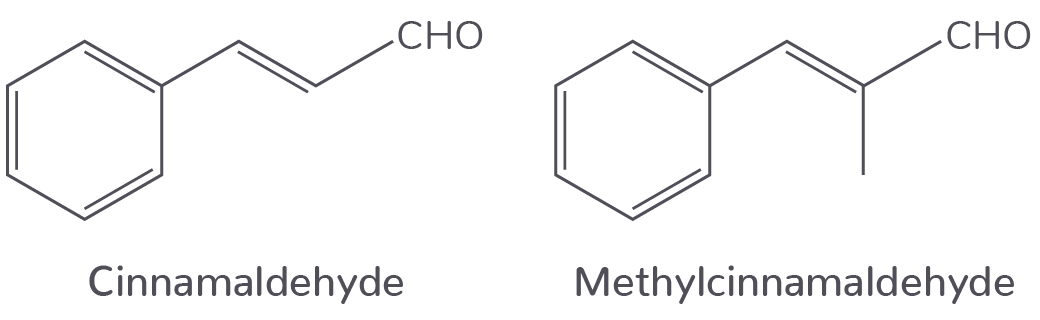
Describe a chemical test, and give the observation that would be made, to confirm that both compounds contain an aldehyde functional group.
Describe a chemical test, and give the observation that would be made, to confirm the presence of a carbonyl group in both compounds.
Include how the two compounds could be distinguished.
Complete the diagram below to show the structure of the product formed when cinnamaldehyde is reacted with NaBH4.
Complete the diagram below to show the structure of the product formed when methylcinnamaldehyde is reacted with KCN and dilute acid.
This question is about the aldehyde ethanal.
Describe the test for an aldehyde and give the result.
Name the reagent that is needed to convert ethanal into ethanol.
Outline the mechanism for the reaction between ethanal and KCN/H+.