Nitrogen Compounds - exam practice
Nitrogen Compounds
Question 1 of 8
Amines can be prepared by the reaction of haloalkanes with ammonia.
Write an equation for the formation of butylamine, CH3CH2CH2CH2NH2, from ammonia and 1-bromobutane.
Name the mechanism for the reaction in part a).
Explain why butylamine is a stronger base than ammonia.
Draw the skeletal formula of a tertiary amine which is an isomer of butylamine.
This question is about propylamine.
Draw the structure of a nitrile compound which can be reduced to form propylamine.
Suggest a suitable reagent for the reduction of a nitrile compound to form an amine.
Isomers of propylamine include a primary, a secondary, and a tertiary amine.
Draw the structures of each of these three isomers.
Propylamine reacts with ethanoyl chloride to form an amide.
Outline a mechanism for this reaction.
Name the amide formed in the reaction in part d).
The diagram below shows the amino acids leucine, proline and glutamic acid.
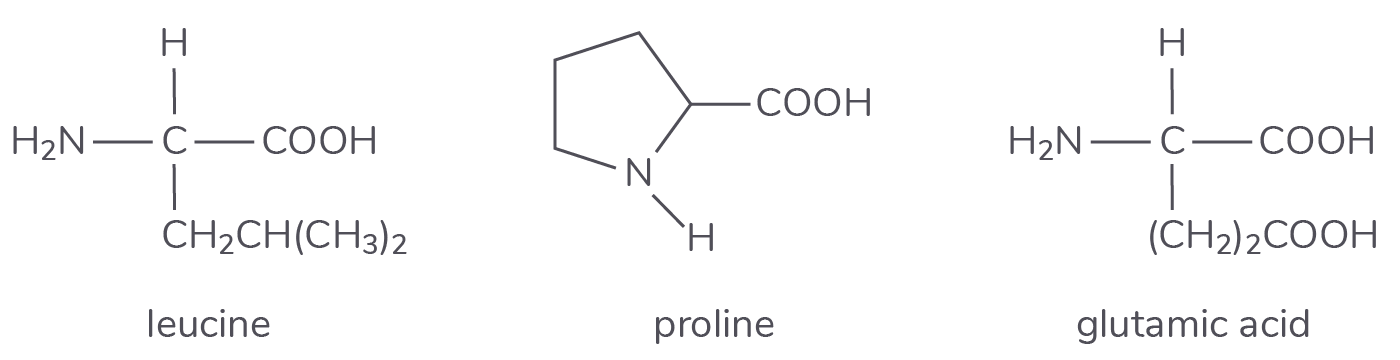
Give the IUPAC name of leucine.
Draw the zwitterion of proline.
Draw the structure of the product formed when glutamic acid is dissolved in an acidic solution.
Draw the structure of the tripeptide leucine-proline-leucine, formed from one molecule of proline and two molecules of leucine.
The diagram below shows the structure of the amino acid aspartic acid.
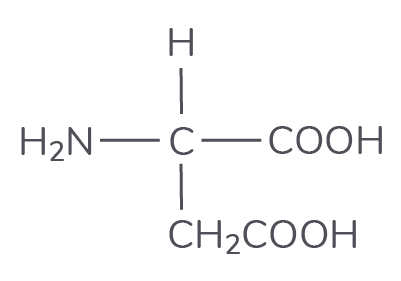
Draw the structure of the product formed when aspartic acid is reacted with HCl.
Draw the structure of the product formed when aspartic acid is reacted with excess CH3OH and H2SO4.
Aspartic acid has an isoelectric point of 2.77.
What is meant by the term isoelectric point?
Draw the structure of aspartic acid when it is dissolved in a solution with a pH greater than its isoelectric point.
Draw the structure of aspartic acid when it is dissolved in a solution with a high pH.
Phenylamine can be prepared by the reduction of nitrobenzene.
Write an equation for the reduction of nitrobenzene to form phenylamine. Use [H] to represent the reducing agent.
Give a suitable reducing agent for the reduction of nitrobenzene.
The diagram below shows the structures of phenylamine and phenylethylamine.
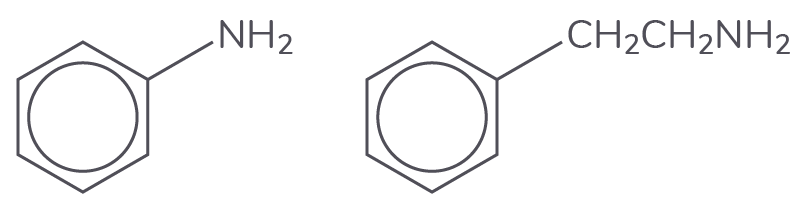
State and explain which of the two amines will be the stronger base.
Phenylamine reacts with nitrous acid (HNO2) to form a diazonium salt.
Draw the displayed formula of the salt.
What type of compound would be formed if the diazonium salt in part d) was reacted with phenol?
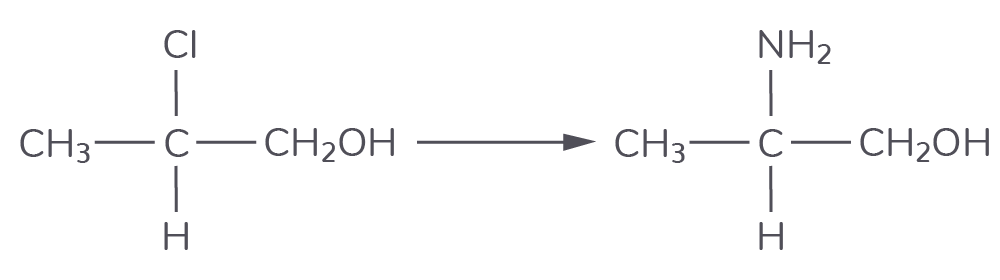
Draw the structure of the product formed in the reaction below.
State the reagent(s) needed for the reaction shown below.
The compound shown in the diagram below contains an amide group.
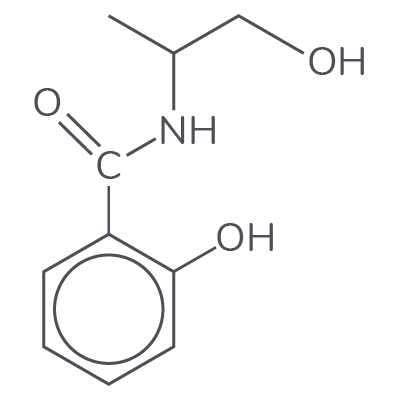
Draw the structures of the two organic products formed when this compound is heated with HCl.
Phenylamine, C6H5NH2, is an aromatic amine and butylamine, C4H9NH2, is an aliphatic amine.
Phenylamine can be prepared from nitrobenzene.
Butylamine can be prepared from butanenitrile.
Compare and contrast these two preparations of amines.
This question is about amines and amides.
Explain why ethylamine is basic.
Explain why phenylamine is less basic than ethylamine.
Ethylamine can react with CH3CH2COCl to form an amide.
Write an equation for the reaction.
Name the amide formed in part d).
The diagram below shows a series of reactions to form the dye X.
Name the reagents for steps 1 and 2.

The diagram below shows the structure of the amino acid alanine.
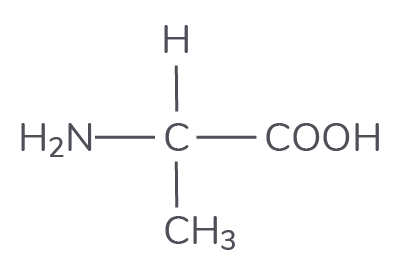
Outline the mechanism for the formation of alanine from CH3CHClCOOH and ammonia.
Draw the structure of the zwitterion formed by alanine.
Draw the structure of the product formed when alanine reacts with CH3OH in the presence of concentrated H2SO4.