States of Matter - exam practice
States of Matter
Question 1 of 5
An experiment was carried out to determine the relative molecular mass (Mr) of a volatile hydrocarbon Y that is a liquid at room temperature.
A known mass of Y was vaporised at a known temperature and pressure and the volume of the gas produced was measured in a gas syringe.
Data from this experiment are shown in the table below.
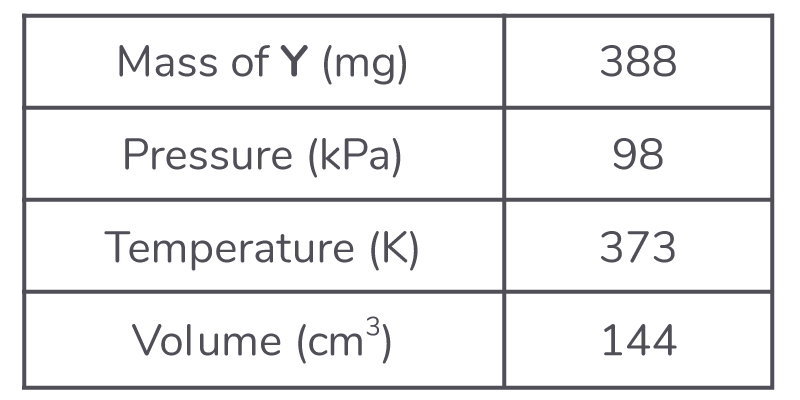
Calculate the relative molecular mass of Y.
Give your answer to two significant figures.
The gas constant, R = 8.31 J K−1 mol−1
266 g of phosphorus reacts with an excess of oxygen to produce gaseous phosphorus pentoxide, P4O10, as shown by the equation:
P4(s) + 5O2(g) ➔ P4O10(g)
Calculate the volume, in m3, of gaseous phosphorus(V) oxide produced at a pressure of 101 kPa and a temperature of 500°C
The gas constant R = 8.31 J K–1 mol–1
Give your answer to three significant figures.
This question is about elements in period 3 of the periodic table.
The table below shows some properties of magnesium, chlorine and magnesium chloride.
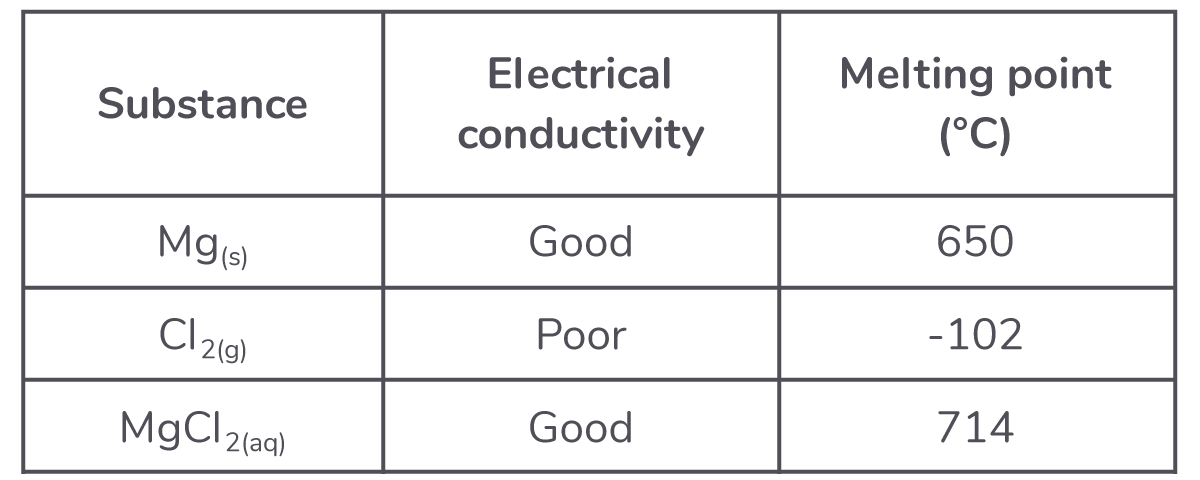
Use your knowledge of structure and bonding to explain the electrical conductivity and melting point of the three substances in the table above.
Many properties of substances can be explained using structure and bonding.
Iodine, magneisum oxide, copper, diamond and ice are all crystalline solids.
Complete the table below with:
- the name of the type of bonding found in each crystalline solid,
- the type of lattice structure for each crystalline solid.
The graph below represents how the temperature of a sample of aluminium changes as it is heated at a constant rate from 0°C.
The melting point of aluminium is 660°C.
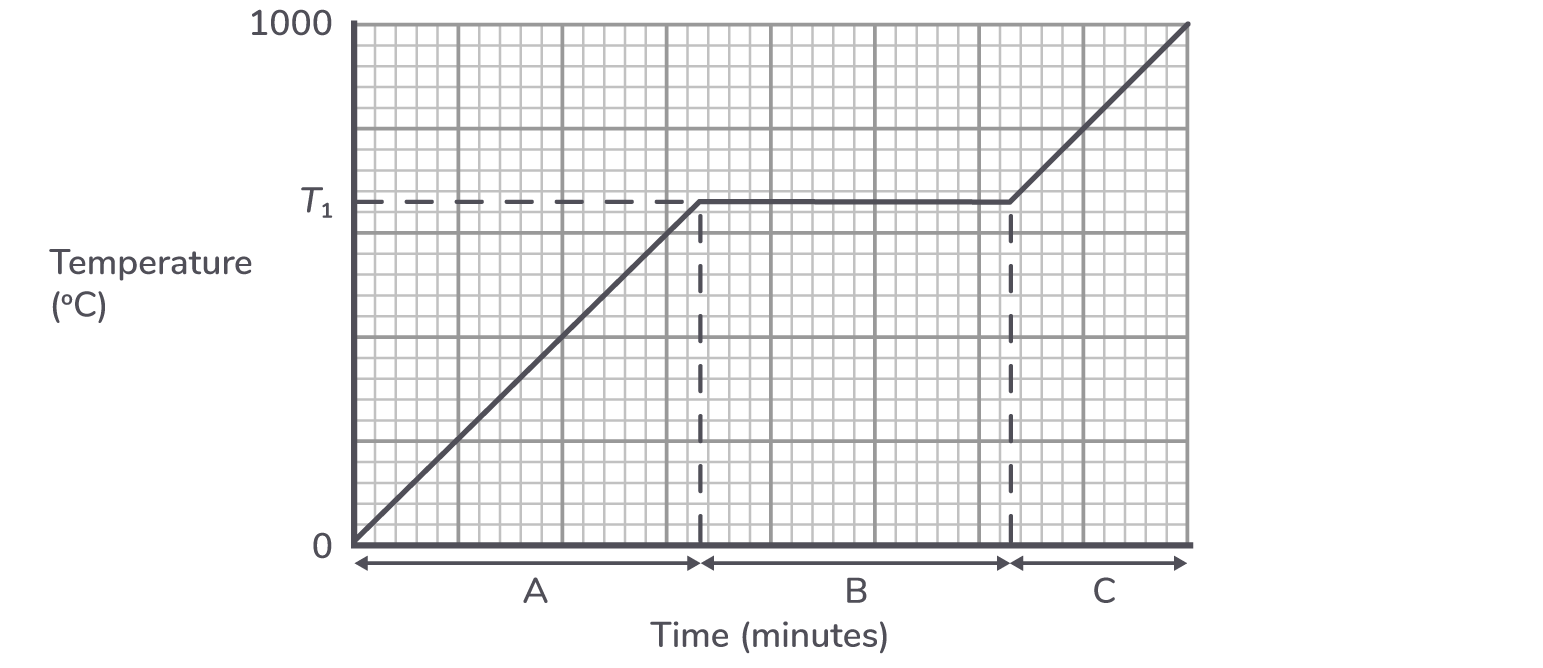
Identify the state(s) of matter present during stages A, B and C of the process shown in the graph above.
State what is happening to the energy and movement of the atoms of aluminium during stage A.
Explain why the temperature stays constant at T1, during stage B.
Most modern vehicles are fitted with airbags which are inflatable safety cushions designed to protect the occupants of the vehicle during a collision.
Airbags inflate rapidly as a result of the thermal decomposition of sodium azide, NaN3, to produce sodium and nitrogen gas.
Write a balanced symbol equation for the decomposition of sodium azide. State symbols are not required.
A typical airbag contains 90 g of sodium azide.
Calculate the maximum volume of nitrogen gas, in dm3, the airbag could be inflated with using this mass of sodium azide.
2NaN3 ➔ 2Na + 3N2
Use the Ideal Gas Equation and give your answer to 2 significant figures.
Assume that the temperature is 300°C and the pressure is 140,000 Pa.
The gas constant, R = 8.31 J K‒1 mol‒1