The Periodic Table: Chemical Periodicity - exam practice
The Periodic Table: Chemical Periodicity
Question 1 of 28
1 of 28
This question is about trends in the periodic table.
Which trend is correct?
Question 2 of 28
2 of 28
Which equation represents the third ionisation energy for element J?
Question 3 of 28
3 of 28
Which observations are made when a sample of silicon chloride, SiCl4, is added to a beaker of water?
Question 4 of 28
4 of 28
The melting points of the period 3 elements sodium to aluminium are shown in the table below.
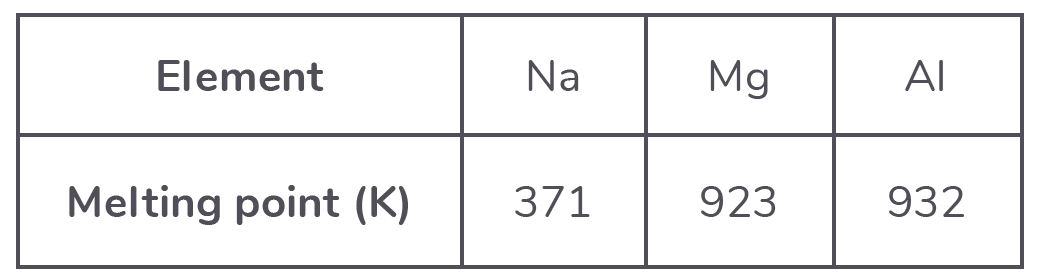
Which factor explains the increase in melting points from sodium to aluminium?
Question 5 of 28
5 of 28
Which factor helps to explain why the first ionisation energies of the group I elements decrease from lithium to sodium to potassium to rubidium?
Question 6 of 28
6 of 28
X and Y are elements in period 3 of the periodic table.
● The oxide of X is a solid at room temperature. This oxide has a giant structure.
● The chloride of X does not react with water.
● Argon is the only element in period 3 with a lower melting point than Y.
What could be the formula of a compound formed between elements X and Y?
Question 7 of 28
7 of 28
Which element has the second smallest atomic radius in its group and the third lowest first ionisation energy in its period?
Question 8 of 28
8 of 28
Why is the second ionisation energy of sodium larger than the second ionisation energy of magnesium?
Question 9 of 28
9 of 28
Consecutive elements X, Y and Z are in period 3 of the periodic table. Element Y has the highest first ionisation energy and the lowest melting point of these three elements.
What are the identities of X, Y and Z?
Question 10 of 28
10 of 28
Which statement describes the trends of electronegativity values in the periodic table?
Question 11 of 28
11 of 28
The 1st to 8th successive ionisation energies, in kJ mol-1, of an element in period 3 are:
1,012 1,903 2,912 4,957 6,274 21,269 25,398 29,855
What is the element?
Question 12 of 28
12 of 28
Which statement best explains why nitrogen has a larger first ionisation energy than oxygen?
Question 13 of 28
13 of 28
Which change requires the largest amount of energy?
Question 14 of 28
14 of 28
Which element is classified as a d block element?
Question 15 of 28
15 of 28
Which element in period 3 has the highest melting point?
Question 16 of 28
16 of 28
Which represents the correct order of increasing radius of the ions?
Question 17 of 28
17 of 28
The diagram shows how a property of period 3 elements varies across the period.
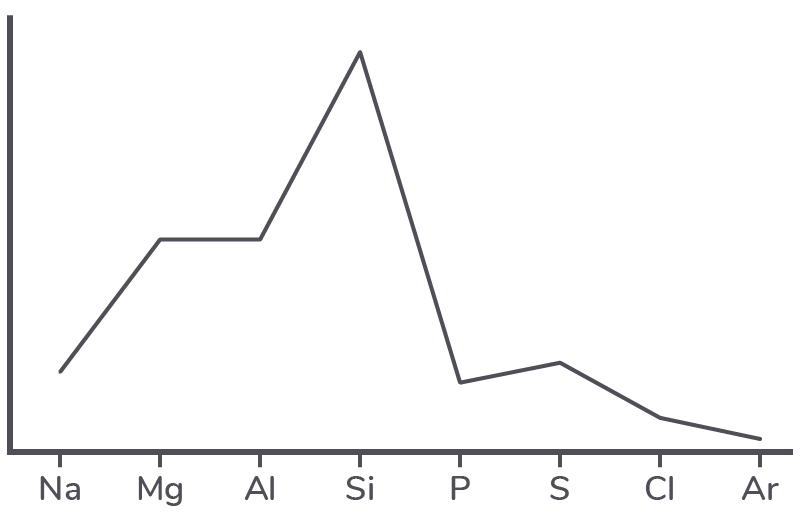
What is the property?
Question 18 of 28
18 of 28
Which element has the highest first ionisation energy?
Question 19 of 28
19 of 28
Which oxide does not react with cold dilute sodium hydroxide to produce a salt?
Question 20 of 28
20 of 28
X is the oxide of a period 3 element. X reacts with water to give an acidic solution.
A solution is prepared by reacting 0.100 g of X with excess water. This solution was neutralised by exactly 25.0 cm3
of 0.100 mol dm-3 sodium hydroxide solution.
What could be the identity of X?
Question 21 of 28
21 of 28
Which property is notassociated with the element sodium?
Question 22 of 28
22 of 28
Which element of the third period requires the least number of moles of oxygen for the complete combustion of 1 mol of the element?
Question 23 of 28
23 of 28
Which oxide is insoluble in aqueous sodium hydroxide?
Question 24 of 28
24 of 28
An element Y reacts according to the following sequence.

What could be element Y?
Question 25 of 28
25 of 28
Which is the equation for the reaction when steam passes over strongly heated magnesium?
Question 26 of 28
26 of 28
Which products are formed when magnesium reacts with steam?
Question 27 of 28
27 of 28
Which element forms an ionic oxide that reacts with strong alkalis?
Question 28 of 28
28 of 28
Which of the following sets of data showing the first four ionisation energies, in kJ mol-1, of four elements is most likely to belong to boron?