Analytical Techniques - exam practice
Analytical Techniques
Question 1 of 13
1 of 13
Compound X consists of carbon, hydrogen and oxygen only. It has only one functional group.
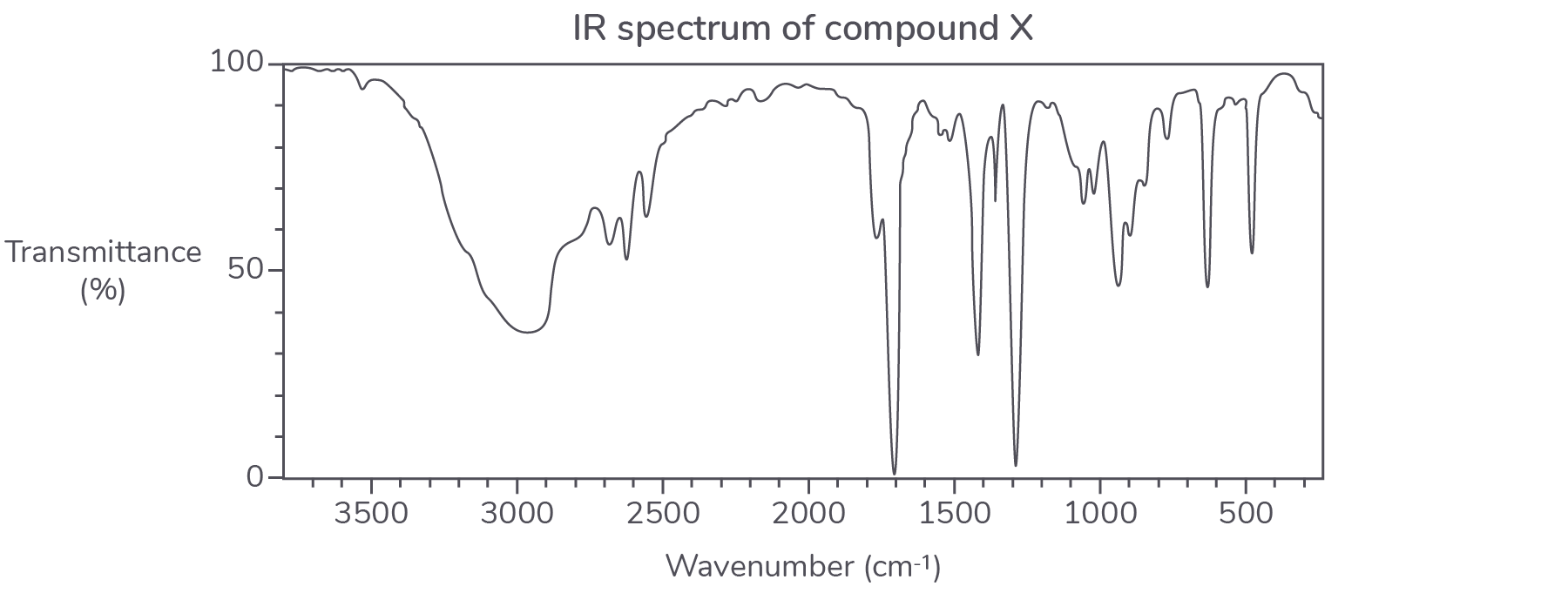
What can be deduced about X?
Question 2 of 13
2 of 13
The infrared spectrum of a compound with molecular formula C10H12O2 includes strong peaks in the ranges 1,750 - 1,735 cm-1 and 1,150 - 1,100 cm-1.
The compound could be
Question 3 of 13
3 of 13
A sample of element X is analysed using mass spectrometry. The mass spectrum obtained is shown.
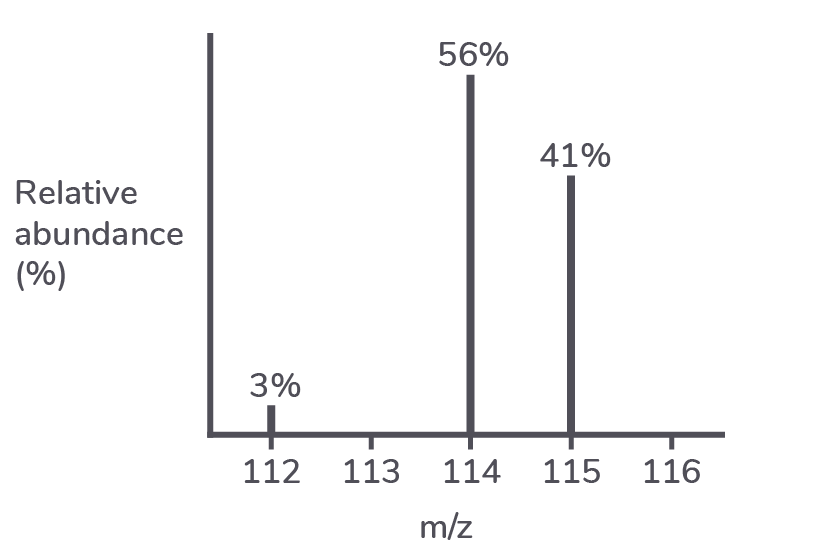
What is the relative atomic mass of this sample of element X?
Question 4 of 13
4 of 13
How many structural isomers with the molecular formula C4H10O give infra-red absorptions both at approximately 1200 cm-1 and at approximately 3400 cm-1?
Question 5 of 13
5 of 13
This question concern the use of infrared (IR) spectra to identify organic compounds.
The IR absorption ranges associated with some organic functional groups are given below.
When propan-2-ol is refluxed with potassium dichromate(VI) and sulfuric acid, the product will show a peak due to
Question 6 of 13
6 of 13
This question concern the use of infrared (IR) spectra to identify organic compounds.
The IR absorption ranges associated with some organic functional groups are given below.
When propan-1-ol is heated with potassium dichromate(VI) and sulfuric acid, the product, that is distilled off as it is formed, will show a peak due to
Question 7 of 13
7 of 13
Bromine has two isotopes with relative isotopic masses 79 and 81.
Which of the following values for mass/charge ratio could correspond to a peak in the mass spectrum of bromine, Br2?
You should assume the ions detected have a single positive charge.
Question 8 of 13
8 of 13
What is correct about a mass spectrum of a compound?
Question 9 of 13
9 of 13
The mass spectrum of ethanoic acid has a peak at m/z 45. Which species could cause this?
Question 10 of 13
10 of 13
Which alcohol is likely to have a fragment ion at m/z = 31 in its mass spectrum?
Question 11 of 13
11 of 13
Chlorine exists as two isotopes 35Cl and 37Cl in the ratio 3:1.
Which statement about peaks in the mass spectrum of Cl2 is correct?
Question 12 of 13
12 of 13
The infrared spectrum of an organic compound is shown.
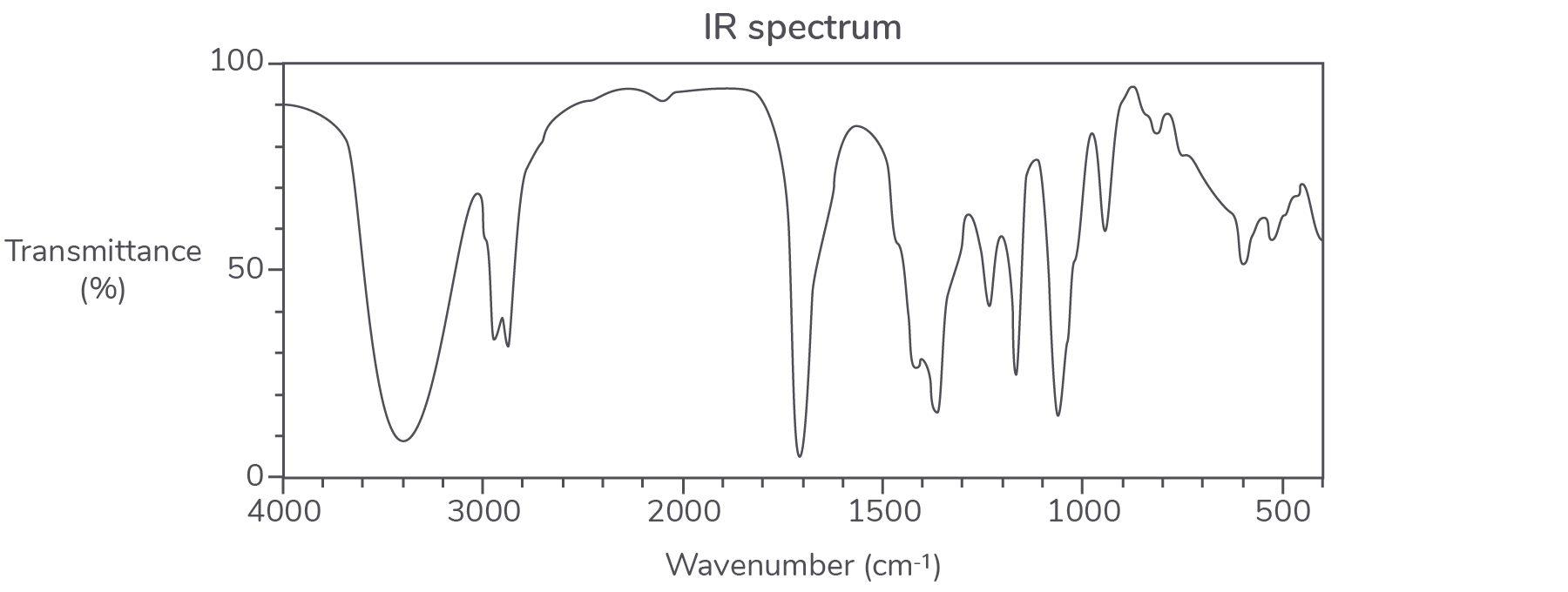
Which compound produces this spectrum?
Question 13 of 13
13 of 13
Propanal (CH3CH2CHO) and propanone (CH3COCH3) are isomers.
Which m/z peak would not be expected in the mass spectrum of propanone?