Organic Synthesis - exam practice
Organic Synthesis
Question 1 of 16
1 of 16
Which pair of compounds can bothbe separately hydrolysed in acidic conditions to form propanoic acid?
Question 2 of 16
2 of 16
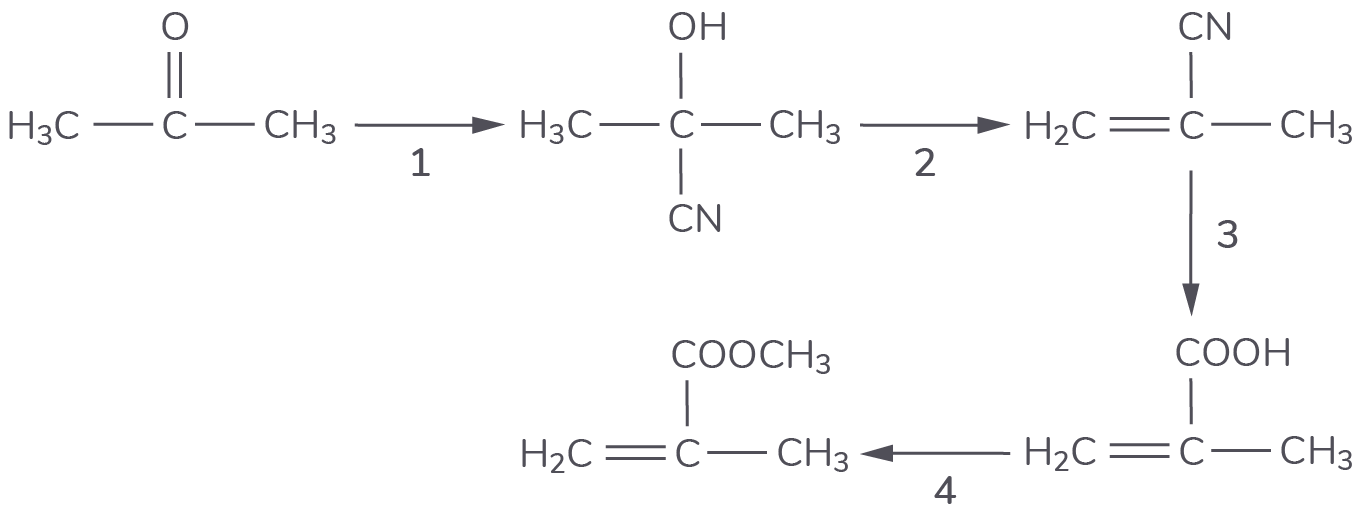
Which set of reagents is not suitable for the step indicated?
Question 3 of 16
3 of 16
Which reaction may be used to make a carboxylic acid in a single step?
Question 4 of 16
4 of 16
Which reagent will give a different observation with compounds P and Q?
HOCH2CH(OH)CHO HOCH2COCH2OH
P Q
Question 5 of 16
5 of 16
Cottonseed oil contains large amounts of polyunsaturated carboxylic acids. When this oil is used to make margarine, the C=C double bonds in the unsaturated carboxylic acids are hydrogenated.
What reagents and conditions would be suitable to bring about this hydrogenation reaction?
Question 6 of 16
6 of 16
Energy is released in the human body by the oxidation of glucose in a complex sequence of reactions. Part of this sequence is the Krebs cycle.
One reaction in the Krebs cycle is the conversion of fumaric acid into malic acid.
HO2CCH=CHCO2H ➔ HO2CCH(OH)CH2CO2H
fumaric acid malic acid
Which reagents could achieve this transformation in the laboratory?
Question 7 of 16
7 of 16
Which reaction will give the best yield of 1-chloropropane?
Question 8 of 16
8 of 16
The compound ‘leaf alcohol’ is partly responsible for the smell of new-mown grass.
CH3CH2CH=CHCH2CH2OH
leaf alcohol
What will be formed when ‘leaf alcohol’ is oxidised using an excess of hot, acidified K2Cr2O7(aq)?
Question 9 of 16
9 of 16
Which pair of reagents will take part in a redox reaction?
Question 10 of 16
10 of 16
Which reaction would not give ethanoic acid?
Question 11 of 16
11 of 16
Which compound could be formed by a one-step reaction from 1-chloropropane?
Question 12 of 16
12 of 16
Which substance cannotbe made in a single step from C2H4?
Question 13 of 16
13 of 16
Which one of the following reacts with ethanoic acid andwith phenol?
Question 14 of 16
14 of 16
Which compound does not react with nucleophiles?
Question 15 of 16
15 of 16
Which reaction involves addition-elimination?
Question 16 of 16
16 of 16
Butan-1-ol can be made by reaction of 1-bromobutane with aqueous sodium hydroxide.
Which of these is the correct name for the mechanism of this reaction?