31.1 - Year 1 Synthetic Routes
- 1
What synthetic routes are and why they are important
- 2
The key organic reactions covered so far
- 3
How functional groups determine reactivity
Synthetic routes map out synthetic pathways
Chemists create complex compounds, which are often used in medicines or agricultural chemicals.
Typically, synthesising the target compound directly from a single starting material in one step is not feasible.
A synthetic route outlines the sequence of reactions needed to transform starting materials into the desired end product.
It details:
- Every chemical intermediate formed along the way.
- The specific reagents and conditions required at each stage of the process.
For instance, converting 2-chloropropane to propanone isn't a straightforward, one-step process.
Instead, a two-step synthetic route is necessary:

- 2-chloropropane reacts with KOH, producing propan-2-ol.
- Propan-2-ol, when treated with acidified K2Cr2O7, yields propanone.
Functional groups dictate reactivity
The behaviour and properties of functional groups significantly affect molecular reactions.
For example:
- Nucleophiles are attracted to the partially positive carbon in halogenoalkanes, but they don't target the electron-rich C=C double bond in alkenes.
- Alcohols, due to their polar O-H bond and the lone pair of electrons on the oxygen atom, can act as nucleophiles.
The following table outlines common reactions associated with key functional groups:
| Homologous series | Functional group | Properties | Typical reactions |
|---|---|---|---|
| Alkane | C-C | Nonpolar, unreactive | Free radical substitution |
| Alkene | C=C | Nonpolar, electron-rich | Electrophilic addition |
| Alcohol | O-H | Polar O-H bond | Oxidation, elimination |
| Halogenoalkane | C-X | Polar C-X bond | Nucleophilic substitution |
| Aldehyde/Ketone | C=O | Polar C=O bond | Oxidation (aldehydes only) |
Accurately predicting the reactivity of compounds with multiple functional groups requires identifying each group.
Summary of key organic reactions
Below is an overview of the primary types of organic reactions we've discussed:
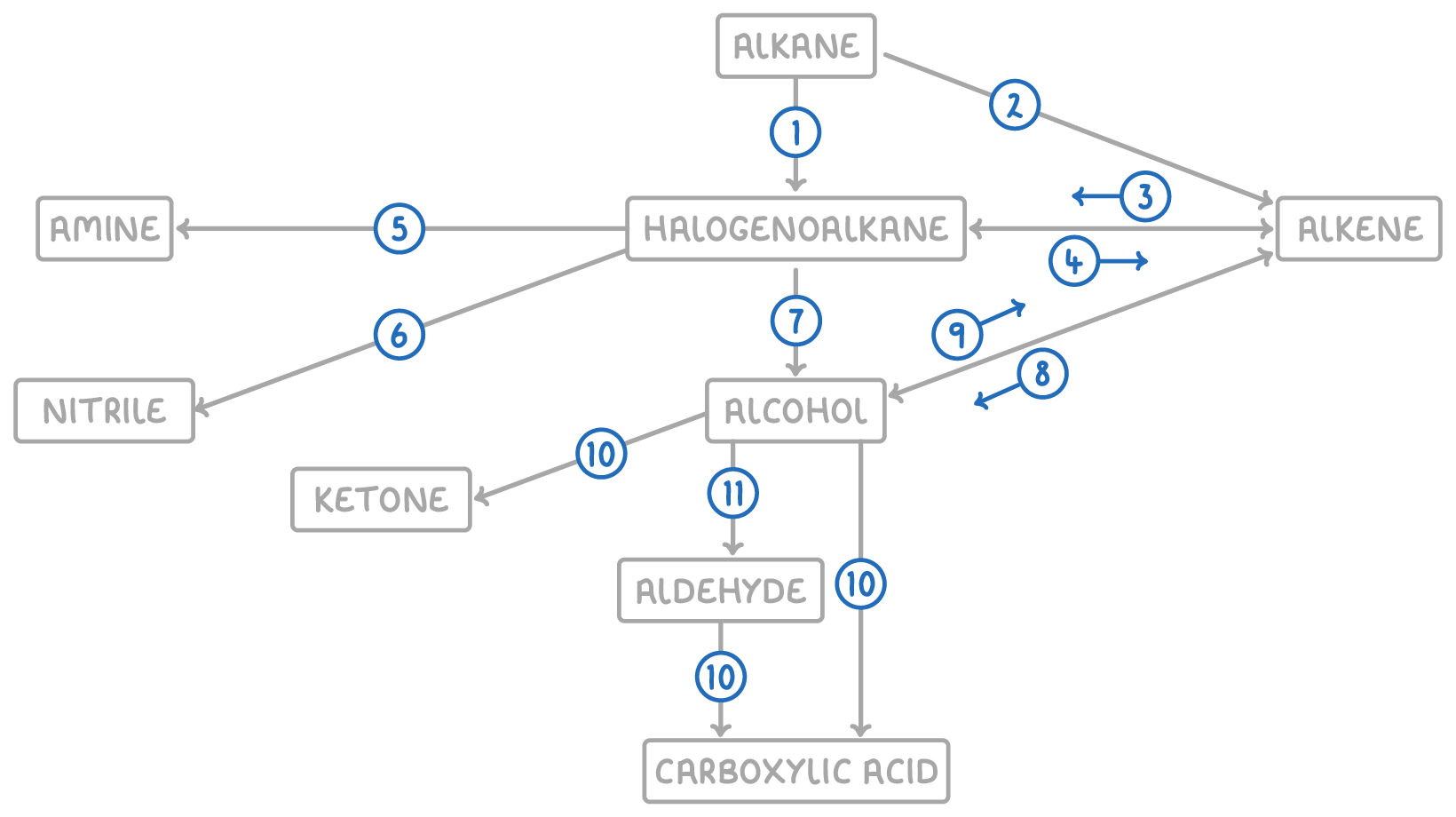
| Reaction | Reagent and conditions | Reaction type |
|---|---|---|
| 1 | Halogen, UV light | Free radical substitution |
| 2 | Zeolite catalyst, heat | Thermal decomposition |
| 3 | Hydrogen halide or halogen | Electrophilic addition |
| 4 | KOH in ethanol, reflux | Elimination |
| 5 | Conc. NH3 in ethanol, heat under pressure | Nucleophilic substitution |
| 6 | KCN in ethanol, reflux | Nucleophilic substitution |
| 7 | NaOH(aq), reflux | Nucleophilic substitution |
| 8 | Steam, H3PO4 catalyst, 300°C, 60 atm | Electrophilic addition |
| 9 | Conc. H2SO4 catalyst, heat | Elimination |
| 10 | K2Cr2O7(aq), H2SO4 catalyst, reflux | Oxidation |
| 11 | K2Cr2O7(aq), H2SO4 catalyst, distill | Oxidation |