15.1 - Alcohols - Introduction
- 1
The functional group and general formula of alcohols
- 2
How alcohols are classified as primary, secondary or tertiary
- 3
How alcohols form hydrogen bonds
Alcohols contain the hydroxyl functional group
Alcohols are organic compounds that contain a hydroxyl (-OH) functional group bonded to a carbon atom.
The general formula for alcohols is:
CnH2n+1OH
Where 'n' represents the number of carbon atoms.
Alcohols are named by replacing the ending "-e" of the corresponding alkane with "-ol", for example:
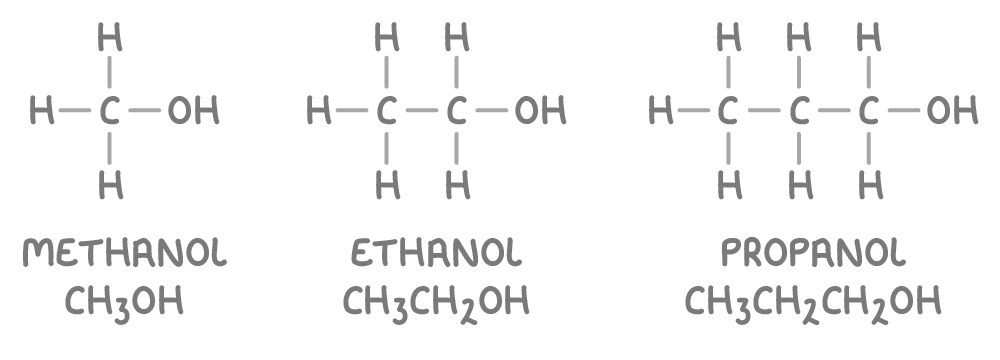
Where necessary, a numerical prefix to the name is added to indicate the position of the hydroxyl group, for example, propan-1-ol.
Classification of alcohols
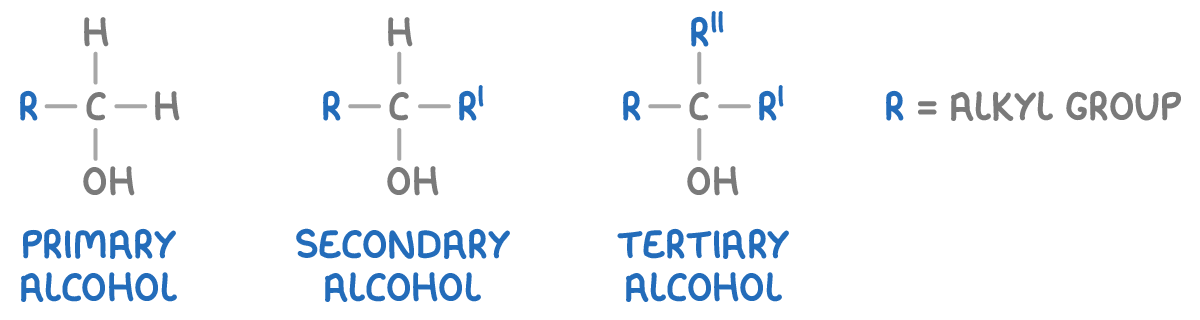
Alcohols are categorised into three types based on the carbon atom to which the hydroxyl group is attached:
- Primary alcohols - The -OH group is attached to a carbon atom that is bonded to only one alkyl group (or no alkyl groups).
- Secondary alcohols - The -OH group is attached to a carbon atom that is bonded to two alkyl groups.
- Tertiary alcohols - The -OH group is attached to a carbon atom that is bonded to three alkyl groups.
Alcohols form hydrogen bonds
The bond between oxygen and hydrogen in the hydroxyl group of alcohols is polar. This is due to oxygen being more electronegative than hydrogen, leading to an unequal sharing of electrons. As a result, the hydrogen atom acquires a partial positive charge (δ+), while the oxygen atom gains a partial negative charge (δ-).
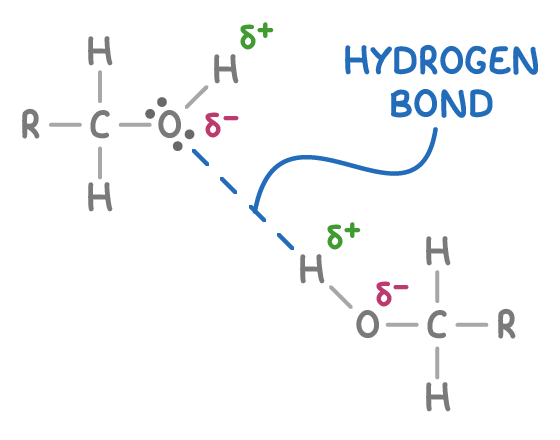
The partially positive hydrogen atom (δ+) can form hydrogen bonds with lone pairs on oxygen atoms in other molecules, including water molecules or other alcohol molecules (as shown above).