Amino Acids, Proteins and DNA - exam practice
Amino Acids, Proteins and DNA
Question 1 of 4
The diagram below shows the amino acids leucine, proline and glutamic acid.
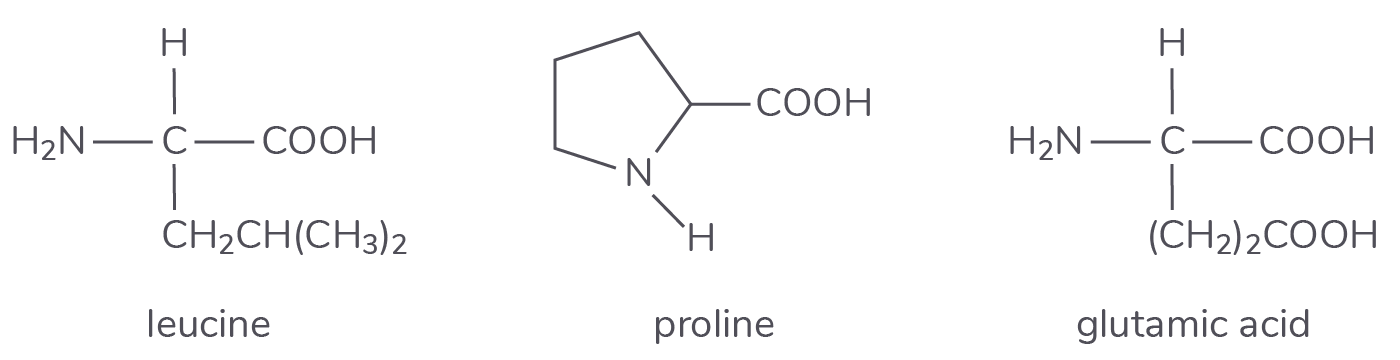
Give the IUPAC name of leucine.
Draw the zwitterion of proline.
Draw the structure of the product formed when glutamic acid is dissolved in an acidic solution.
Draw the structure of the tripeptide leucine-proline-leucine, formed from one molecule of proline and two molecules of leucine.
This question is about proteins and DNA.
A bond can form between two polypeptide chains that both contain the amino acid cysteine.
The structure of cysteine is shown below.
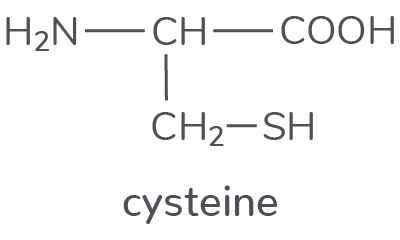
Complete the diagram below to show the bond that forms between two molecules of cysteine.
The bond in part a) influences the 3D structure of a protein.
Name this type of protein structure.
The diagram below shows a fragment of a DNA double helix.
Complete the diagram to show the correct sequence of complementary base pairs in strand 2.
The diagram below shows an incomplete molecule of 2-deoxyribose.
Complete the diagram to show the structure and position of a base and a phosphate group. Use 'B' to represent the structure of a base.
The diagram below shows the structure of the amino acid alanine.
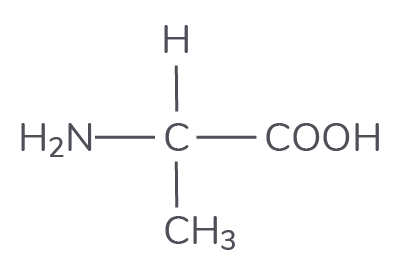
Outline the mechanism for the formation of alanine from CH3CHClCOOH and ammonia.
Draw the structure of the zwitterion formed by alanine.
Draw the structure of the product formed when alanine reacts with CH3OH in the presence of concentrated H2SO4.
The diagram below shows the structure of the amino acid aspartic acid.
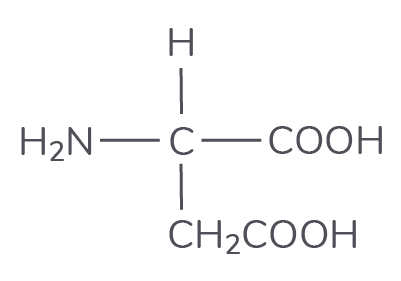
Draw the structure of the product formed when aspartic acid is reacted with HCl.
Draw the structure of the product formed when aspartic acid is reacted with excess CH3OH and H2SO4.
Draw the structure of aspartic acid when it is dissolved in a solution with a high pH.