Chromatography - exam practice
Chromatography
Question 1 of 4
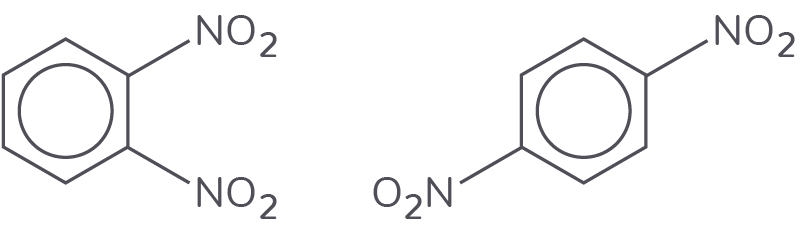
This question is about the use of thin-layer chromatography (TLC) to investigate 1,2-dinitrobenzene and 1,4-dinitrobenzene, the structures of which are shown in the diagram below.
A solution of 1,4-dinitrobenzene was spotted onto a TLC plate coated with a polar solid, and the plate was run using hexane as the solvent. The diagram below shows the resulting chromatogram.
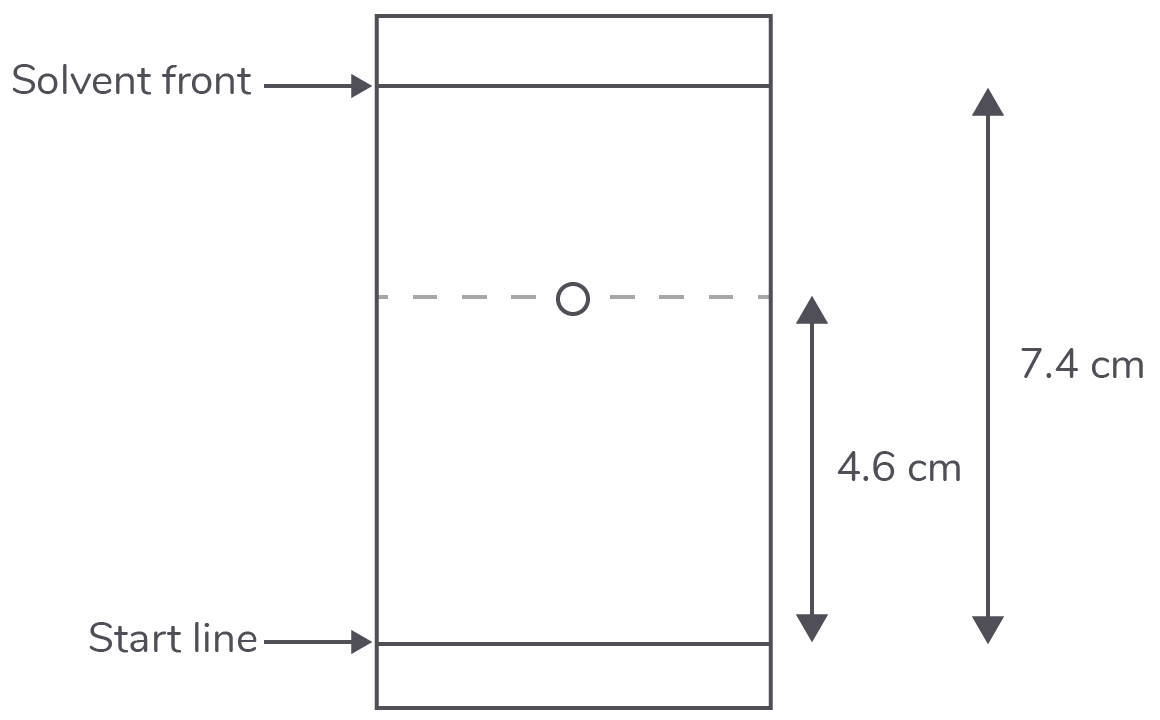
Use the chromatogram to determine the Rf value of 1,4-dinitrobenzene. Give your answer to 2 decimal places.
State what determines the distance travelled by a spot in TLC.
A second TLC experiment is carried out with 1,2-dinitrobenzene using the same conditions as before. The Rf value for 1,2-dinitrobenzene was calculated to be less than 1,4-dinitrobenzene.
State the relative polarities of 1,2-dinitrobenzene and 1,4-dinitrobenzene, and explain why 1,2-dinitrobenzene has a lower Rf.
A third TLC experiment is carried out with 1,2-dinitrobenzene using an identical TLC plate but using ethyl ethanoate as the solvent.
Explain whether the Rf value would be greater or lower than in the experiment in part c).
Gas chromatography is an analytical technique used to separate mixtures into their individual components.
Define the term retention time as applied to gas chromatography.
What is the role of the gas in gas chromatography?
Sketch a chromatogram on the axes below showing a mixture containing two components.
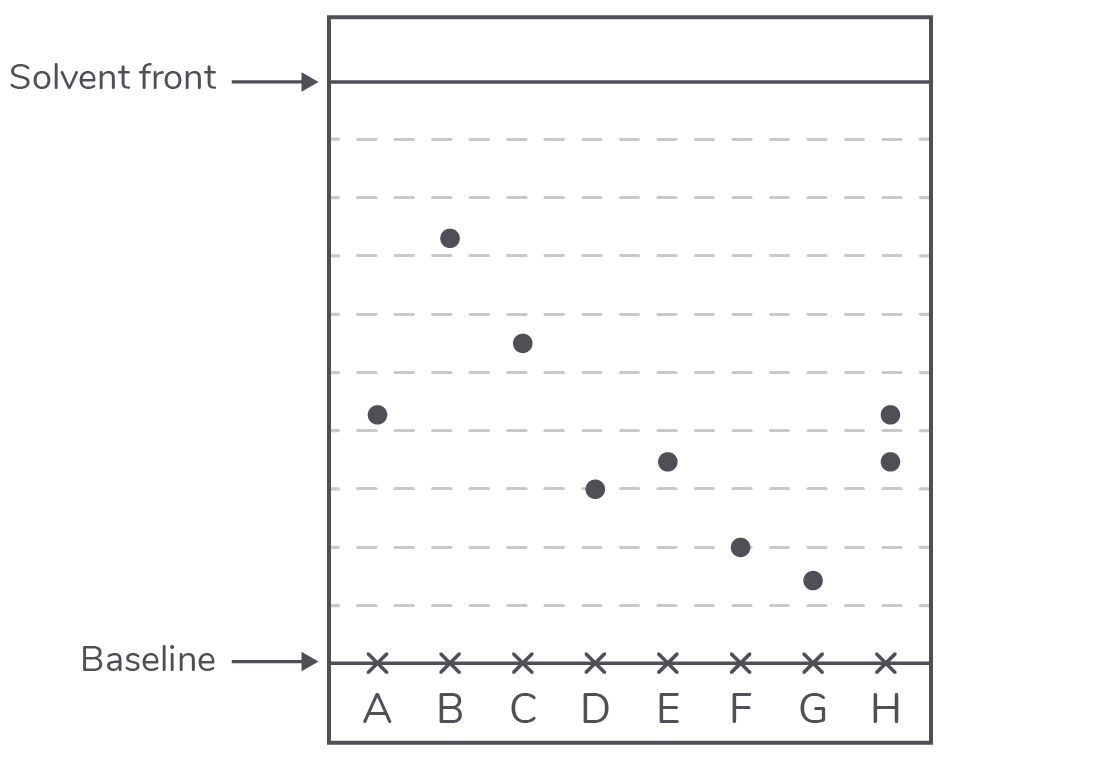
A sample of a tripeptide was hydrolysed and then placed on a thin layer chromatography (TLC) plate. Samples of possible amino acids present were also placed on the TLC plate for reference.
A simplified diagram of the developed TLC plate is shown.
| TLC sample spot | Compound |
|---|---|
| A | Serine |
| B | Histidine |
| C | Proline |
| D | Methionine |
| E | Tyrosine |
| F | Lysine |
| G | Isoleucine |
| H | Hydrolysed tripeptide |
Calculate the Rf value for the amino acid lysine.
Give your answer to 2 decimal places.
Identify by name the two amino acids present in the tripeptide, giving a reason for the lack of a third spot.
Give two reaons why different amino acids have different Rf values.
In chromatography, a 'locating' reagent is often used when the components in a mixture are colourless.
Which reagent is used to locate the amino acid spots?
Gas chromatography can be used both to separate the components in a mixture and to determine the amount of each present.
State why argon and nitrogen are suitable carrier gases for gas chromatography.
A mixture containing one part substance X, two parts substance Y and one part substance Z was separated by gas chromatography.
Substance X has a retention time of 10 seconds, substance Y of 25 seconds and substance Z of 50 seconds.
Complete the sketch of this chromatogram.
The compound ethyl 3-oxobutanoate, which is used in food flavouring, has the formula CH3COCH2COOCH2CH3.
The carbon-13 (13C) NMR spectrum of ethyl 3-oxobutanoate has six peaks.
Draw the structural formula of an isomer of ethyl 3-oxobutanoate that contains a carboxylic acid group and a ketone functional group, but only has four peaks in its carbon-13 NMR spectrum.
A chemist synthesising ethyl 3-oxobutanoate looked for its presence in the reaction mixture using thin-layer chromatography. The solvent used was a mixture of ethoxyethane, C2H5OC2H5, which is polar, and hexane.
Under these conditions, the Rf value for ethyl 3-oxobutanoate was 0.45.
Complete the diagram below, showing a chromatogram for ethyl 3-oxobutanoate, including appropriate labels.
Suggest why the Rf value for ethyl 3-oxobutanoate is significantly lower than 0.45 when just hexane is used as the solvent.