Reactions of Inorganic Compounds in Aqueous Solutions - exam practice
Reactions of Inorganic Compounds in Aqueous Solutions
Question 1 of 6
Some reactions of the [Al(H2O)6]3+(aq) ion are shown.

Explain, with the use of an equation, why a solution containing [Al(H2O)6]3+ has a pH of less than 7.
Describe 2 observations when excess Na2CO3(aq) is added to [Al(H2O)6]3+(aq).
Write the formula of the complex ion A.
Describe 1 observation when NaOH(aq) is added dropwise to [Al(H2O)6]3+(aq) to form the complex ion B.
Give an equation for this reaction.
Describe 1 observation when NaOH(aq) is added, in excess, to Bto form the complex ion C.
Give an ionic equation for this reaction.
The precipitate B, Al(H2O)3(OH)3 displays amphoteric character when treated separately with dilute hydrochloric acid and with dilute aqueous sodium hydroxide.
State the meaning of the term amphoteric.
Write an equation for the reaction of B with dilute hydrochloric acid.
Describe the reactions of [Cu(H2O)6]2+ complex ions with:
- aqueous sodium hydroxide
- excess concentrated aqueous ammonia
- excess concentrated hydrochloric acid In your answer you should link observations with ionic equations.
When NH3(aq) is added to Cu2+(aq), dropwise at first and then in excess, two chemical reactions occur as shown.

For each reaction:
- describe what you would see
- write an equation.
When complex ion B, [Cu(NH3)4(H2O)2]2+, reacts with 1,2-diaminoethane (en), the ammonia molecules but not the water molecules are replaced.
Write an equation for this reaction.
en = 1,2-diaminoethane.
Suggest why the enthalpy change for the reaction in part b) is approximately zero.
Explain why the reaction in part b) is spontaneous despite having an enthalpy change that is approximately zero.
Explain why an aqueous solution containing [Fe(H2O)6]3+ ions has a lower pH than an aqueous solution containing [Fe(H2O)6]2+ ions.
The equation below represents the dissociation of [Fe(H2O)6]3+ ions in aqueous solution.
[Fe(H2O)6]3+(aq) ⇌ [Fe(H2O)5OH]2+(aq) + H+(aq)
The Ka for this dissociation is 6.00 × 10⁻³ mol dm-3
Calculate the pH of a 1.50 x 10⁻² mol dm-3 solution of [Fe(H2O)6]3+.
Give your answer to 2 decimal places.
The diagram below shows some reactions of iron ions in aqueous solution.
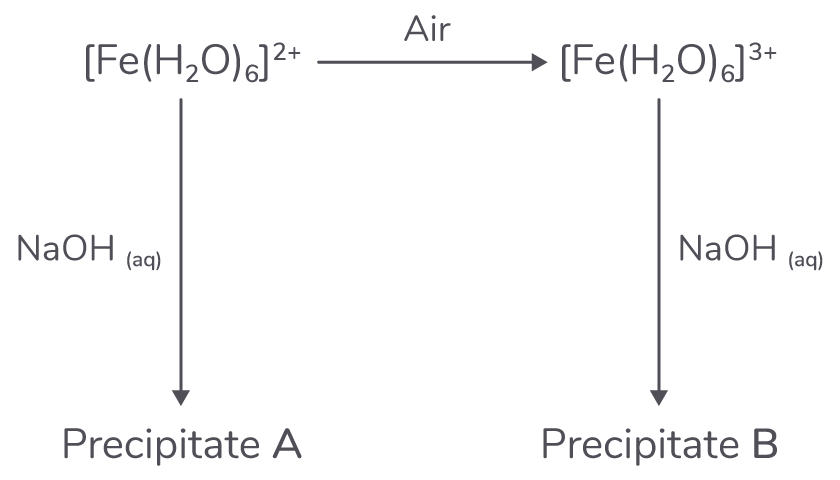
Give the formulae of A and B and state their colours.
The green precipitate A, Fe(OH)2, turned brown on standing in air.
Explain why.
When concentatd hydrochloric acid is added to aqueous Cu2+ ions, the following equilibirum is established.
[Cu(H2O)6]2+ + 4Cl- ⇌ [CuCl4]2- + 6H2O
State the colours of the [Cu(H2O)6]2+ and [CuCl4]2- complex ions.
Draw the shapes of the [Cu(H2O)6]2+ and [CuCl4]2- complex ions.
Give the name of the shape for each ion.
State the coordination numbers of the copper ion in [Cu(H2O)6]2+ and [CuCl4]2-.
Explain the change in coordination number in this equilibrium.
In aqueous solution, the [Cu(H2O)6]2+ ion reacts with an excess of ethane-1,2-diamine (en) to form the complex ion Z.
Write an equation for this reaction.
en = 1,2-diaminoethane
Explain, in terms of the chelate effect, why the complex ion Z is formed in preference to the [Cu(H2O)6]2+ complex ion.
A precipitate Y forms when aqueous sodium carbonate, Na2CO3(aq), is added to [Cu(H2O)6]2+(aq).
Identify Y and state its colour.
Write an ionic equation for the reaction.
This question looks at the biological applications of transition metal complexes.
Red blood cells contain haemoglobin.
Explain using ligand substitutions:
- how haemoglobin transports oxygen around the body
- why carbon monoxide is toxic.
Cis-platin, Pt(NH3)2Cl2, is an effective anti-cancer drug.
Describe the action of cis-platin in this role.
The use of cis-platin can cause side effects so nedaplatin has been developed.
Nedaplatin can be synthesised from cis-platin, as shown below.
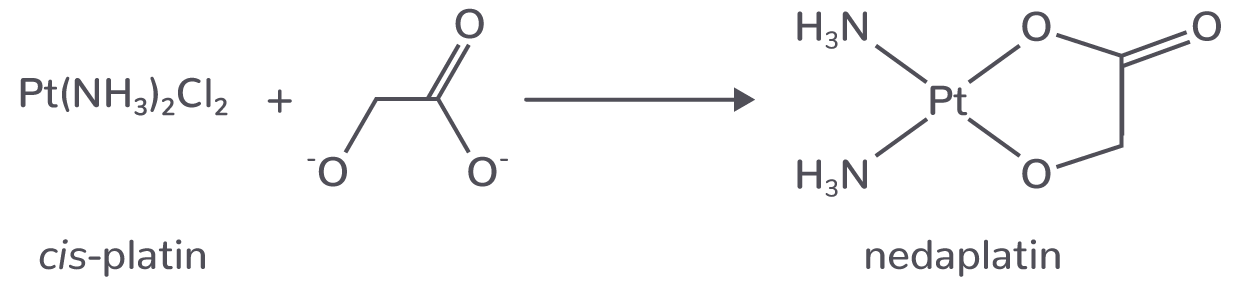
Name the type of reaction that is occuring.