The Transition Metals - exam practice
The Transition Metals
Question 1 of 12
Vanadium(V) oxide acts as a catalyst in the oxidation of sulfur dioxide in the Contact process.
State the meaning of the term heterogeneous as applied to catalysts.
Give two equations to describe how V2O5 acts as a catalyst in this process.
Explain why V2O5 can be described as a catalyst in this reaction.
Fe2+(aq) ions catalyse the reaction between iodide and peroxodisulfate ions:
S2O82-(aq) + 2I-(aq) ➔ 2SO42-(aq) + I2(aq)
Explain what type of catalysis is occuring this reaction.
Give two equations to describe how Fe2+(aq) ions act as a catalyst in this reaction.
Ethanedioic acid, (COOH)2, is the active ingredient in a spray to treat infections of the outer ear.
A chemist carries out a redox titration using aqueous cerium(IV) sulfate, Ce(SO4)2(aq), to determine the percentage, by mass, of ethanedioic acid in the spray.
In the titration, Ce4+(aq) ions oxidise ethanedioic acid in acidic conditions, as shown by the equation below
2Ce4+(aq) + (COOH)2(aq) → 2Ce3+(aq) + 2CO2(g) + 2H+(aq)
Ce4+(aq) ions have a yellow colour. Ce3+(aq) ions are colourless.
Dilute sulfuric acid is added to 5.00 g of the spray to form a colourless solution which is made up to 250.0 cm3 with distilled water.
25.00 cm3 of this solution is titrated with 1.00 x 10⁻² moldm-3 Ce(SO4)2 from the burette.
The titration is repeated until concordant titres are obtained.
The mean titre is 22.25 cm3.
What colour change would the chemist observe at the end point?
Calculate the percentage, by mass, of ethanedioic acid, (COOH)2, in the spray.
Give your answer to 3 significant figures.
A chemist uses the following procedure to analyse iron tablets containing iron in the form of iron(II) sulfate, FeSO4.
- Crush 1 iron tablet and transfer the resulting powder to a 250.0 cm3 volumetric flask.
- Rinse the apparatus used with dilute sulfuric acid transferring all washings to the volumetric flask.
- Add dilute sulfuric acid to make up the solution to exactly 250.0 cm3. Stopper the flask and invert it several times.
- Titrate 25.00 cm3 of this solution with 2.00 x 10⁻³ mol dm-3 potassium manganate(VII) solution.
- Repeat the titration until concordant results are obtained. The overall equation for the reaction occurring in the titration is:
MnO4-(aq) + 8H+(aq) + 5Fe2+(aq) ⇌ Mn2+(aq) + 4H2O(l) + 5Fe3+(aq)
The table below shows some standard electrode potential data.
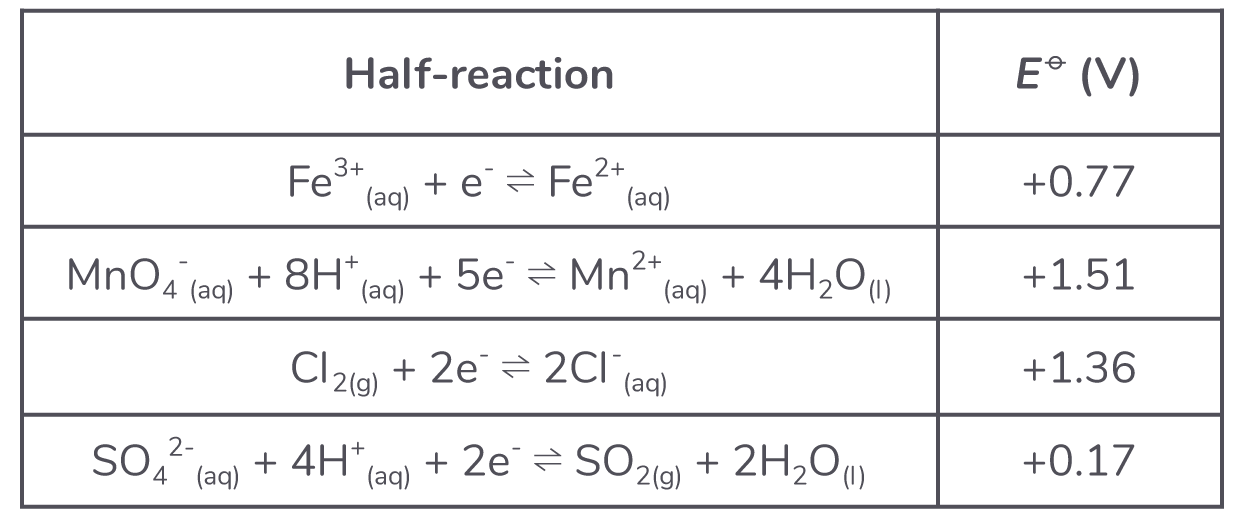
Using data in the table, explain why the chemist used sulfuric acid and not hydrochloric acid in their titration.
Suggest why this titration does not require the addition of an indicator.
State the colour change at the end-point of this titration.
The chemist decides to take burette readings from the top of the meniscus rather than from the bottom.
Explain the effect of this, if any, on the titre values.
The chemist's titration readings are shown in the table below.
Complete the table.
Use the titration results in part e) and information from the procedure to calculate the mass of FeSO4 in 1 iron tablet.
Give your answer to 3 significant figures.
Some transition metals and their compounds act as catalysts. The catalysis can be classified as heterogeneous or homogeneous.
Complete the table below to indicate the type of catalysis in each reaction.
The oxidation of C2O42- ions by MnO4- ions in acidic solution is an example of a reaction that is autocatalysed.
State the meaning of the term autocatalysed.
Write 2 equations to show how the autocatalyst, Mn2+, is involved in this oxidation of C2O42- ions.
This question look at the ions and complexes of cobalt.
An octahedral complex ion Y, C9H30N6Co3+, exists as two optical isomers.
In complex ion Y, Co3+ is bonded to three molecules of a bidentate ligand L.
Write the molecular formula of the bidentate ligand L.
The diagram below shows the skeletal formula of L.
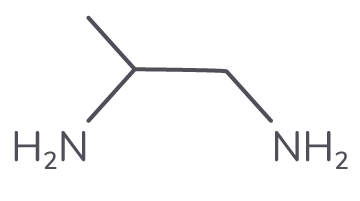
Explain how L is able to act as a bidentate ligand.
Draw a diagram that shows the shape of the complex ion Y and shows the type of bond between the ligand L and the cobalt.
The compounds [Co(NH3)5Br]SO4 and [Co(NH3)5SO4]Br are structural isomers.
Define the term structural isomer.
What is the oxidation number of cobalt in [Co(NH3)5Br]2+?
Ammonium hexachloroplatinate, (NH4)2PtCl6, is a complex of platinum used in platinum plating. Ammonium hexachloroplatinate contains the hexachloroplatinate ion.
Draw a 3D diagram to show the shape of a hexachloroplatinate ion.
On your diagram, show:
- the name of the shape
- the charge on the ion
- the value of the bond angle.
Platin, Pt(NH3)2Cl2, is a neutral complex of platinum(II).
Explain why Pt(NH3)2Cl2 has no overall charge.
Pt(NH3)2Cl2, displays cis-trans isomerism.
Draw the structure of cis-platin. State its shape and give a value of the Cl-Pt-Cl bond angle.
The use of cis-platin can cause side effects so oxaliplatin has been developed.
The structure of oxaliplatin is shown below.
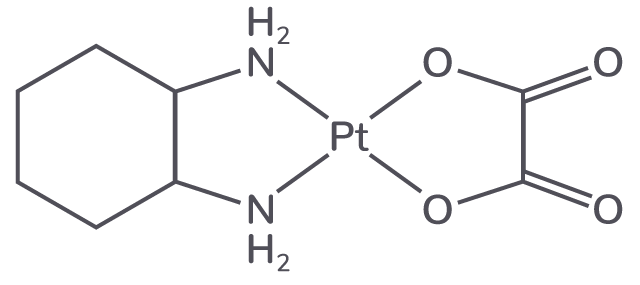
Draw the structures of the two bidentate ligands in oxaliplatin.
Steel pipelines carrying natural gas can corrode to form ‘green rust’, Fe(OH)2.
After some time, green rust can change into ‘black rust’ via the equation shown below.
3Fe(OH)2 ➔ Fe2+Fe3+2O4 + H2 + 2H2O
Use oxidation states to show that this is a redox reaction.
If seawater is present, the green rust is often oxidised to [FeCl4]- ions.
Draw diagrams to show two possible shapes for [FeCl4]-.
Name the shapes.
State the type of bonding between the chloride ligands and the iron ion in [FeCl4]-.
Cu+ also forms complexes with chloride ligands.
One example is the colourless complex [CuCl2]-.
Explain why [CuCl2]- ions are colourless.
The complex [Co(NH3)4Cl2]+ shows isomerism.
Suggest the type of isomerism shown in [Co(NH3)4Cl2]+ and draw 3D structures of the two isomers.
The diagram below shows the structure of ethane-1,2-diamine, en.
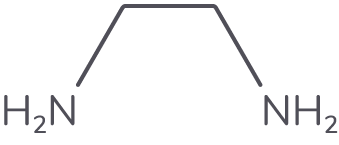
en is an example of a bidentate ligand.
Explain what is meant by the term bidentate ligand.
[Cr(en)2Cl2]+ shows geometrical and optical isomerism.
Complete the 3D diagrams to show the 3 stereoisomers of [Cr(en)2Cl2]+.
Using the model answer diagram, give the letters of the two isomers of [Cr(en )2Cl2]+ which show optical isomerism.
Using the model answer diagram, give the letter of the isomer which has no overall dipole moment.
Explain what is meant by the term transition element.
Draw electrons in the boxes below to show the electronic configurations of Cu, Cu+ and Cu2+.
Complete the table by predicting the appropriate metal ions, co-ordination numbers, formulae and charges for the complexes A-D.
Transition metals have characteristic properties due to their electron arrangements.
Give two characteristic properties of transition metals.
Give the electronic configurations of a chromium atom, a Cr2+ ion and a Cr3+ ion.
Explain why chromium has variable oxidation states.
Ethanal is oxidised to ethanoic acid by oxygen. The equation for this reaction is:
2CH3CHO + O2 ➔ 2CH3COOH
This redox reaction is slow at room temperature but speeds up in the presence of cobalt compounds.
Explain why a cobalt compound is able to act as a catalyst for this process.
In the Contact process, vanadium(V) oxide acts as a heterogeneous catalyst.
State the meaning of the term heterogeneous.
Write 2 equations to show how vanadium(V) oxide acts as a catalyst in the Contact process.
Give a reason why impurities in the reactants can cause problems in processes that use heterogeneous catalysts.
Explain why complexes formed from transition metal ions are coloured.
This diagram represents the energy change that occurs when a d electron in a transition metal ion is excited by visible light.
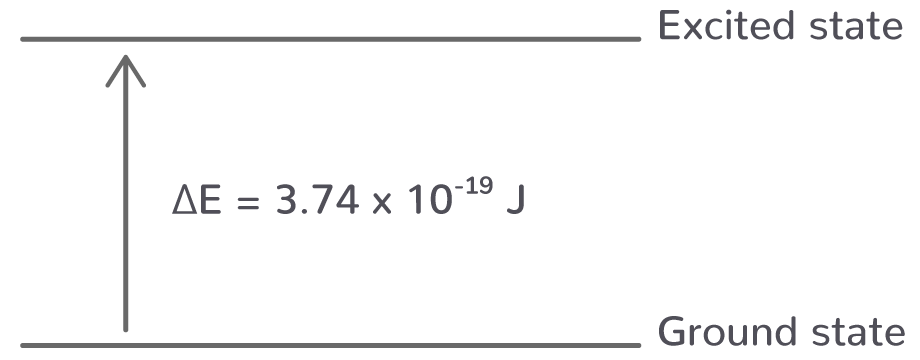
Give the equation that relates the energy change ΔE to the Planck constant h, the speed of light in a vacuum c and the wavelength of the visible light λ.
Use this equation and information in the diagram to calculate a value for the wavelength of the visible light, in nm.
Give your answer to the nearest integer.
The speed of light c = 3.00 x 10⁸ m s-1
The Planck constant h = 6.63 × 10⁻³⁴ J s.
The energy change shown in the diagram represents the energy of green light and results in a solution that appears violet.
Violet light has a higher frequency than green light.
Suggest how the energy change, ΔE,will differ for a transition metal ion that forms a green solution.
Explain your answer.
State 3 different features of transition metal complexes that cause a change in the value of ΔE.