Qualitative Tests for Cations - exam practice
Qualitative Tests for Cations
Question 1 of 4
Barium chloride solution and hydrochloric acid were added to separate aqueous solutions of ammonium sulfate and ammonium nitrate.
State what would be seen for each compound which would allow you to distinguish between them.
Give a test, with the expected result, to confirm the presence of the ammonium ion (NH4+) in the ammonium compounds.
Describe how a student could distinguish between aqueous solutions of magnesium chloride, MgCl2, and aluminium chloride, AlCl3, using one simple test-tube reaction.
Give a suitable reagent that could be added separately to AgBr(s) and AgI(s) to distiguish between them.
Describe what you would observe in each case.
A blue solid was given to a student who suggested, from its colour only, that it was copper(II) sulfate. Another student suggested that it was copper(II) hydroxide, which is also blue. The students proposed some tests to distinguish between these two blue solids.
Give the expected observations for copper(II) sulfate and copper(II) hydroxide.
A flame test was carried out on the blue solid, but the flame colour observed was not that expected for a blue solid containing copper(II) ions.
Therefore another student suggested that the blue solid could be anhydrous cobalt(II) chloride.
Cobalt(II) chloride can be distinguished from copper(II) sulfate and copper(II) hydroxide by testing for the anion. Describe a suitable test for the chloride ion, including the positive result.
The table below shows observations of changes from some test-tube reactions of aqueous solutions of compounds Q, R and S with five different aqueous reagents. The initial colours of the solutions are not given.
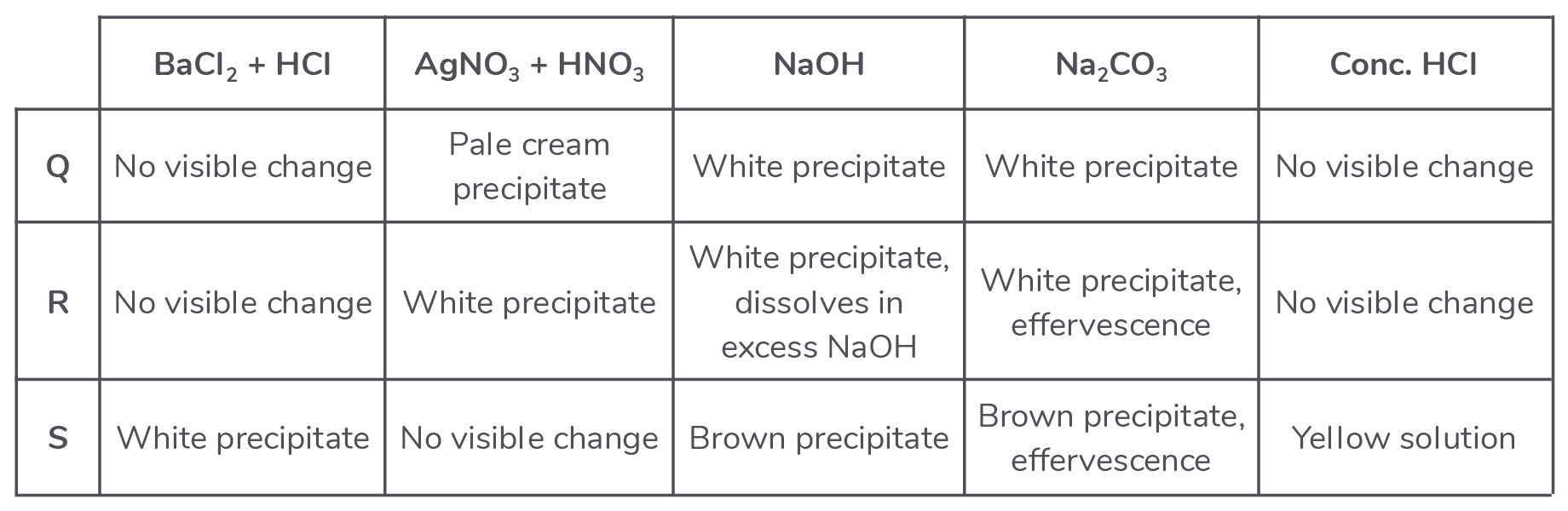
Identify each of compounds Q, R and S.
You are not required to explain your answers.
Write ionic equations for each of the positive observations with S.
A compound of a d-block element is dissolved in water to form a solution X.
A series of tests is carried out on separate 1 cm3 portions of solution X.
Complete the table.
Sulfur dioxide is passed through a sample of solution X. A redox reaction occurs in which the sulfur dioxide forms sulfate ions.
The solution Y which forms is no longer yellow-brown.
Excess dilute aqueous ammonia was added to a 1 cm3 solution of Y in a test tube. A precipitate is observed.
State the colour and formula of the precipitate.
State the formula of the cation in solution Y.
The mixture from part b) was left to stand for a few minutes. The surface of the precipitate turned brown.
State the formuala of the brown compound.
Complete the ionic equation for the reaction between the cation in solution X and sulfur dioxide to form solution Y.
State symbols are not required.
.......... + SO2 + 2H2O ➔ .......... + SO42- + ..........