Periodicity - exam practice
Periodicity
Question 1 of 8
State the meaning of the term periodicity.
Identify the element in period 3 with the highest electronegativity value.
Identify the element in period 3 with the largest atomic radius.
Explain your answer.
Melting points show a trend across a period.
The melting points of some period 3 elements are shown in the table below.

Explain the trend shown in melting point, in terms of structure and bonding.
Define the term first ionisation energy.
State and explain the trend in first ionisation energy of the elements in group 2.
The first ionisation energy of aluminium is lower than that of magnesium.
Give the full electronic configurations of an atom of aluminium and an atom of magnesium.
Explain the difference in the first ionisation energies of the two metals.
Successive ionisation energies provide evidence for the existance of different electron shells in atoms.
Write an equation to represent the third ionisation energy of nitrogen
Describe what can be deduced about the electronic structure of nitrogen from its successive ionisation energies.
On the axes below, add crosses to estimate the successive ionisation energies of nitrogen.
Explain why the first ionisation energy of nitrogen is higher than the first ionisation energy of carbon.
This question is about the periodicity of the period 3 elements.
State and explain the general trend in first ionisation energy across period 3.
Give one example of an element which deviates from the general trend in first ionisation energy across Period 3.
Explain why this deviation occurs.
Identify the element in period 3 that has the highest melting point.
Explain your answer in terms of structure and bonding.
Identify the metallic element in period 3 that has the highest melting point.
Explain your answer in tems of structure and bonding
The log of the third ionisation energy for six elements is shown in the table below.
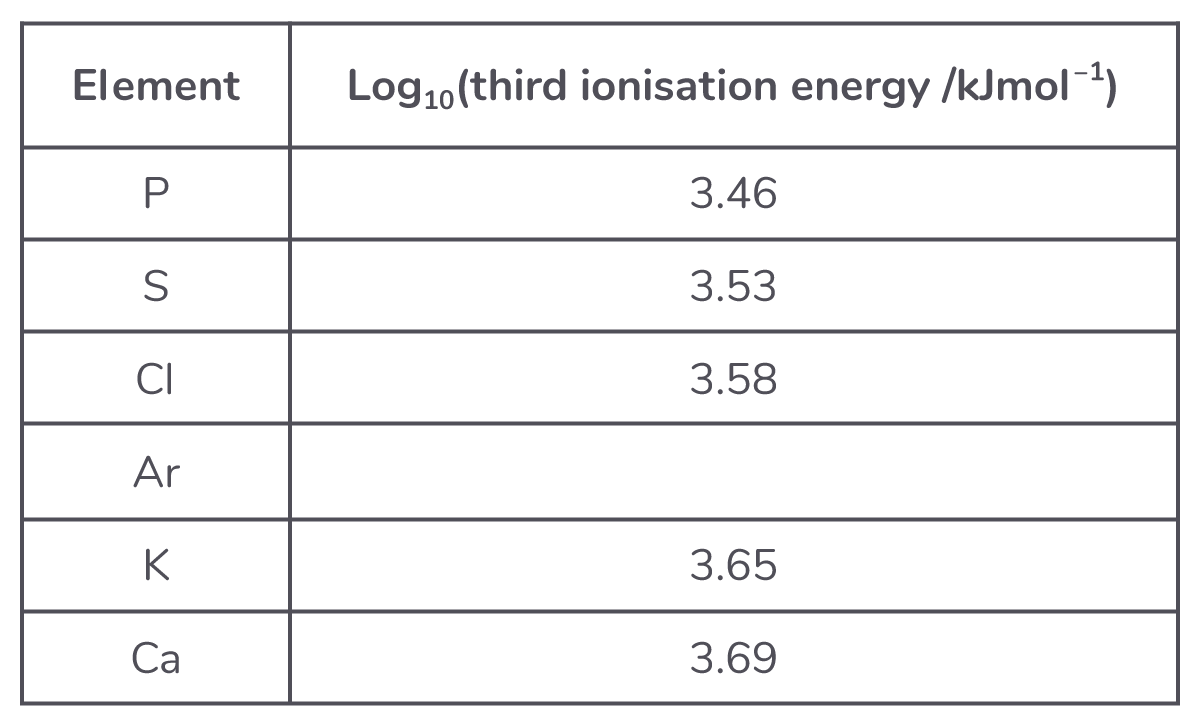
Plot a graph of these data
Use the graph in part a) to estimate the third ionisation energy for argon, in kJ mol-1.
Give your answer to the nearest whole number.
Suggest why the third ionisation energy of chlorine and argon are similar in magnitude.
The melting points of the period 3 elements are shown in the table below.

Explain the trend in melting points across the elements of period 3 in terms of their structure and bonding.
Elements and their compounds exhibit similarities and differences based on their respective positions within the periodic table.
Considering only the elements in periods 1-3, name the element with the largest atomic radius.
Considering only the elements in periods 1-3, name the element with the largest ionic radius.
Considering only the elements in periods 1-3, name the element with the highest first ionisation energy.
Considering only the elements in periods 1-3, name the element with the largest electronegativity.