Atomic Structure - exam practice
Atomic Structure
Question 1 of 17
1 of 17
How many orbitals are there, in total, in the first three energy levels of an atom?
Question 2 of 17
2 of 17
This question refers to isolated gaseous atoms.
In which atom are all electrons paired?
Question 3 of 17
3 of 17
The electronic configuration of the two outermost shells of an atom is 3s23p63d54s2.
What is this atom?
Question 4 of 17
4 of 17
Which statement about an atom of 23Na is correct?
Question 5 of 17
5 of 17
Which statement about p-orbitals is correct?
Question 6 of 17
6 of 17
What is a possible mass number of a magnesium isotope?
Question 7 of 17
7 of 17
An element forms ions with a charge of 3+.
What could be the electron configuration of the atoms of the element?
Question 8 of 17
8 of 17
What is the shape of an s-orbital?
Question 9 of 17
9 of 17
Which element has atoms with the greatest number of singly occupied orbitals?
Question 10 of 17
10 of 17
Which ion has a different number of electrons from the other three ions?
Question 11 of 17
11 of 17
A sample of naturally occuring boron contains the isotopes 10B and 11B.
The relative atomic mass of the boron sample is 10.8.
What is the percentage of 11B atoms in the sample of boron?
Question 12 of 17
12 of 17
Which statement about time of flight mass spectrometry is correct?
Question 13 of 17
13 of 17
What is the electron configuration of V2+ in the ground state?
Question 14 of 17
14 of 17
Which atom has the smallest number of neutrons?
Question 15 of 17
15 of 17
Which is the electron configuration of an atom with only two unpaired electrons?
Question 16 of 17
16 of 17
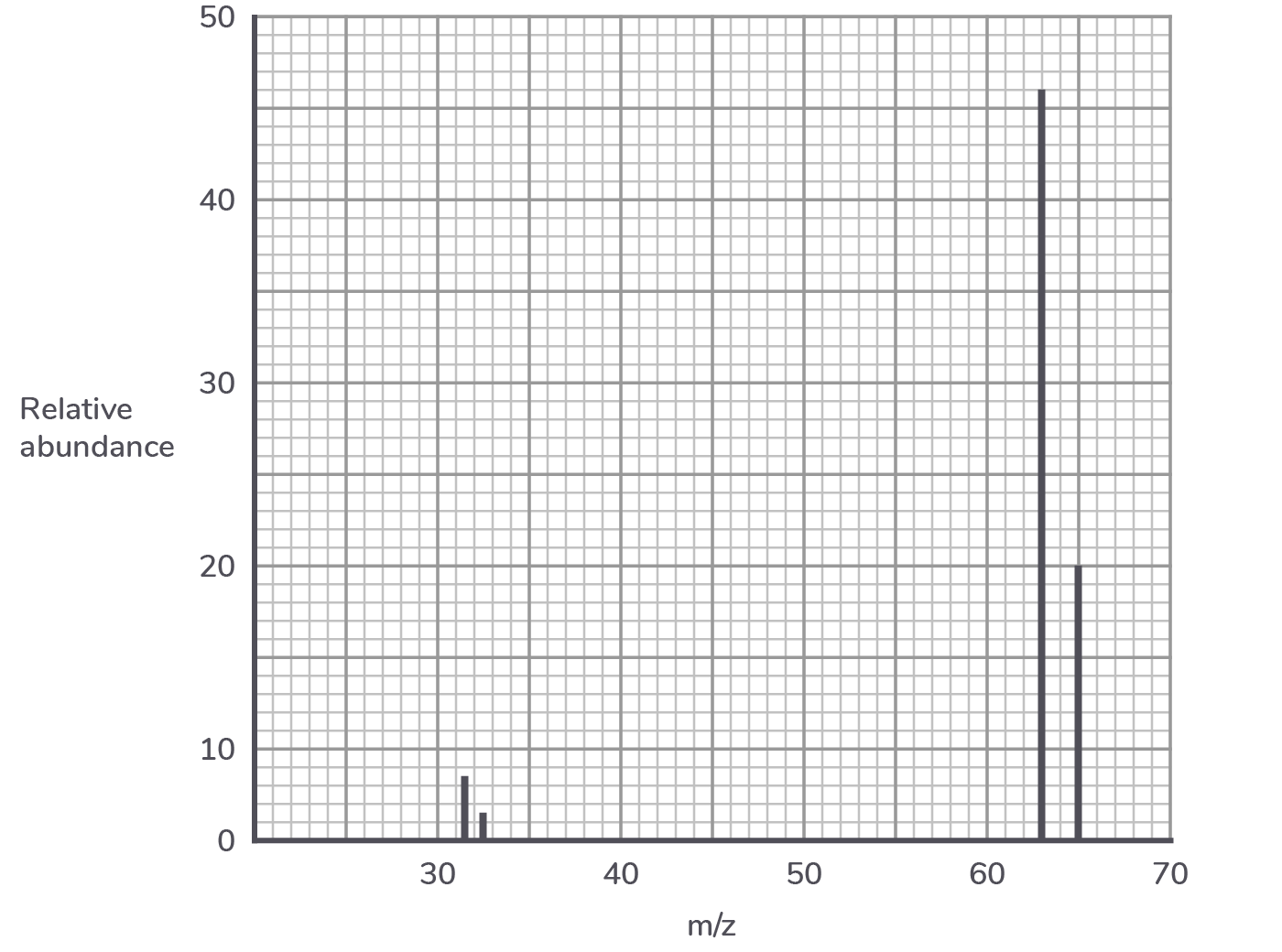
The mass spectrum of a sample of an element is shown above.
What is the Ar of the element?
Question 17 of 17
17 of 17
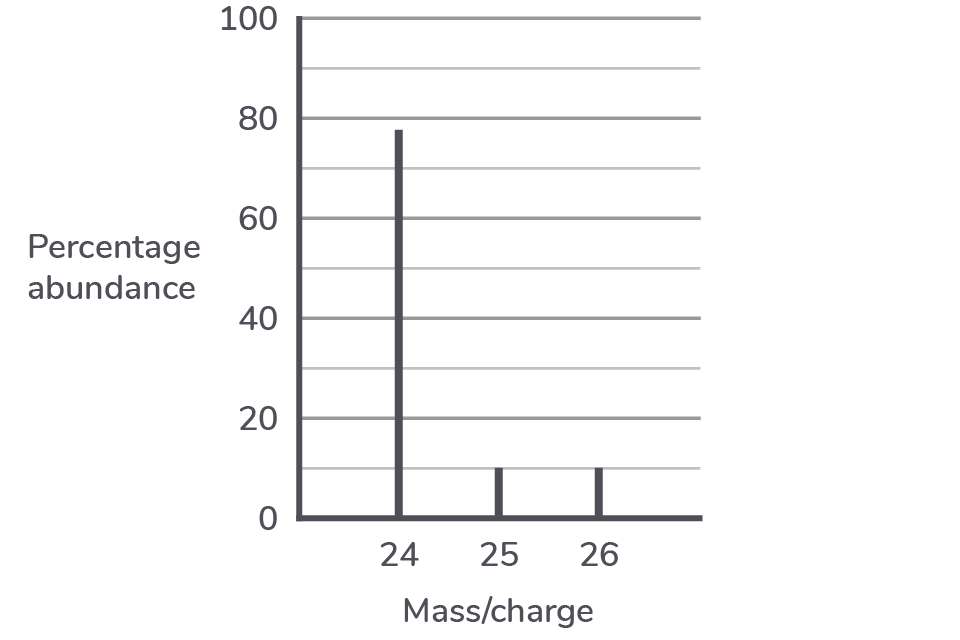
What is the relative atomic mass, Ar, of an element with this mass spectrum?